My Account
Sign-in / Join

Sign-in

Hi My Account

Dashboard

Logout

Cart

My Shopping Cart

Subtotal
${{total.toFixed(2)}}
QUOTE

TORNADO 1 & 2 Olive Leaf & Branch removal machine by CLEMENTE

Please call for Price
Clemente Model
Quantity

VC.TORNADO
  • Description
  • Features
  • Enquiry
  • Specifications
  • Documents
  • Knowledge


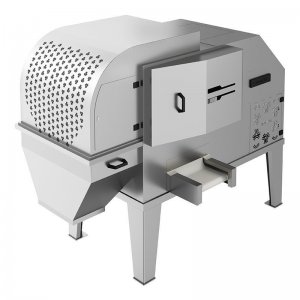
Tornado is the biggest stalk and branch remover in the range and is produced by Clemente Snc.  

The working capacity of this machine is up to 20 tons per hour.

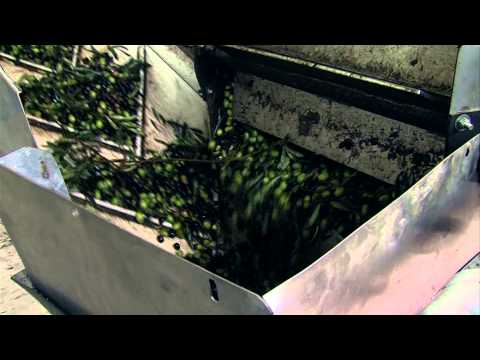
On the top of the machine there is an electric vibratory motor used for distributing the olives uniformly along the tray thus allowing the blower to separate the leaves from the olives and to eject them in a leaf bin.  The olives are then separated from the branches by rotating rollers and are separated from the dirt by spirals.

At the end of the process all the waste material is collected and ejected from the machine.


TORNADO 1
Tornado 1, a leaf and branch remover, with a processing capacity of up to 8 tons per hour.

The machine's upper section incorporates a vibrating screen, facilitating the even distribution of olives. With the assistance of a fan, it efficiently separates and ejects any foliage, directing it to a designated collector.

Additionally, the Tornado 1 machine serves the purpose of the final separation of olives from leaf & branch material through a spiral plane.


TORNADO 2
Tornado 2 for larger production processing rate of up to 20 tons per hour.

In its upper section, the machine is equipped with a vibrating screen that efficiently loads olives, ensuring an even distribution. The incorporated fans effectively separate and expel any foliage, directing it into a dedicated leaf collector.

The subsequent cleaning phase involves a rotating disk that detaches branches from the olives. In the third phase, the remaining product undergoes a separation process where soil is efficiently removed via the self-cleaning roller conveyor.

Beyond its primary function as a leaf and branch remover, the Tornado 2 machine is the perfect solution for the final separation of olives from the leaf and branch material through a spiral plane.
tornado.png

VIDEO'S


Frequently Asked Questions 

The Tornado Series ensures superior cleaning by combining vibratory classification, airflow separation, and precision screening. At the top of each machine, a vibro-classifier evenly distributes olives before a variable-speed fan removes leaves and stems, sending them into a collector.

Subsequent separation phases eliminate heavier debris such as stones, twigs, and soil. By removing foreign matter early, the Tornado system prevents equipment wear and reduces oxidation or bitterness in the oil. The result is a cleaner fruit feed, consistent milling performance, and higher-quality olive oil with improved flavour stability and yield.
Feature Tornado 1 Tornado 2
Model 5CR / T 5CR / K
Processing Capacity Up to 8 t/h Up to 20 t/h
Electric Motor Power 7.5 kW 10 kW
Cleaning Stages Vibro-classifier with fan; sloped auger platform for final selection. Vibro-classifier, twin fans, rotating drum, self-cleaning roller table, and screw-conveyor platform.
Dimensions (L × W × H) 3544 × 1081 × 2545 mm 3850 × 1900 × 4050 mm
Weight 900 kg 1800 kg
Material AISI 304 Stainless Steel AISI 304 Stainless Steel
Application Scale Small to medium-size mills requiring compact operation and efficiency. Medium to large industrial mills needing high-capacity throughput and advanced automation.

​The Tornado 1 suits smaller mills seeking a compact, efficient machine, while the Tornado 2 delivers industrial-level throughput and multi-stage cleaning for large production facilities. Both share Clemente’s hygienic AISI 304 stainless-steel construction and low-maintenance design.
Maintenance has been simplified through modular stainless-steel construction and easy-access panels. The internal components can be removed for cleaning in minutes, and the fan housing, drum, and auger channels are designed to prevent residue buildup.

The self-cleaning roller table (Tornado 2) and smooth interior surfaces reduce manual washing time between shifts. Regular rinsing with pressurised water is generally sufficient for hygiene compliance. With minimal lubrication points and robust components, both models deliver low downtime and long service life, even under intensive seasonal use.

 
TORNADO 1 - TECHNICAL FEATURES
  • Model 5CR / T
  • Length 3544 mm
  • Width 1081 mm
  • Height 2545 mm
  • Weight 900 kg
  • Capacity 8 t/h
  • Construction material AISI 304
  • Vac 400
  • Hz 50 Hz
  • Supply line 3Ph+Ground
  • Electric motor 7,5 Kw


TORNADO 2 - TECHNICAL FEATURES
  • Model 5CR / K
  • Length 3850 mm
  • Width 1900 mm
  • Height 4050 mm
  • Weight 1800 kg
  • Capacity 20 t/h
  • Construction material AISI 304
  • Vac 400
  • Hz 50 Hz
  • Supply line 3Ph+Ground
  • Electric motor 10 Kw
  • :
  • :
  • :
  • :
  • :
  • :
  • :
  • :
  • :
  • :
  • :
File Title File Description Type Section
Tornado-1-1_1.pdf CLEMENTE Tornado 1 Brochures Document
tornado-2.pdf CLEMENTE Tornado 2 Brochures Document

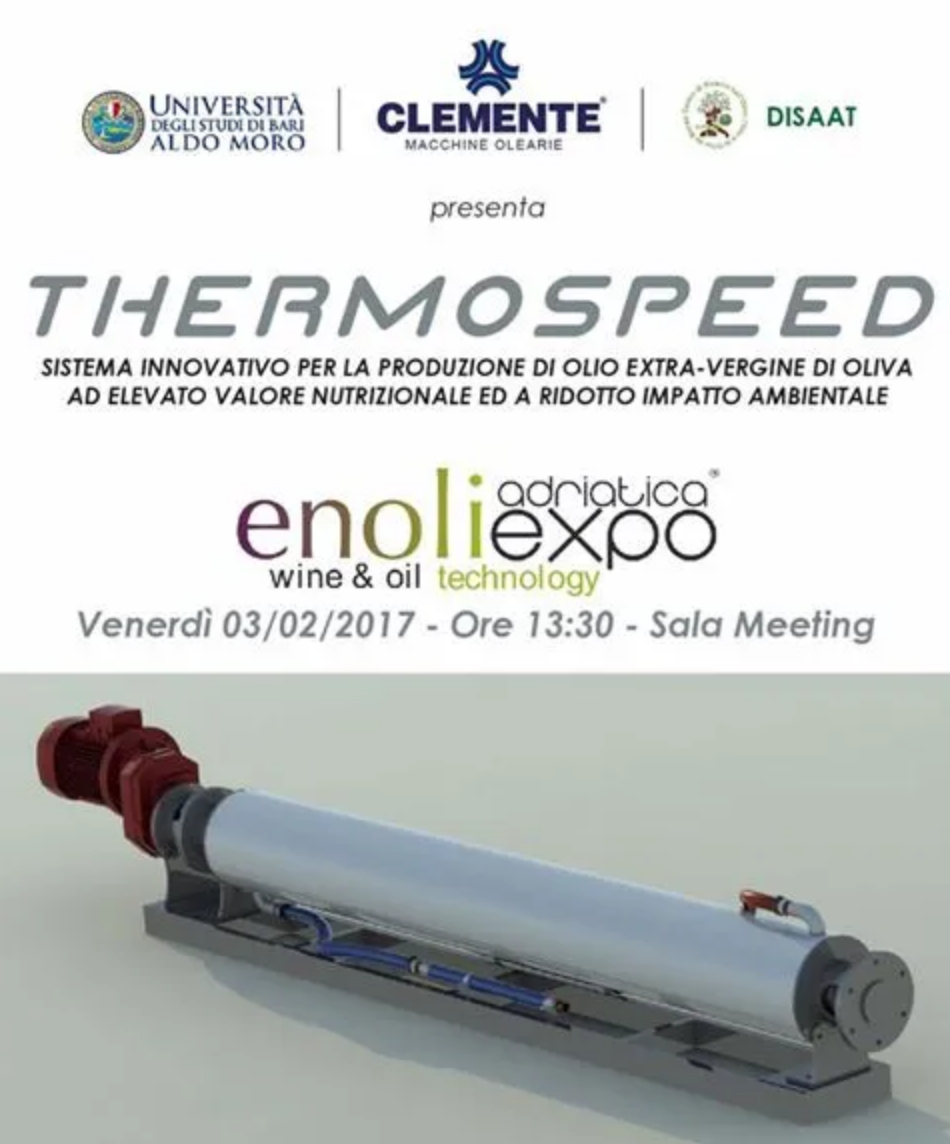
A new innovation in Olive Oil Processing the THERMOSPEED

CLEMENTE Thermospeed - The Next Generation in Olive Oil Processing

During my visit to Italy in November 2016, I had the opportunity to see an exciting new innovation being tested under scientific trial by the University of Bari - the CLEMENTE Thermospeed. 


This breakthrough technology represents the future of olive oil processing, with developments set to redefine efficiency and production performance. The Thermospeed system has demonstrated the capability to accelerate the olive oil extraction process by up to 50%, marking a significant advancement in processing speed and throughput. 

At the core of the system is an innovative design that reduces malaxation time - the critical stage where the olive paste is gently mixed before separation. The Thermospeed achieves this by pumping the olive paste through a section surrounded by a temperature-controlled tube, which can either heat or cool the paste as needed. This process optimisation helps to enhance extraction efficiency while minimising oxidation, ultimately preserving the oil’s natural quality and nutritional value. 

Early trials have shown no negative effects on olive oil quality, and research is continuing over the next 12 months to further evaluate and refine the system’s performance. 

This remarkable innovation could soon be integrated into olive oil processing facilities worldwide, offering producers an efficient, sustainable, and scientifically proven step forward in extra-virgin olive oil production.

Bark Photosynthesis in Olive Trees

While leaves are the primary sites of photosynthesis in plants, bark photosynthesis, also known as corticular photosynthesis, plays a significant role in the carbon economy of woody plants, including olive trees (Olea europaea). This process involves the fixation of carbon dioxide (CO₂) by the green tissues in the bark, contributing to the tree's overall photosynthetic capacity, especially under stress conditions.
Please log in to view the entire article

Understanding Olive Leaf Tip Dieback: Causes, Diagnosis, and Management

Discover how to diagnose and manage olive leaf tip dieback, a common issue caused by nutrient deficiencies, salinity, or environmental stress. Learn expert strategies for restoring tree health through balanced nutrition, soil and water management, and effective disease prevention — backed by The Olive Centre’s professional resources and products.
Please log in to view the entire article

Global Olive Oil Prices Soar to Record Highs in 2023 Amid Spain’s Severe Drought Crisis

MARKET INSIGHT: GLOBAL OLIVE OIL ECONOMY 2023

Global Olive Oil Prices Soar to Record Highs in 2023 Amid Spain’s Severe Drought Crisis

Introduction

The global olive oil industry in 2023 has entered uncharted territory, experiencing an extraordinary surge in olive oil prices driven by a combination of climatic and economic forces. At the centre of this crisis lies Spain’s devastating drought, which has crippled the world’s largest olive oil producer. This severe shortage has led to a dramatic contraction in olive oil supply, triggering price escalation and a corresponding decline in consumer demand. The ripple effects are being felt worldwide, reshaping the balance between producers and consumers alike. Meanwhile, Australian olive oil producers find themselves in a rare position of advantage, benefitting from unprecedented market highs. This article explores the causes, consequences, historical trends, and economic signals surrounding this remarkable global olive oil price spike.


The Spanish Drought and Its Impact on Supply

The ongoing drought across Spain stands as the principal factor behind the current olive oil price surge. As one of the largest olive oil-producing nations globally, Spain’s drastically reduced harvest - caused by months of extreme heat and minimal rainfall - has sharply curtailed olive oil availability in both European and international markets. This has intensified supply shortages, compelling consumers to pay more for what has long been a staple Mediterranean product. The interplay of limited supply and escalating demand has magnified price volatility, reinforcing the classic supply-and-demand imbalance now driving global markets.

Decline in Consumer Demand

As prices have risen steeply, the shortage of olive oil has led to a noticeable decline in consumption, particularly in Spain, where demand has reportedly dropped by around 35%. Consumers are now scaling back their purchases, finding olive oil increasingly unaffordable compared to other cooking oils. The once-steady household consumption patterns are shifting as people seek alternatives or modify their cooking habits. This contraction in domestic demand not only highlights the growing accessibility gap for consumers but also underscores the broader economic strain caused by high inflation and food price increases.

Australian Olive Oil Producers Reap the Rewards

Amid the turmoil, Australian olive oil producers are experiencing a windfall. Thanks to limited global supply, Australian growers are commanding record prices exceeding AUD $8 per litre, marking the highest levels ever recorded in the nation’s olive oil industry. This lucrative period presents a rare opportunity for Australian exporters, with demand from Europe - including Spain itself - now turning toward Australian supplies. For producers Down Under, this unique reversal of roles underscores how regional climate resilience and diversified production can translate into significant financial gains when global shortages arise.

Historical Context: How the Market Reached 2023

The olive oil market’s volatility is not a new phenomenon. Previous spikes occurred in 1996, 2006, and 2015, each triggered by weather-related supply constraints. Yet, the 2023 price explosion stands out as the most dramatic in recorded history -over 40% higher than any previous price peak, and roughly double the magnitude of earlier surges. This extreme escalation reflects not just climatic hardship but a clear pricing bubble forming within the market, echoing the cyclical nature of commodity pricing.

Cyclical Trends and Economic Correlations

The olive oil sector has long followed cyclical pricing patterns, typically alternating between low and high price phases roughly every decade. The current surge aligns almost perfectly with the predicted start of another 10-year cycle, occurring just three years into its anticipated timeline. Furthermore, a notable correlation has been identified between the Australian Food Inflation Index and the Global Olive Oil Price Index as reported by the International Monetary Fund (IMF). This connection illustrates the deep interdependence between food commodity pricing and global economic conditions.

While the IMF’s benchmark prices are denominated in USD, for the purposes of this analysis they have been converted to AUD to track the trend relative to Australian markets. These benchmark indicators -based on the world’s largest olive oil exporters -serve as a reliable gauge of overall market direction, confirming how global shortages and inflationary pressures move in tandem.

   Global olive oil prices show a recurring 10-year cycle, driven by droughts, crop shortages, and rising production costs

Technical Indicators: Signals of an Overbought Market

From a technical analysis perspective, the Relative Strength Indicator (RSI) is often used to measure price momentum and potential overextension in markets. On recent olive oil price charts, the RSI (represented in purple) indicates that prices have once again entered overbought territory - a level seen during previous speculative phases. Historically, such readings have preceded market corrections or reversals, suggesting that the current surge may not be sustainable in the long term.

Analysts caution that as the European olive harvest begins in September and October 2023, an influx of new oil supplies could help ease prices, though the timing and extent of this correction remain uncertain. Until then, speculative trading and limited inventory continue to support inflated market values.

Conclusion

The record-breaking olive oil prices of 2023, primarily triggered by Spain’s drought-induced production collapse, mark a turning point for the global olive oil economy. With consumer demand declining under the pressure of soaring prices and Australian producers thriving amid the scarcity, the industry is experiencing a dramatic rebalancing. Historical precedents, cyclical trends, and market indicators all point toward a complex, transitional period defined by volatility and uncertainty.

As the world’s producers, traders, and consumers adapt to these new market dynamics, one truth remains clear: olive oil - celebrated for its taste, health benefits, and cultural significance - continues to be at the mercy of both climate change and economic cycles. Stakeholders across the value chain must remain alert, flexible, and forward-thinking as the olive oil market navigates this extraordinary phase of transformation.

Other Sources

Clemente Olive Oil Advanced Machinery and Installations

Clemente has been a pioneer in olive oil machinery design since 1963, creating reliable, high-performance systems for every stage of olive processing. From malaxing and cleaning to crushing, decanting, and pomace recovery, each installation is engineered for efficiency and quality.
Please log in to view the entire article

Esterification in Olive Oil Extraction and the Role of Processing Aids


PROCESSING AIDS AND THEIR EFFECT ON OIL CHEMISTRY

Esterification in Olive Oil Extraction and the Role of Processing Aids

Esterification is a natural chemical reaction where free fatty acids (FFA) combine with alcohols, typically glycerol, to form esters. This process reduces the measurable acidity of the oil. While esterification can occur in the olive paste during milling, it is usually a minor contributor to quality changes compared with factors such as fruit condition, malaxation parameters, and extraction efficiency.

Why Esterification Matters

  • Directly affects FFA values, a major criterion for Extra Virgin classification
  • Influences how certain processing aids appear to improve acidity
  • Helps understand why some additives must be used carefully to avoid unintended chemical changes
  • Provides insight into the relationship between pH, temperature, and enzymatic activity during malaxation
Esterification and Hydrolysis in Olive Oil Chemistry


This diagram illustrates the reversible reactions of esterification and hydrolysis, showing how free fatty acids and glycerol form triglycerides—and how they break down again under certain milling conditions.
Process Flow Diagram for Olive Oil Extraction


This diagram outlines the continuous olive oil extraction line: olives are crushed, malaxed, separated, clarified, and routed for bottling, while husk and wastewater are channelled to waste management systems.


High-Quality Talc Used in Olive Paste Processing


    Talcoil Micronised Mineral Talc by Mivico


When added to the paste, talc increases yield and improves malaxation and decanter performance.

How Processing Aids Interact with Esterification and Oil Chemistry

Processing aids act physically or chemically on the olive paste. Some enhance enzyme activity, others alter pH or moisture, and a few influence esterification indirectly. Below is a breakdown of the main aids used by professional olive processors and how each relates to esterification.

1. Calcium Carbonate

Calcium carbonate is the processing aid most associated with apparent esterification effects.

Influence on esterification

  • Raises the pH of the paste, shifting reaction conditions
  • Can promote mild esterification of free fatty acids, producing a lower measured FFA
  • May mask poor fruit quality because the reduction in FFA does not represent a true improvement in oil integrity
Operational considerations
  • Produces very green oils
  • Can alter flavour and oxidative parameters
  • Requires precise dosing due to its aggressive action
The Olive Centre can supply controlled dosing systems to ensure correct application in mills seeking maximum extractability.  See Talc Dispenser and Enzyme dosing units

2. Salt (Sodium Chloride)

Salt acts primarily on the physical structure of the paste rather than the oil chemistry.

Influence on esterification

  • Minimal direct effect
  • Does not change paste pH in a way that promotes esterification
  • The perceived improvements in acidity are due to better separation, not chemical modification
Operational benefits
  • Improves extractability
  • Helps produce greener oils
  • Increases centrifugal efficiency of the decanter
Salt can be metered via hopper dosing units or inline auger systems.

3. Talc (Magnesium Silicate)

Talc is inert and valued for its physical functionality.

Influence on esterification

  • No chemical interaction with oil or fatty acids
  • Does not modify FFA or promote esterification
  • Its benefits come entirely from improved paste structure and reduced emulsification
Operational benefits
  • Improves oil yield in high moisture or difficult pastes
  • Enhances malaxation and decanter performance
  • Works reliably across varieties and seasonal conditions
Available talc dosing equipment can be integrated with paste blenders, malaxers, and continuous milling lines.

4. Enzymes

Commercial enzyme blends can influence chemistry indirectly.

Influence on esterification

  • Break down cell walls, releasing bound lipids and sometimes alcohol groups
  • May create conditions where minor esterification occurs naturally
  • Effects are small compared with changes in extraction efficiency
Operational benefits
  • Higher extractability
  • Reduced malaxation time
  • Often improved phenolic release
Enzyme dosing and thermal control in malaxers improve consistency and performance.

5. Kaolin and Bentonite

These clay minerals are used more for paste modification or clarification.

Influence on esterification

  • No direct chemical effect
  • Do not reduce FFA or change oil acidity
  • Their performance is purely physical, based on adsorption and improved paste rheology
Operational benefits
  • Support separation in high moisture pastes (kaolin)
  • Assist in clarification and impurity removal (bentonite)
Clay based aids should be added with care to avoid over-adsorption of oil.

Summary: Which Aids Influence Esterification?

Processing Aids & Their Effects

Processing Aid Impact on Esterification Notes
Calcium Carbonate Moderate … via pH shift Can lower measured FFA but may affect flavour and oxidation
Salt (NaCl) None Improvements come from better separation, not chemical change
Talc None Purely physical aid for difficult pastes
Enzymes Minor, indirect Mostly physical… chemical breakdown of cell walls
Kaolin None Improves rheology only
Bentonite None Used for clarification rather than extraction

Optimising Processing Aids in Olive Mill Machinery

Professional olive mills benefit from:

  • Precision dosing systems for powders and enzymes
  • Malaxers with stable temperature control to avoid unintended chemical changes
  • Decanters tuned to handle modified paste characteristics
  • Regular chemical testing to verify FFA, PV, and phenolic stability
The Olive Centre supplies processing aid dosing equipment, malaxation systems, decanter upgrades, and quality testing instruments designed to support efficient, traceable and high quality olive oil production.


How Esterification Happens and the Conditions That Allow It

CHEMICAL CONDITIONS DRIVING ESTERIFICATION

How Esterification Happens and the Conditions That Allow It

Esterification occurs when free fatty acids (FFA) in olives or olive paste react with natural alcohols—most commonly glycerol—to form esters. While this is a natural chemical reaction found in many biological systems, it usually plays only a small role during standard olive oil extraction. However, under certain processing or fruit-quality conditions, esterification can become more noticeable and can affect how acidity is interpreted during quality assessment.

Understanding when and why esterification occurs is important for mill operators, as it can influence extraction decisions, processing aid use, and the accuracy of acidity readings that determine Extra Virgin classification.

How It Comes About

Esterification begins when three conditions align:

  • Free fatty acids are already present due to fruit damage, overripeness, frost injury, or delays between harvest and milling. It is a natural chemical process, but it becomes noticeable mainly when fruit quality is not ideal or when additives change the chemistry of the paste.
  • The olive paste becomes warm and chemically active during malaxation, allowing molecular interactions to accelerate.
  • Acids and alcohols remain in contact long enough for the reaction to occur within the paste matrix.

Esterification is not inherently harmful, but it becomes more noticeable when fruit quality is compromised or when additives alter the paste’s pH and reaction environment. This means that an oil’s reduced measurable acidity may not always reflect true quality improvement.

Conditions That Promote Esterification

Esterification becomes more likely when certain environmental or operational factors occur within the mill. Understanding these allows processors to maintain better control over oil chemistry and avoid misleading test results.


1. Higher Paste Temperatures

  • Warm malaxation conditions accelerate chemical reactions. If the paste temperature rises excessively—due to long malaxation times, inadequate cooling, or equipment limitations—ester formation becomes more favourable. This can cause a measurable decrease in free acidity even though the underlying fruit quality has not improved
2. Increased Paste pH
  • Processing aids such as calcium carbonate raise the pH of the olive paste. A higher pH creates a more reactive environment, encouraging esterification and artificially lowering the measured FFA value. While this may seem beneficial, the oil’s true chemical integrity may remain unchanged or even decline if over-correction occurs.
3. Presence of Excess Free Fatty Acids
  • When olives are bruised, overripe, frost damaged, or held too long before milling, the fruit’s natural lipase activity increases FFA levels.
  • High FFA content gives esterification more raw material to work with, increasing the likelihood of esters forming during malaxation.

4. Extended Contact Time

  • Longer malaxation sessions or slow-moving processing lines keep acids and alcohols in contact for extended periods.
  • This additional time increases the probability of esterification occurring, particularly if other promoting conditions (temperature, pH) are also present.

5. Enzymatic Activity

  • During crushing, enzymes are released from olive cells. If the fruit is not fresh or has undergone stress, enzymatic activity becomes more pronounced and can indirectly support esterification pathways. Although the overall effect is small, it can still contribute to changes in measured acidity.

Why Understanding These Conditions Matters

When esterification occurs under the conditions described above, it can lower the measured FFA without actually improving the oil’s true chemical quality. This can mislead producers into thinking their processing steps or additives improved the oil, when in reality the acidity reduction was simply a chemical conversion—not a restoration of fruit integrity.

Producers who understand these mechanisms can:

  • Avoid masking fruit defects with processing aids
  • Maintain accurate interpretations of acidity values
  • Optimise malaxation and temperature control
  • Ensure extraction conditions prioritise real quality, not numerical artefacts

In simple terms: Esterification becomes noticeable when the olive paste is warm, slightly alkaline, contains damaged fruit components, or sits too long before separation. Managing these factors helps prevent misleading acidity readings and supports genuine quality improvements.