My Account
Sign-in / Join

Sign-in

Hi My Account

Dashboard

Logout

Cart

My Shopping Cart

Subtotal
${{total.toFixed(2)}}
QUOTE

Talcoil Micronised Mineral Talc by Mivico

Natural micro-talc additive used in olive oil extraction.
Please call for price
Talc supply
Quantity

GA02.Talcoil
  • Description
  • Features
  • Enquiry
  • Documents
  • Knowledge
TALCOIL – Micronised Mineral Talc for Olive Oil Extraction

TALCOIL is a finely micronised natural mineral talc specifically designed for use in olive oil extraction. Produced by Minerales MIVICO in Spain, it serves as a technological aid that enhances oil recovery, increases processing capacity, and produces cleaner, brighter olive oil.

This food-grade talc is a hydrated magnesium silicate, free from asbestos and compliant with European Union food additive regulations (E553b). It is widely used in olive mills to optimise the malaxation phase by improving paste consistency, reducing emulsions, and facilitating oil separation.

TALCOIL is suitable for use in modern olive oil processing lines where efficiency, hygiene, and quality are priorities. Its use is especially recommended when the olive paste has a moisture content above 50%, ensuring effective oil recovery with minimal product loss.

TALCOIL helps improve the efficiency and yield of olive oil extraction by reducing emulsions and increasing oil separation during malaxation. Its physical properties allow better coalescence of oil droplets and faster clarification of the final product.

The product is food-grade certified and entirely free from asbestos, ensuring safety and compliance with European food industry standards. Its inert nature makes it stable, odourless, and non-reactive, while its fine particle size ensures easy dispersion in olive paste.

TALCOIL enables olive mills to achieve cleaner oils, reduce processing time, and enhance capacity, particularly in high-moisture pastes or difficult batches. Minimal doses already provide visible improvement, making it a practical and cost-effective aid for professional processors.
 
LOGO TALCOIL.jpg
 
Better Yield of Extraction  |  More working capacity  |  Cleaner olive oil  |  Minimum dosage

TALCOIL is commercialised as an authorised processing aid by the EU to improve the extraction of virgin olive oil.

TALCOIL consists of natural micro-talc which is an effective solution when difficult paste presents. The totality of TALCOIL is pure talc, which joined to its high micronisation, it guarantees a product with excellent results when it comes to difficult pastes.  Talcoil is regarded as a superfine talc.

THE PROBLEM:  DIFFICULT PASTES

Sometimes, and due to different circumstances subjected by the olive fruit during the growing season, the extraction of virgin olive oil can become difficult if the fruit has been subjected to excess moisture.

During the stage of malaxing the olive paste sometimes does not have the appropriate structure and/or consistency to carry out proper extraction. An emulsion may appear and the phases of liquid and solid are not easy to separate. When is happens, a considerable amount of olive oil is lost in solid phase and it goes out with the pomace/waste. As a result, the yield of extraction is lower than normal which causes important economical loss in the manufacturing process.
 
mixing phase.JPG
Paddles not coming out clean in the malaxing tank
 
 
THE SOLUTION:  TALCOIL
 
TALCOIL breaks the emulsion which origins the difficult paste so the olive oil can be released and it is then easier to separate. A very low dose of TALCOIL gets outstanding results. The expense in natural microtalc is nothing in comparison to the profit due to increase the yield of extraction. The usage of natural microtalc is regulated by the EU and by many studies that prove its effectiveness.

comparison.JPG
Higher extraction where microtalc was added (left)
The other test tube has no talc (right)

More Information:

TALCOIL:  BULK DENSITY: 0.45 g/cm³

The dosing system must be adjusted to a density of 0.45, and the amount of TALCOIL to add will mainly depend on the moisture content of the paste.

HOW MUCH TALCOIL DO I NEED?

The use of TALCOIL is recommended when the moisture content of the ground paste exceeds 50%.
It is advised not to exceed 1% of TALCOIL, as this could be excessive and lead to oil loss with the pomace. Minimal doses of TALCOIL already offer excellent results.

Dosing is never an exact science. It is the experienced master of the mill who will know how to make good use of TALCOIL. It is very important to control the paste's moisture and extraction yields to ensure proper dosing.

TALCOIL MOISTURE

50% -> 0.2% (2 kg per ton of olives)
60% -> 0.4% (4 kg per ton of olives)
70% -> 0.5% (5 kg per ton of olives)
80% -> 0.7% (7 kg per ton of olives)
TALCOIL can also be used with dosers of this type. The trick is to adjust the amount of talc dispensed by the doser for a given minimum density, keeping in mind that TALCOIL always has a density of 0.45.

The following page shows a conversion table indicating the feeding rate of the doser depending on its minimum density and the desired amount of TALCOIL to add.

TABLE OF CONVERSIONS FOR DOSERS THAT DO NOT INCLUDE DENSITY 0.45
 
Desired Amount of Talc to Add (kg talc/ton olives) 2 3 4 5 6 7 8 9 10
Minimum Density of the Doser  
Adjusted Doser Amount  
0.5 2.22 3.33 4.44 5.56 6.67 7.78 8.89 10.00 11.11
0.55 2.44 3.67 4.89 6.11 7.33 8.56 9.78 11.00 12.22
0.6 2.67 4.00 5.33 6.67 8.00 9.33 10.67 12.00 13.33
0.65 2.89 4.33 5.78 7.22 8.67 10.11 11.56 13.00 14.44
0.7 3.11 4.67 6.22 7.78 9.33 10.89 12.44 14.00 15.56
0.75 3.33 5.00 6.67 8.33 10.00 11.67 13.33 15.00 16.67
0.8 3.56 5.33 7.11 8.89 10.67 12.44 14.22 16.00 17.78
0.85 3.78 5.67 7.56 9.44 11.33 13.22 15.11 17.00 18.89
0.9 4.00 6.00 8.00 10.00 12.00 14.00 16.00 18.00 20.00
0.95 4.22 6.33 8.44 10.56 12.67 14.78 16.89 19.00 21.11
1.0 4.44 6.67 8.89 11.11 13.33 15.56 17.78 20.00 22.22


Example: If the minimum density of the doser is 0.75 and I want to add talc at 0.3%, i.e., 3 kg of talc per ton of olives, I have to look at the table and see where 0.75 density intersects with 3 for the desired amount. In this case, it intersects at 5.00. This means I will adjust the doser to 5 kg of TALCOIL, but it will actually be dosing 3 kg of microtalc, which is what I wanted. We have "tricked" the doser to adapt it to our needs.

Talc, also known as magnesium silicate, plays a significant role as a processing aid in olive oil extraction processing. Talc and its finer variant, microtalc, are commonly used in olive oil production to improve the efficiency of the extraction process, particularly in challenging conditions like high-moisture fruit.

Talc is a natural mineral composed of magnesium, silicon, and oxygen. It has a high adsorption surface and a lipophilic nature, which means it has the ability to absorb and attract oil droplets, increasing their size and aiding in their separation from water during processing.

The traditional use of talc powder in the olive oil industry has led to the development of microtalc powder, a more refined version of talc with a smaller particle size and higher specific surface area. This improvement allows for better performance in extraction processes with less product use.
 
  1. Increases Extraction Efficiency: Talc aids in creating a structure in the olive paste during malaxation, which is essential for optimal separation in the decanter. It prevents the paste from sticking to the internal walls of the malaxer, thus facilitating a smoother and more efficient extraction process.
  2. Improves Oil Quality: Talc does not chemically alter the olive oil, as it remains a physical processing aid. This ensures that the oil’s sensory qualities, such as taste and color, are maintained.
  3. Ideal for High Moisture Conditions: Talc and microtalc are particularly beneficial when processing olive varieties with high moisture content (above 56%). These varieties often present challenges in terms of oil extraction, and the addition of talc helps to absorb excess water, improving the overall yield.
  4. Versatility: Talc can be used across various olive varieties, especially with difficult-to-process fruits like Arbequina, Leccino, and Manzanillo. It is also useful when dealing with small malaxer grids or low extraction efficiencies.
  1. Talc Powder: Traditional talc powder has a median particle size (d50%) of 8µm, with a specific surface area of 3.6 m²/gram. The recommended dosage typically ranges from 0.5% to 3% of the olive paste, depending on the moisture content and variety of olives being processed.
  2. Microtalc Powder: Microtalc is a finer product with a particle size of 2µm and a specific surface area of 7.0 m²/gram. This refined version requires a lower dosage, generally between 0.3% and 1%.
During olive oil extraction, talc is added to the olive paste in the malaxer, where it helps to absorb water and increase the size of the oil droplets. This structure facilitates better separation in the decanter. Additionally, talc prevents the paste from sticking to the equipment, ensuring a more efficient process and a higher yield of oil.

Talc is particularly useful when working with:
  • High-moisture fruit: Varieties that contain more than 56% water.
  • Small malaxer grids: Grids between 4 to 5 mm in size benefit from talc's structural properties.
  • Low extraction efficiencies: When extraction rates are below 85%, talc can help boost the process.
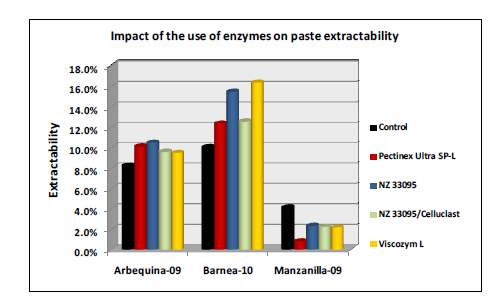
Talc can be used alongside other processing aids, such as enzymes depending on the condition of the olives. When combined with enzymes, talc can further enhance paste extractability, especially in low maturity fruits or during seasons where extraction is difficult.

Talc and microtalc powders are essential processing aids in olive oil extraction, particularly when dealing with high-moisture olives or challenging extraction conditions. By improving the structure of the olive paste and enhancing oil separation, talc increases extraction efficiency without altering the quality of the final product.

Its versatility, effectiveness, and minimal impact on oil quality make it a valuable tool in the olive oil production process.


logotipo mivico.jpg
Product Features
  • Micronised mineral talc for olive oil extraction
  • Food-grade E553b processing aid
  • Improves yield and oil clarity
  • Suitable for high-moisture olive paste
  • Non-toxic and asbestos-free
  • EU Regulation compliant
  • Used in olive oil malaxation process
  • Manufactured by Minerales MIVICO, Spain
File Title File Description Type Section
TALCOIL-23.pdf Talcoil Technical Data Sheet Brochures Document
TALCOIL_MSDS_English_3.pdf Talcoil MSDS English Brochures Document
TALCOIL_registration_spanish_3.pdf Talcoil Registration Spanish Brochures Document
Certificate_Talc_Food_Grade_4.pdf Talcoil Certificate Food Grade Brochures Document
Talc_Dosage_guide_Talcoil.pdf TALCOIL Dosage Specifications Document

Using Processing Aids in Olive Oil Extraction Process: Expert Insight from Pablo Canamasa

As global extra virgin olive oil (EVOO) production expands into non-traditional regions with varying climates and agroecological conditions, producers are facing a new wave of operational complexities. Join leading agricultural scientist and processing expert Pablo Canamasas as he unpacks the evolving challenges in EVOO extraction and explores strategic solutions tailored for industrial-scale operations. In this exclusive video, you’ll gain insig
Please log in to view the entire article

Key Adjustable Parameters in Olive Oil Processing Machinery for Quality & Yield Optimisati

Efficient and high-quality olive oil extraction depends on fine-tuning multiple process variables. Below are critical control points and potential adjustment areas within modern olive oil production systems:
Please log in to view the entire article

Processing Aids for Olive Oil Extraction: Functions, Benefits and Practical Application

Olive oil producers can enhance extraction efficiency and oil quality with the strategic use of processing aids. These materials, including talc, enzymes, salt, and citric acid, improve oil release, reduce paste viscosity, and help separate oil from water.
Please log in to view the entire article

Esterification in Olive Oil Extraction and the Role of Processing Aids


PROCESSING AIDS AND THEIR EFFECT ON OIL CHEMISTRY

Esterification in Olive Oil Extraction and the Role of Processing Aids

Esterification is a natural chemical reaction where free fatty acids (FFA) combine with alcohols, typically glycerol, to form esters. This process reduces the measurable acidity of the oil. While esterification can occur in the olive paste during milling, it is usually a minor contributor to quality changes compared with factors such as fruit condition, malaxation parameters, and extraction efficiency.

Why Esterification Matters

  • Directly affects FFA values, a major criterion for Extra Virgin classification
  • Influences how certain processing aids appear to improve acidity
  • Helps understand why some additives must be used carefully to avoid unintended chemical changes
  • Provides insight into the relationship between pH, temperature, and enzymatic activity during malaxation
Esterification and Hydrolysis in Olive Oil Chemistry


This diagram illustrates the reversible reactions of esterification and hydrolysis, showing how free fatty acids and glycerol form triglycerides—and how they break down again under certain milling conditions.
Process Flow Diagram for Olive Oil Extraction


This diagram outlines the continuous olive oil extraction line: olives are crushed, malaxed, separated, clarified, and routed for bottling, while husk and wastewater are channelled to waste management systems.


High-Quality Talc Used in Olive Paste Processing


    Talcoil Micronised Mineral Talc by Mivico


When added to the paste, talc increases yield and improves malaxation and decanter performance.

How Processing Aids Interact with Esterification and Oil Chemistry

Processing aids act physically or chemically on the olive paste. Some enhance enzyme activity, others alter pH or moisture, and a few influence esterification indirectly. Below is a breakdown of the main aids used by professional olive processors and how each relates to esterification.

1. Calcium Carbonate

Calcium carbonate is the processing aid most associated with apparent esterification effects.

Influence on esterification

  • Raises the pH of the paste, shifting reaction conditions
  • Can promote mild esterification of free fatty acids, producing a lower measured FFA
  • May mask poor fruit quality because the reduction in FFA does not represent a true improvement in oil integrity
Operational considerations
  • Produces very green oils
  • Can alter flavour and oxidative parameters
  • Requires precise dosing due to its aggressive action
The Olive Centre can supply controlled dosing systems to ensure correct application in mills seeking maximum extractability.  See Talc Dispenser and Enzyme dosing units

2. Salt (Sodium Chloride)

Salt acts primarily on the physical structure of the paste rather than the oil chemistry.

Influence on esterification

  • Minimal direct effect
  • Does not change paste pH in a way that promotes esterification
  • The perceived improvements in acidity are due to better separation, not chemical modification
Operational benefits
  • Improves extractability
  • Helps produce greener oils
  • Increases centrifugal efficiency of the decanter
Salt can be metered via hopper dosing units or inline auger systems.

3. Talc (Magnesium Silicate)

Talc is inert and valued for its physical functionality.

Influence on esterification

  • No chemical interaction with oil or fatty acids
  • Does not modify FFA or promote esterification
  • Its benefits come entirely from improved paste structure and reduced emulsification
Operational benefits
  • Improves oil yield in high moisture or difficult pastes
  • Enhances malaxation and decanter performance
  • Works reliably across varieties and seasonal conditions
Available talc dosing equipment can be integrated with paste blenders, malaxers, and continuous milling lines.

4. Enzymes

Commercial enzyme blends can influence chemistry indirectly.

Influence on esterification

  • Break down cell walls, releasing bound lipids and sometimes alcohol groups
  • May create conditions where minor esterification occurs naturally
  • Effects are small compared with changes in extraction efficiency
Operational benefits
  • Higher extractability
  • Reduced malaxation time
  • Often improved phenolic release
Enzyme dosing and thermal control in malaxers improve consistency and performance.

5. Kaolin and Bentonite

These clay minerals are used more for paste modification or clarification.

Influence on esterification

  • No direct chemical effect
  • Do not reduce FFA or change oil acidity
  • Their performance is purely physical, based on adsorption and improved paste rheology
Operational benefits
  • Support separation in high moisture pastes (kaolin)
  • Assist in clarification and impurity removal (bentonite)
Clay based aids should be added with care to avoid over-adsorption of oil.

Summary: Which Aids Influence Esterification?

Processing Aids & Their Effects

Processing Aid Impact on Esterification Notes
Calcium Carbonate Moderate … via pH shift Can lower measured FFA but may affect flavour and oxidation
Salt (NaCl) None Improvements come from better separation, not chemical change
Talc None Purely physical aid for difficult pastes
Enzymes Minor, indirect Mostly physical… chemical breakdown of cell walls
Kaolin None Improves rheology only
Bentonite None Used for clarification rather than extraction

Optimising Processing Aids in Olive Mill Machinery

Professional olive mills benefit from:

  • Precision dosing systems for powders and enzymes
  • Malaxers with stable temperature control to avoid unintended chemical changes
  • Decanters tuned to handle modified paste characteristics
  • Regular chemical testing to verify FFA, PV, and phenolic stability
The Olive Centre supplies processing aid dosing equipment, malaxation systems, decanter upgrades, and quality testing instruments designed to support efficient, traceable and high quality olive oil production.