My Account
Sign-in / Join

Sign-in

Hi My Account

Dashboard

Logout

Cart

My Shopping Cart

Subtotal
${{total.toFixed(2)}}
QUOTE

Organica Ganixx-Bio Cal-Si-N 6

Calcium + Nitrogen + Silica Bio Nutrient
Volume Pack Size
Strength
Quantity

EAOACSIN
  • Description
  • Features
  • Enquiry
  • Specifications
  • Knowledge
Organica Ganixx-Bio Cal-Si-N 6 – Calcium + Nitrogen + Silica Bio Nutrient

High-performance liquid calcium and nitrogen supplement for enhanced plant strength, nutrient uptake, and soil conditioning.

Organica Ganixx-Bio Cal-Si-N 6 is a premium liquid calcium supplement formulated with nitrogen and bio-available silica for superior foliar and soil performance.
It delivers a unique triple-action formula that strengthens cell walls, improves fruit shelf-life, and removes harmful sodium salts from the root zone.
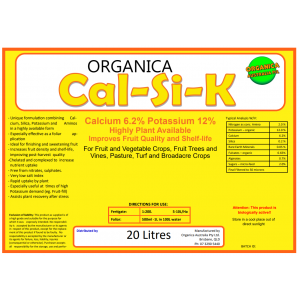
Containing 6% Nitrogen, 12% Calcium, and Silica, this product promotes rapid nutrient uptake, stress tolerance, and enhanced plant vigour across a wide range of crops.
Specially designed for sodium-affected soils, Cal-Si-N 6 provides both corrective and preventive benefits for improving structure, nutrient balance, and resilience under environmental stress.

Uses – For Soil and Foliar Application

Cal-Si-N 6 is suitable for all fruit, nut, vegetable, and broadacre crops where calcium and nitrogen supplementation is required.
It is especially effective in sodium-affected or compacted soils and for foliar use during periods of rapid vegetative growth, fruit-set, and stress recovery.
Ideal for use on crops such as grapes, apples, cherries, pears, cotton, soybeans, tomatoes, melons, cucumbers, and other horticultural plants.
Quickly absorbed through foliage and roots, it enhances calcium mobility and silica protection throughout the plant system.

Technical Specifications
Specification Cal-Si-N 6
Nitrogen (as conc. organic liquid) 6.0 %
Calcium (as water-soluble foliar-available) 12.2 %
Silica 0.2 %
Rare Earth Minerals 0.05 %
Fulvates (Organic) 0.65 %
Alginates 0.5 %
Sugars (Micro-feed) 2.0 %
Typical Use Rate (Foliar) 4–10 L / ha every 7–10 days
Typical Use Rate (Soil) 10–20 L / ha pre-plant or fertigated
Formulation Type Liquid Calcium + Silica + Nitrogen Complex
Compatibility Do not mix with Zinc or heavy metals; avoid phosphate/sulphate fertilisers
Certified Input Australian Organic Registered Farm Input No. 442
Manufacturer Organica Australia Pty Ltd, Brisbane QLD

Organica Product Packaging & Weight Specifications

Container Type Dimensions (cm / m) Weight Range Notes
20 Litre Drum 23 × 30 × 40 cm 23–27 kg (varies by product) Standard size for smaller quantities of Organica liquid formulations.
20 Litre Bucket 30 × 30 × 40 cm 23–27 kg (varies by product) Used for Organica paste, suspension, or heavy nutrient blends requiring a wider base.
200 Litre Drum 1.2 × 1.2 × 1.2 m 240–300 kg Commonly used for bulk product supply to farms and distributors.
1000 Litre IBC 1.2 × 1.2 × 1.2 m 1.2–1.6 tonnes Ideal for large-scale agricultural applications and long-term storage of Organica liquid nutrients.

*All weights are approximate and may vary depending on the Organica product composition and density.

Compatibility

Compatible with most pesticides and fungicides when used as directed.
Do not mix with zinc, phosphate, or sulphate-based fertilisers to avoid formation of insoluble compounds.
Conduct a jar test before mixing with other products.

Why Choose This Product

Organica Cal-Si-N 6 combines calcium, nitrogen, and silica into a single nutrient-dense liquid that delivers rapid foliar uptake and sustained soil improvement.
It enhances fruit firmness, quality, and resistance to stress, while improving soil structure and reducing nitrogen loss—making it a powerful, sustainable input for organic and conventional growers alike.

Frequently Asked Questions

Organica Ganixx-Bio Cal-Si-N 6 is a liquid calcium and nitrogen supplement formulated to enhance soil and plant health, particularly in sodium-affected or stressed growing conditions. It provides 6% nitrogen, 12.2% calcium, and silica, which together promote nutrient uptake, reduce salinity effects, and strengthen plant cell walls for improved fruit firmness and shelf life. It’s ideal for use in horticultural, broadacre, and tree crop systems.
For most crops, apply 4–5 L/ha during the rapid growth stage, flowering, or fruit development. Repeat every 7–10 days as required. For vegetables and leafy crops, apply 5–10 L/ha in no less than 150 L water per hectare. Always spray early in the morning or late afternoon when air temperatures are below 30°C and humidity is moderate.
Cal-Si-N 6 should not be mixed with phosphate or sulphate-based fertilisers, as insoluble precipitates can form. Avoid tank-mixing with products containing zinc, copper, or other heavy metals. Always perform a small jar test before blending with other solutions to ensure compatibility.
Cal-Si-N 6 enhances nutrient exchange capacity by increasing calcium availability and reducing sodium buildup in the root zone. Silica reinforces cell walls, while non-volatile nitrogen improves uptake efficiency. The formula also supports beneficial microbial activity, helping restore soil balance and plant vigour in saline or compacted soils.

 
Key Features
  • 6% Nitrogen with 12% plant-available Calcium plus Silica
  • Improves cell wall strength and shelf-life
  • Rapid correction of calcium and sodium imbalance in soils
  • Compatible with most fungicides and pesticides
  • Enhances uptake of nutrients and foliar sprays
  • Reduces nitrate loss and urease activity by up to 70%
  • Ideal for saline or sodic soils requiring calcium replacement
  • Formulated with rare earth minerals, fulvates, and alginates
  • Safe for both foliar and soil application
  • Certified Australian Organic Input No. 442
  • :
  • :
  • :
  • :
  • :
  • :
  • :

Global Shortage of MAP (Monoammonium Phosphate) & DAP (Diammonium Phosphate)

URGENT FERTILISER SUPPLY UPDATE – MAP & DAP SHORTAGE

Global Shortage of MAP (Monoammonium Phosphate) & DAP (Diammonium Phosphate)

This summer cropping season is facing unprecedented challenges in fertiliser supply. Availability of MAP fertiliser (monoammonium phosphate) and DAP fertiliser (diammonium phosphate) is expected to remain extremely limited worldwide, with serious implications for growers planning their nutrient programs.

Why is Fertiliser Supply Tight

China’s Export Restrictions Continue

Since 2021, China has imposed strict quotas and inspection rules on phosphate fertiliser exports to protect domestic prices and safeguard food security. 

The impact has been dramatic:

  • March 2025 exports: just 13,000 tonnes, compared with 950,000 tonnes in March 2022.
  • Q1 2025 exports: 111,000 tonnes, versus a three-year average of 785,000 tonnes.
China’s internal demand continues to climb due to increased grain production and the rapid growth of the electric vehicle industry, especially in battery manufacturing. Analysts predict that restrictions will remain in place... or even tighten... throughout 2025.

Other Suppliers Cannot Fill the Gap

Although Morocco, Russia, the USA, and Saudi Arabia also produce MAP and DAP, they cannot offset the sharp drop in Chinese exports. 

The result is:

  • Rising global fertiliser prices
  • Longer delivery lead times
  • Stricter supplier allocations
  • Reduced pricing flexibility across the summer cropping season

What This Means for Growers

For olive growers and other professional producers, the impacts are already being felt:

  • Reduced fertiliser availability for summer cropping
  • Higher input costs with delivery delays
  • Less flexibility in nutrient timing and program planning

Looking forward, risks include:
  • Reduced or cancelled fertiliser allocations
  • Possible product unavailability at short notice
  • Last-minute program changes forced by supply shortages

Our Recommendations - Secure Your Supply Now

Do not wait for traditional ordering windows. Place orders immediately and consider forward contracting for next season. Securing current pricing now helps protect your operation against higher costs and potential shortages later.

Optimise Your Nutrient Strategy

  • Review alternative phosphate fertiliser options
  • Adjust application rates where agronomically feasible
  • Consider split applications to maximise nutrient efficiency
  • Explore precision application technologies to reduce overall fertiliser requirements

Biennial Bearing (Alternate Bearing) in Olive Trees

Olive trees often swing between heavy and light crops. This article explains why biennial bearing happens and how growers can manage it for steadier harvests.
Please log in to view the entire article

So You Want to Plant an Olive Grove?

Healthy olive groves need the right balance of soil care, water, and pruning. While olives are hardy, they can suffer from pests like black scale or lace bug, and diseases such as anthracnose. With good monitoring and sustainable practices, most issues can be managed before they become serious problems.
Please log in to view the entire article

Sunburn Damage in Olive Trees - What It Looks Like, Why It Matters & What You Can Do

PEST & DISEASES

Sunburn Damage in Olive Trees: What It Looks Like, Why It Matters & What You Can Do

Olive trees are well adapted to hot and dry Mediterranean climates, but even they can suffer from sunburn (also called sunscald) when exposed to intense sunlight, heat stress, or when bark that was previously shaded becomes suddenly exposed. In mature or neglected/abandoned groves - especially those with heavy pruning or thin canopies - the risk can increase significantly. 

Sunburn damage weakens trees, opens the way for pests and disease, slows growth, and in severe cases may lead to branch dieback or decline. It’s worth recognising early and managing before the damage becomes irreversible.


What Causes Sunburn to Olive Trees 


Several factors often combine to cause sunburn:


  • Sudden exposure of bark: If a tree is heavily pruned or loses branches, parts of the trunk or limbs previously shaded may be exposed for the first time to intense sunlight. This sudden change can shock the tissue.
  • Heat stress during dry periods: High temperatures, especially coupled with drought stress, reduce the tree’s ability to cool itself through transpiration, making bark and inner tissues more vulnerable.
  • Reflective heat / radiative load: In orchards with bare ground or light-coloured surfaces (rock, white gravel, concrete), heat can amplify and radiate back toward trunks and lower canopy, increasing the load on bark tissues. 
  • Thin bark or young growth: Younger trees or new branches often have thinner bark, which offers less protection from temperature extremes.
  • Water deficit: When the tree is already stressed by lack of water, its tissues are less resilient and more vulnerable to sun damage.
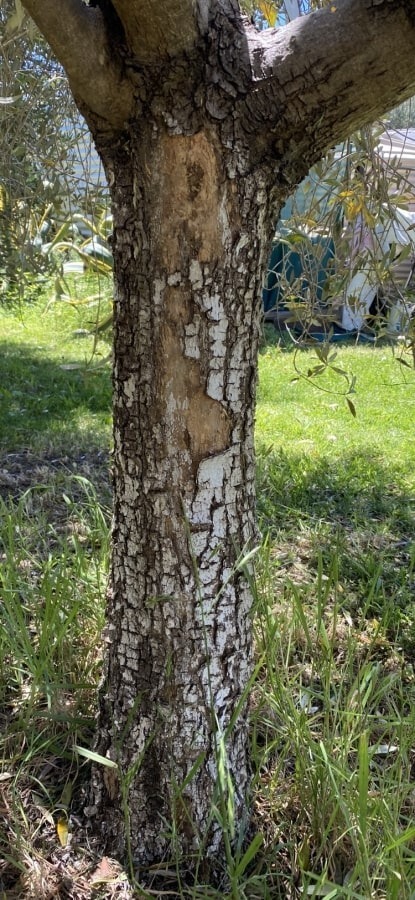
Once sunburn occurs, the damaged bark may crack, dry, peel, or become sunken. Underneath, the cambium (growing tissue) may be killed in patches, reducing the tree’s capacity to transport water and nutrients through that section.


Sunburn Damage to Olive Tree Trunk -The image above shows classic symptoms: cracked, peeling bark and exposed wood.

Recognising Sunburn Damage in Olives

Here are key symptoms to watch for:

  • Bark becomes discolored (straw, pale, or bleached areas) compared to healthy bark.
  • Cracking, peeling or flaking bark, sometimes exposing pale wood beneath.
  • Sunken or collapsed bark patches where the surface is depressed.
  • In severe cases, sections of bark slough off entirely and expose dead wood.
  • Cankers or lesions forming in the affected areas.
  • Reduced leaf vigor, scorching or browning of leaves, especially near the canopy edges.
  • Fruit drop or shriveling if the tree is already bearing. High heat stress may trigger olive abscission.
  • Over time, branch dieback or trunk weakness in the sunburned section may appear.

One important effect is that sunburned bark is more vulnerable to pest and fungal invasion, such as wood-boring insects or opportunistic pathogens that exploit the compromised protective barrier. 

Because olive trees often live many decades, even older trees can sustain recovery—provided the damage is not too extensive and you intervene early.

Why Sunburn in Your Olive Grove Is a Concern

  • Reduced growth and productivity: Damaged bark and cambium reduce the tree’s ability to translocate water and nutrients. The tree may divert energy to healing instead of growth or fruiting.
  • Structural weakness: Sunken or damaged trunk areas may become weak points, prone to breakage or cracks later, especially under wind stress. 
  • Higher susceptibility to pests and pathogens: Exposed or cracked bark invites insects (borers) or fungal pathogens to colonize. 
  • Delayed recovery: If large patches are affected, the tree may require a long time to compartmentalize the damage, and growth may be permanently affected in that area.
Given your background (older trees, clay soils, variable canopy coverage), sunburn may not be your primary challenge, but it can aggravate other stresses (nutritional, water, disease) and slow the recovery process.

Preventative Measures & Remedies

Here’s a set of strategies you can apply now or over seasons to protect your olive trees and help heal existing damage.

1. Maintain or restore shade to the trunk

  • When pruning, retain lower branches or scaffold limbs that offer partial shading to the trunk. Don’t prune so aggressively that bark is suddenly exposed. 
  • Use ground covers, mulch, or low shrubs around the dripline (but not touching the trunk) so that radiant heat from bare soil is reduced.
  • If possible, plant shade species (small trees or shrubs) in-line rows or adjacent to blocks to break sunlight incidence midday or afternoon.
2. Apply protective coatings or wraps
  • Whitewashing or painting the trunk with a light, water-based paint (often diluted limewash or similar) helps reflect sunlight and reduce temperature extremes. Many growers use this method on sensitive or newly exposed trunks. 
  • Use tree wrap or reflective sleeves on trunks, ideally on the side facing intense sun (often western or northwestern exposure in Australian climates). Wrapping material should allow air movement—avoid tight plastic wraps that trap moisture. 
  • In olive orchards, kaolin clay sprays (e.g. “Surround” brand or similar) are sometimes used on foliage and trunk to reduce radiant heat absorption and protect against sun and heat stress. Some trials report yield improvements by reducing fruit burn and drop under high-heat conditions.
3. Manage irrigation and soil moisture
  • Ensure the tree is not already under water stress. Provide adequate soil moisture during hot seasons (without overwatering).
  • Use mulches (organic materials like prunings, compost, bark chips) to help moderate soil temperature and reduce evaporation, which helps maintain a stable microclimate for roots.
  • Avoid practices that leave the soil bare and hot—bare clay can retain and radiate heat back onto trunks.
4. Gentle healing & care for affected trees
  • Remove loose or dead bark carefully, but don’t over-prune or cut live tissue aggressively. Let the tree compartmentalize the damage naturally.
  • For deeper or cankered sections, consult a tree health specialist to assess whether you need to trim back to sound wood or apply wound dressings.
  • Monitor the area over seasons; the tree may form callus growth around the margin of the injury and seal it internally if conditions are favorable.
  • Avoid additional stress (drought, nutrient deficiency, pests) in damaged trees so energy is available for healing.
5. Ongoing monitoring & orchard layout improvements
  • As you rehabilitate your grove, assess tree spacing, row orientation, and tree height to reduce reflective heat loading.
  • Avoid creating large expanses of bare, reflective ground under rows. Maintain a cover crop, grass alley, or soil cover to diffuse heat.
  • Track which trees show signs of sunburn after pruning or canopy changes. Use careful pruning patterns that don’t suddenly expose shaded bark.

Signs of sunburn in olive trees

Sunburn appears as pale, bleached bark patches on exposed trunk surfaces, cracks or peeling bark, and sometimes sunken or depressed bark areas. In advanced damage, bark may fall off, leaving wood exposed. Leaves near the margins of canopy may show browning or scorching, and fruit may drop prematurely under heat stress.

If you can, have a sample branch punched from just beyond the edge of the sunburn area so an arborist or consultant can evaluate whether live cambial tissue remains. Also, map out which exposures (north, west, etc.) in your grove tend to show sunburn more often—this helps plan protective shading or wrap strategies.

As you re-establish your grove’s health in other areas (soil fertility, drainage, pest and disease management, good pruning), protecting against sunburn becomes part of the maintenance process rather than a standalone issue.

References

  • UC IPM (University of California): guidance on whitewashing trunks to prevent sunburn/sunscald on trees. 
  • The Olive Centre: overview of sunburn damage in olive trees, risk factors (water deficit, heat), and vulnerability to borers.
  • Tessenderlo Kerley technical note: kaolin (Surround) particle film reduces heat load/sunburn and can improve olive yield/quality under high-radiation conditions.
  • Peer-reviewed study (Horticulturae/MDPI): mineral clay particles (incl. kaolin) evaluated on olives for effects on yield and oil quality.
  • Research summary (IPB/Portugal): field experiments with kaolin 5% on ‘Cobrançosa’ olives under rainfed and deficit irrigation; particle film proposed to reflect heat/irradiance. 
  • Australis Plants (AU olive resource): practical tips—white water-based paint (50:50) or trunk wraps on young/renovated olives; risk after hard summer pruning.
  • NSW DPI (citrus reworking guide—general orchard practice): after heavy cutting, paint exposed trunks/limbs with diluted white water-based paint to prevent sunburn (principle applicable to olives after renovation pruning). 
  • Agriculture Victoria (orchard recovery): recommends whitewash/diluted white paint on trunks/large limbs to minimise sunburn following canopy loss—relevant where olive canopies are thinned or defoliated. 
  • Australian Olives (Olives Australia): Peacock spot factsheet (context—sunburned tissue predisposes to disease; useful companion reference for disease pressure in humid regions).