My Account
Sign-in / Join

Sign-in

Hi My Account

Dashboard

Logout

Cart

My Shopping Cart

Subtotal
${{total.toFixed(2)}}
QUOTE

Bio Gypsum by Organica Australia

Organic 3-Phase Calcium Fertiliser
Volume Pack Size
Quantity

EAOABIOG
  • Description
  • Features
  • Enquiry
  • Specifications
  • Documents
  • Knowledge
  • Blog
Organica Liquid Bio-Gypsum (3 Phase) – BFA Certified

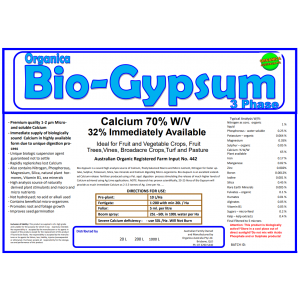
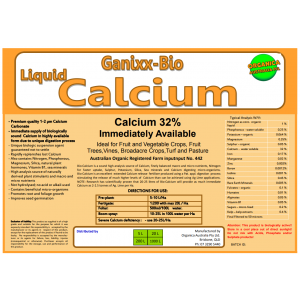
70% calcium (32% immediately available) organic liquid gypsum for improved soil health and sustained calcium release.

Organica Liquid Bio-Gypsum (3 Phase) is a high-performance organic calcium supplement designed to stimulate root and foliage growth, enhance soil microbiology, and replenish lost calcium and crop vigour, especially after periods of heavy rain.

Formulated and manufactured by Organica Australia Pty Ltd, this product delivers 70% calcium W/V, with 32% immediately available calcium, ensuring both rapid and extended nutrient release in three distinct phases – immediate, medium, and long-term availability.

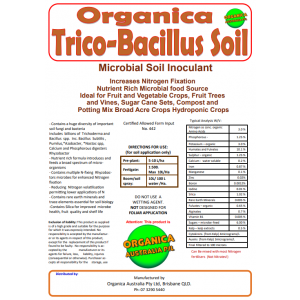
Each container is supplied with a 20 L Trico-Bac inoculant, containing beneficial microorganisms such as photosynthetic and actinobacteria, promoting biological activity and sustainable nutrient cycling. Bio-Gypsum is ideal for use across fruit and vegetable crops, vineyards, turf, broadacre, and pastures, ensuring superior calcium correction and soil balance for all crop stages.

Uses – For Fruit, Vegetable, Turf, and Broadacre Crop Production

The Organica Liquid Bio-Gypsum (3 Phase) is designed for growers, orchardists, and agronomists aiming to improve soil structure, root health, and long-term calcium stability. It enhances seed germination, boosts bloom set, and increases calcium uptake efficiency in both acidic and alkaline soils. The formula works to restore soil microbial diversity while supporting vigorous, balanced plant growth under challenging conditions such as heavy rainfall or nutrient leaching.

Technical Specifications
Nutrient Typical Analysis (W/V)
Calcium (Plant Available) 70% W/V (32% immediately available)
Nitrogen (as organic liquid) 1.00%
Phosphorous (water soluble) 0.25%
Potassium (organic) 0.064%
Magnesium 0.35%
Sulphur (organic) 0.05%
Iron 0.17%
Manganese 0.02%
Zinc 0.002%
Boron 0.0012%
Iodine 0.001%
Silica 0.45%
Rare Earth Minerals 0.005%
Fulvates (organic) 0.10%
Humates 0.01%
Alginates 0.05%
Vitamin B1 0.05%
Sugars (micro-feed) 0.20%
Kelp Extracts 0.40%
Filtration Final filtered to 50 microns

Organica Product Packaging & Weight Specifications

Container Type Dimensions (cm / m) Weight Range Notes
20 Litre Drum 23 × 30 × 40 cm 23–27 kg (varies by product) Standard size for smaller quantities of Organica liquid formulations.
20 Litre Bucket 30 × 30 × 40 cm 23–27 kg (varies by product) Used for Organica paste, suspension, or heavy nutrient blends requiring a wider base.
200 Litre Drum 1.2 × 1.2 × 1.2 m 240–300 kg Commonly used for bulk product supply to farms and distributors.
1000 Litre IBC 1.2 × 1.2 × 1.2 m 1.2–1.6 tonnes Ideal for large-scale agricultural applications and long-term storage of Organica liquid nutrients.

*All weights are approximate and may vary depending on the Organica product composition and density.

Compatibility

Organica Liquid Bio-Gypsum is compatible with most fertilisers and biological products but should not be mixed with acids, phosphate, or sulphate products. It can be applied through drip, boom, foliar, or fertigation systems. Store in a cool, shaded area to maintain microbial activity.

Why Choose This Product

The Bio-Gypsum 3 Phase system offers growers a unique combination of rapid calcium correction and long-term soil conditioning. By including a dedicated Trico-Bac microbial inoculant, it delivers living soil biology to improve calcium solubility, root colonisation, and nutrient exchange. Its triple-phase calcium release ensures extended protection against leaching losses and supports strong, resilient plant growth — making it an essential tool for sustainable and organic farm systems.

Frequently Asked Questions

 
Organica Bio-Gypsum is a biologically enhanced calcium supplement designed to improve soil structure, plant health, and crop productivity. It combines immediately available calcium (32%) with additional slow-release calcium phases (up to 70% total), ensuring both rapid uptake and long-term nutrient availability. Formulated using Organica’s unique biological digestion process, it stimulates beneficial soil microbes, enhances root growth, and replenishes calcium lost through leaching or heavy rainfall. This 3-phase action supports crop vigour, stronger stems, improved flowering, and higher yield consistency across fruit trees, vines, pastures, and broadacre crops.
The 3 Phase formulation provides a tiered calcium release system for immediate, short-, medium-, and long-term nutrient supply. Unlike traditional gypsum or lime, which can take months to break down, Bio-Gypsum’s micronised calcium particles (1–2 μm) and biologically digested suspension ensure instant solubility and bioavailability. It also contains fish hydrolysate, kelp extracts, humates, fulvates, and rare earth minerals, which act as natural chelators and microbial stimulants. These components enhance soil oxygenation and promote beneficial microorganisms such as photosynthetic bacteria and Actinobacteria, ensuring balanced soil microbiology and sustainable fertility improvement.
  • Pre-plant: 10 L/ha
  • Fertigation: 1:200 dilution, minimum 20 L/ha
  • Foliar spray: 5 mL per litre
  • Boom spray: 25–50 L per 100 L water per hectare
  • Severe calcium deficiency: Apply up to 50 L/ha — will not burn plants

Each Bio-Gypsum unit is supplied with a 20 L Trico-Bac inoculant, which contains beneficial microbes that synergise with the product’s calcium complex to accelerate biological activity in the soil. The product should be stored in a cool, shaded area and must not be mixed with acids, phosphate, or sulphate-based fertilisers to preserve its biological integrity.
Bio-Gypsum provides both chemical and biological soil correction. The fine calcium particles neutralise soil acidity, improve cation exchange capacity (CEC), and increase nutrient uptake efficiency. Meanwhile, the biological additives — including sea minerals, humic compounds, and beneficial microbes — boost enzymatic activity and nutrient cycling. Plants experience faster root establishment, enhanced seed germination, improved flower set, and sustained growth even under stress. In practical field trials, growers have reported visible increases in bloom density, fruit size, and leaf turgor, particularly following periods of heavy rainfall or nutrient depletion.

 
Key Features

• 70% calcium W/V with 32% immediately available calcium
• Dual-action formula: immediate and slow-release calcium phases
• Includes Trico-Bac inoculant (20 L) with beneficial microbial strains
• Stimulates root and foliage growth and improves seed germination
• Replenishes lost calcium and crop vigour after rain events
• Enhances microbial life, including photosynthetic and actinobacteria
• Contains nitrogen, phosphorous, magnesium, silica, sea minerals, and kelp
• Formulated with a biological suspension agent that prevents settling
• Not hydrolysed; no acid or alkali used in production
• Ideal for organic and regenerative farming systems
• BFA Certified (Australian Organic Farm Input No. 442)
  • :
  • :
  • :
File Title File Description Type Section
BioGypsum__New_Label.pdf BioGypsum Label by Organica Specifications Document
MSDS-Liquid-Bio-Gypsum_MSDS-07_2019-Current.pdf Gypsum /Bio-Gypsum Material Safety Data Sheet Specifications Document

4 Factors In Grove Management To Focus On For Next Olive Harvest

The Grove Management Plan: Essential Areas to Focus On

A successful Grove Management Plan must cover these key areas:

Irrigation

"A grove without an effective irrigation system is unlikely to deliver consistent yields year after year. Many growers still underestimate the water needs of olive trees, and few actually monitor soil moisture levels. This is why so many groves have never achieved a commercial crop."  Marcelo Berlanda Specialist Olive Consultant

Water stress negatively affects flowering, fruit set, oil accumulation (oil production), fruit size (table olives), fruit quality, and overall tree health. However, many growers lack a proper system to monitor soil moisture or manage irrigation effectively. 

Marcelo recommends:

"Growers should inspect soil moisture weekly during spring and summer, and every two weeks in autumn and winter. Use a shovel to dig at least 400mm under the tree canopy to check moisture. If the soil is hard to dig, it’s too dry – even if the canopy shows no visible signs of stress." 

Advanced soil moisture monitoring tools can also provide reliable data on a digital display or computer dashboard. 

For optimal grove health, growers must consistently check soil moisture and prevent water stress.

Nutrition

As discussed previously, taking leaf samples is essential to assess your trees’ nutritional status. This information guides the creation of a fertiliser program, a critical component for boosting or maintaining yields.

Typically, no fertiliser is needed in winter, unless you’re addressing soil amendments. However, some groves have severe nutrient deficiencies requiring fertiliser even in winter. Where proper irrigation systems aren’t in place, growers must broadcast fertiliser before rain to allow rainfall to incorporate nutrients into the soil profile, an inefficient use of resources but often the only option.

When applying fertiliser in these conditions, target the area beneath the canopy and, if possible, cultivate the soil to improve incorporation and reduce product loss.

Olives need four essential nutrients: Nitrogen, Phosphorus, Potassium, and Calcium. Check product labels carefully. As a general guideline, aim for:

Pruning

Avoid pruning during the coldest part of winter and when it’s wet or foggy to reduce the risk of bacterial and fungal disease spread.

The main goals of pruning are to remove dead wood, reduce canopy size, restore tree balance, encourage healthy new growth, and increase fruit set in spring.

Tip: After pruning, apply a copper-based spray to protect wounds from infection by fungi and bacteria.

Pest and Disease Control

Pest & disease management is crucial for sustaining yield and tree health. Winter’s colder temperatures reduce insect activity, offering a prime time to tackle pest issues.

Set up a comprehensive Pest and Disease Monitoring Program. During winter, check marked trees (previously affected by pests or diseases) every two weeks; in spring, check weekly. Look under leaves and on new growth for signs like crawlers, yellow spots, black sooty mold, or anything unusual.

Proactive, weekly management is essential for a successful grove.

If you need further assistance, please contact us.


Understanding Olive Leaf Tip Dieback: Causes, Diagnosis, and Management

Discover how to diagnose and manage olive leaf tip dieback, a common issue caused by nutrient deficiencies, salinity, or environmental stress. Learn expert strategies for restoring tree health through balanced nutrition, soil and water management, and effective disease prevention — backed by The Olive Centre’s professional resources and products.
Please log in to view the entire article

The importance of Boron & Calcium in Olive Trees

In the lead up to flowering, you need to ensure your trees have adequate nutrition, particularly of Boron and Calcium. ?A lack of Boron?and Calcium may lead to decreased fruit set, oil quality and oil stability.

The application of Boron?and?Calcium?can never be overstressed. ?It is a requirement for your trees.

In Brief

A study on olive trees has looked at different application rates of Boron and Calcium and the effects on fruit set, fruit oil and oil chemical characteristics.

The rate of 100ppm of Boron?and 2% Calcium?was applied at full bloom and the 2nd application at 15 days later.  Trees were sprayed with nutrient solution till run off.

Fruit Set %

Trees in this study showed a higher fruit set. ?Results also confirm the role of Boron?and?Calcium?nutrients in improving fruit set of olive flowers.

From the overall data, the two studied nutrients effectively increased fertilisation either through controlling pollen germination on the stigma or growth of pollen tube through the style. ?Therefore, the subsequent increase in fruit set % was observed.

Fruit oil %

Furthermore, the effects could also be seen in increased fruit oil content. ?This increase reached a significant level in most cases.

Oil Chemical Characteristics

Peroxide Value

The study of the application of Boron?and?Calcium?at the same rate noted above greatly decreased the peroxide value in the cultivars studied.

If you would like to read the full paper, please?Press to view article

http://youtu.be/fkFD1Osg4Y4