Herbicides are a crucial tool in modern agriculture, but recent research highlights an unintended consequence that olive producers must consider—potential harm to pollination. A study by Dummer et al. (2025) has identified that common herbicides, including glyphosate and 2,4-D, significantly impair olive pollen germination, raising serious concerns about their impact on fruit set and overall yield.
When establishing an olive grove, one of the most critical decisions you will make is the layout of your trees. The arrangement you choose will influence tree health, productivity, and long-term management efficiency. This guide will walk you through key considerations, including aspect, tree spacing, irrigation, harvesting methods, drainage, pruning, and marking out your olive grove.
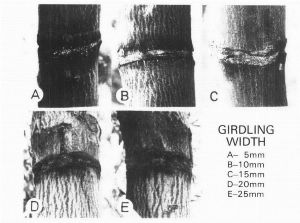
Girdling (or cincturing) involves removing a narrow strip of bark around the trunk or scaffold of an olive tree to interrupt the flow of carbohydrates to the roots — thereby redirecting energy toward fruit development. When applied correctly, early trials in Israel and Spain reported up to a 40% yield increase and larger fruit size (from 3.9 g to 4.7 g) the following harvest cycle. But the technique carries risks: timing, girdle width, wound heal
Occasionally a sap-sucking insect known as Brown or Black Olive Scale will be seen on olive trees. It is rarely a problem if the trees are in good health. We usually only spray our mature trees for scale every two to three years and only then if they need it. However, certain areas of Australia are more prone to the scale.
The fungal disease Armillaria is responsible for the "white rot" root disease.The Armillaria fungus damages the root system.The fungus survives in the soil until the infected root breaks down. Characteristic white fan-shaped mycelial mats can be seen growing on the wood when the rotting bark is peeled back. Freshly infected roots have a strong mushroom smell. The wood of infected roots is rotted by the fungus, becoming either white and powdery ..
Anthracnose is one of the most destructive olive diseases in Australia, capable of devastating crops and oil quality. This guide outlines how to identify early symptoms, understand the infection cycle, and apply proven prevention strategies to protect yield and grove health.