RELIABLE LABELLING MACHINES FOR ACCURATE, HIGH-EFFICIENCY PACKAGING
The Role of Reliability in Labeling Machines
Reliable labelling systems are essential for consistent product identification, accurate label placement, and packaging efficiency. Selecting the correct machine requires matching the equipment to the specific characteristics of each container. Bottles, vials, and jars vary in wall shape, surface regularity, height, and diameter, making equipment compatibility a critical engineering decision. To achieve reliable performance, all packaging variations should be assessed by a specialist experienced in labelling and packaging equipment.
Core Principles of Effective Labeling
The labelling process consists of several controlled mechanical and adhesive-transfer stages. Each stage must operate precisely to ensure consistent results
Label Feed- The label is drawn from the roll and routed through the machine using rollers or tension-controlled guides.
Label Pickup- Pickup may be achieved via:
- suction cups
- compressed air
- buffer pads
- rollers
- secondary adhesive systems
Label Application- The adhesive side is applied to the container using full-surface, vertical, or horizontal pads, supported by roller pressure for uniform bonding.
Compression and Securing- Once positioned, the label is secured using:
- buffer pads
- compressed air
- belts
- brushes
Container Motion Path- Containers may travel:
- linearly, or
- via rotary systems for high-speed applications.
Industrial labelling machines can exceed
50,000 bottles per hour.
Categories of Labelling Machines
Semi-Automatic Labelling Machines
Semi-automatic systems require manual placement of each container before the labelling cycle is triggered using:
- a turn handle
- a push button
- a foot pedal
Suitable for small to mid-scale operations requiring flexibility and short changeover times. Models:
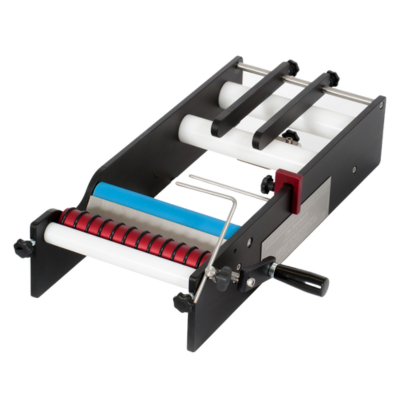
Manual turn-handle applicator

Supports single labels, full wrap-around, and front/back application
High-Capacity Semi-Automatic Systems
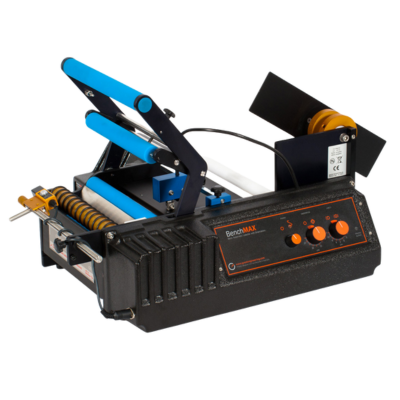
The Benchmax supports the widest range of product sizes and offers high application speeds suitable for industrial output. It applies transparent or clear labels with high precision.
Fully Automatic Labelling Machines
Fully automatic systems integrate into production lines following filling and capping. Conveyors transfer containers across each station.
Automated lines may include:
- depalletisers
- filling modules
- capping heads
- labelling stations
- automated packing systems
The Polaris Line demonstrates a complete automated workflow from filling through to finished bottles.
Common Types of Labeling Machines Used in Production
Labeling machines generally come in two formats: semi-automatic and fully automatic. Semi-automatic labeling machines require manual placement of each bottle or container before the labeling cycle begins, and the operation is typically triggered by a turn handle, button, or foot pedal.
Fully automatic labeling machines are integrated directly into the production line, usually following the filling and capping stages. These systems rely on conveyors to move packaging through each section of the process. Containers may be fed in automatically by a depalletizer and packed at the exit point by machine, though these steps can also be performed manually depending on the overall line configuration and equipment capabilities.
Benchmate: An Entry-Level Semi-Automatic Labeling Solution
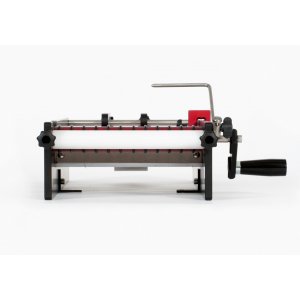
Manufactured in Australia, the Benchmate delivers excellent performance in the entry-level category. This manually operated label applicator is driven by a simple turn handle.
Semi-Automatic Labeling Machine for Mid-Level Production
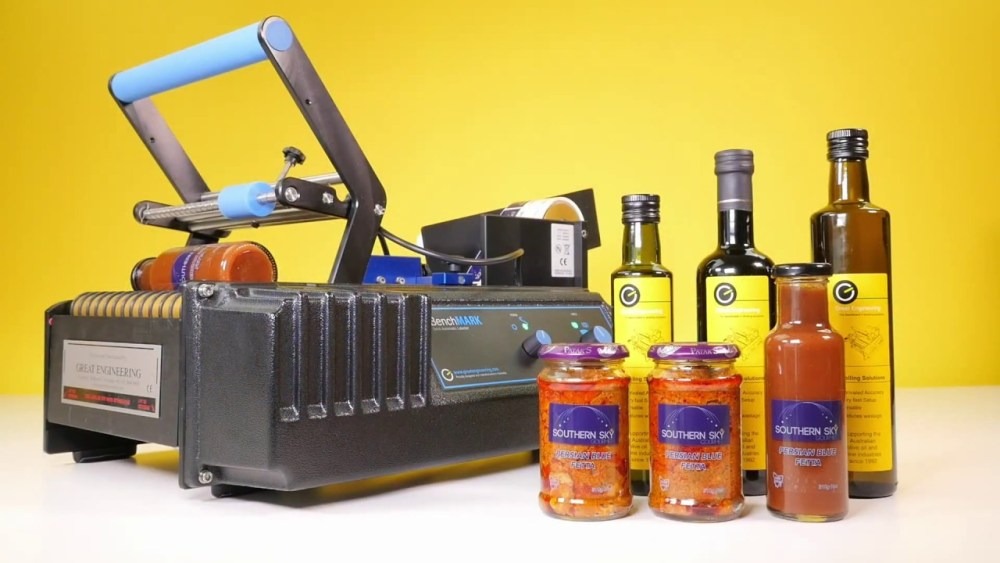
The Benchmark, also manufactured in Australia, is the next level up from the Benchmate and can apply single, full wrap-around, or front-and-back labels with ease.
High-Capacity Semi-Automatic Labeling Machine
The Benchmax handles the widest range of product sizes and delivers exceptional speed, making it ideal for high-output industrial applications. It’s user-friendly and supports precise application of transparent or clear labels.
Observe the foot-pedal system in use.
Fully Automated Labeling Systems
Watch the full Polaris Line showcase, demonstrating filling, capping, and labeling from start to finish.
View the entire workflow of filling, capping, and labeling.
Over the years, I’ve encountered a wide range of labelling problems and have helped many producers fine-tune their equipment, as correct setup and label tension are absolutely critical. Some of the most common labelling issues arise because:
-
Tearing often happens when the wrong label material is used during production. In some cases, poor machine calibration can prevent labels from applying smoothly, causing them to drag across the container and tear.
-
Peeling often happens when moisture is present or when the adhesive has aged or isn’t the right type for the application.
-
Curling typically appears when the adhesive releases from the container, which is more common in colder environments, such as refrigeration. It can also stem from die strikes created during the label-cutting process. These die-cutting issues tend to be more noticeable on automated production lines.
-
Die strikes can occur during the label manufacturing stage, and it is the label supplier’s responsibility to ensure their equipment is calibrated and operating correctly to prevent them.
- Wrinkling and folds develop when a label is applied incorrectly to the bottle or container. Manufacturing inconsistencies in the container’s sidewall can also prevent the label from adhering smoothly. Proper label tension is essential as well—if the tensioner is worn or malfunctioning, it can lead to wrinkling, folding, or the formation of ridges during application.
- Bubbles typically appear when the container or bottle has surface inconsistencies, preventing the label from adhering evenly across the wall.
-
Clear labels won’t apply properly when the sensor is unable to detect the gap between each label.
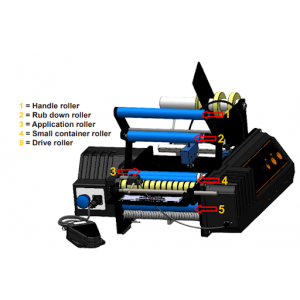
Correct setup of the labelling machine is essential. Below, you can see the BenchMax being adjusted for operation:
Importance of Expert System Configuration
Correct configuration of equipment, such as the BenchMARK and BenchMAX systems, requires:
- precision tension control
- accurate sensor calibration
- pressure pad adjustment
- roller alignment
- verification of material compatibility
These steps ensure repeatability and reliable performance.
Summary and Technical Recommendations
- Work with an experienced labelling specialist during selection and commissioning.
- Confirm compatibility between the machine design and all container dimensions and materials
- Perform routine calibration and mechanical inspections.
- Ensure appropriate label material selection to avoid common application issues.
A label is a critical component of product presentation and an extension of brand identity. Reliable equipment ensures consistent quality, operational efficiency, and long-term cost stability.
See more about:
If you require guidance in selecting labelling equipment, you can contact The Olive Centre on 07 4696 9845 or email sales@theolivecentre.com.au. Having details about your bottles or containers, as well as your label sizes and shapes, will help us assist you more effectively.
Overview of Great Engineering
Australian-made, Great Engineering labellers offer a suite of features that position them among the best in the industry. These pressure-sensitive labelling machines represent a new generation of “on-demand” equipment designed for cylindrical containers. They’re ideal for sectors such as food and beverage, pharmaceuticals, cosmetics, wine, essential oils, edible oils, brewing, contract packaging, health foods, and preserves — providing consistent product identification and strong shelf presence for any round container. With a global reputation for reliability and performance, their machines are now exported to 55 countries and are recognised for their innovative engineering and high manufacturing quality.
BRANDS: https://theolivecentre.com/brand/great-engineering-labelling-machines-benchmark-benchmate-olive-oil
About Polaris Automazioni
Polaris Automazioni has been active in the bottling sector since the 1960s, operating from its facility in Reggio nell’Emilia, Italy. Over time, the company has become highly specialised in developing and manufacturing automatic filling systems for unique and specialty bottles, a product line that has achieved strong success in markets worldwide.
The company now offers an extensive range of machines featuring advanced technology, high production efficiency, and patented engineering, enabling them to meet a wide variety of industry needs. Today, the Polaris team continues to uphold the technical heritage established by its founder, driving further growth through a blend of expertise, innovation, and forward-looking design.