My Account
Sign-in / Join

Sign-in

Hi My Account

Dashboard

Logout

Cart

My Shopping Cart

Subtotal
${{total.toFixed(2)}}
QUOTE

Viscount Plastics Square Pail 10L – Spacesaver Range (White)

Delivery will be calculated separately
Call for Price
Quantity

NASS10L
  • Description
  • Features
  • Enquiry
  • Specifications
  • Documents
  • Knowledge
  • Blog

Viscount Plastics Square Pail 10L – Spacesaver Range (White)

Shipping calculated separately at checkout

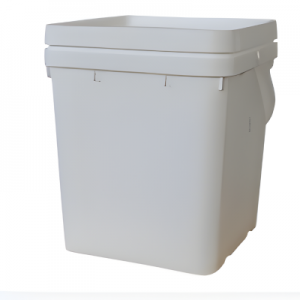
10 litre square polypropylene pail designed for hygienic, stackable storage of food, liquids and chemicals.

The Viscount Plastics Square 10 Litre Pail from the Spacesaver range is a compact, durable and highly efficient storage container designed for professional use across food processing, chemical handling and industrial applications. Its square profile maximises pallet density, storage efficiency and transport economy while maintaining excellent strength and hygiene standards. Manufactured under HACCP conditions, this pail is suitable for both hot and cold filling and offers reliable performance in regulated and demanding environments. The seamless polypropylene construction and integrated handle ensure safe handling and long service life.

Where this product is used

The Viscount Plastics 10L Square Pail is widely used in food production, olive processing, agriculture, engineering, chemical storage and manufacturing environments. It is ideal for applications requiring hygienic, secure and space-efficient storage of liquids or solids.

Viscount Plastics Square Pail 10L – Technical Specifications

Specification Details
Nominal capacity 10 litres
Capacity under lid 11.5 litres
Height 303 mm
Flange width 234 mm
Base width 195 mm
Nesting height 55 mm
Weight (pail incl. handle) 492 g
Material Polypropylene (PP)
Colour White
Filling suitability Hot and cold filling compatible
Manufacturing standard Manufactured under HACCP conditions


Why choose this product

The Viscount Plastics 10L Square Pail offers superior space efficiency, hygiene and durability compared to conventional round pails. Its square design delivers over 30% savings in warehousing and distribution efficiency, while the high-strength polypropylene construction ensures resistance to chemicals, impact and repeated handling. It is a reliable solution for professional environments requiring consistent quality and performance.

Frequently asked questions
Yes. The 10L Viscount Plastics Square Pail is manufactured under HACCP conditions and approved for a wide range of food applications.
The square profile allows more units per pallet and improved storage density, reducing warehousing and transport costs compared to round pails.
No. Lids are available separately, including tamper-evident and Flip-Lok™ lid options for the 10L size.
General main key features

• Square spacesaver design for maximum pallet and storage efficiency
• Food-contact suitable and manufactured under HACCP conditions
• Durable polypropylene construction with high chemical resistance
• Stackable design with reduced risk of leaks or deformation
• Compatible with tamper-evident and gasket lid options (sold separately)
  • :
  • :
  • :
  • :
  • :
  • :
  • :
  • :
  • :
  • :
File Title File Description Type Section
VP10L-20L-SQ-Spec-Sheet.pdf Viscount Plastics Square Pail 10L – Spacesaver Range (White) Viscount Plastics Square Pail 10L Specification Data Specifications Document

Research into olive oil Storage

Research into olive oil storage

In a world-first, Industry & Investment (I&I) NSW scientists are exploring how long olive oil can be confidently stored and still taste great. The Rural Industries Research and Development Corporation funded project aims to enhance the science which predicts the shelf life of olive oil.

I&I NSW principal research scientist Dr Rod Mailer said that although the tests to predict oil shelf life exist, this project is taking the chemistry a step further.
"We're already testing oil to authenticate that it is extra virgin olive oil, now we're looking at the factors which cause oil to oxidise and recording the reactions of a range of oils during the three-year project," said Dr Mailer.
"The chemical composition of each oil has been analysed and we are exposing them to light, temperature and oxygen all of which cause oxidation," he added.

Oxidation eventually produces offflavours and bad odours in oil and the aim of the project is to identify how to extend oil stability so that the fruity olive oil flavour lasts longer. Dr Mailer said that oils with high levels of polyphenols, which are antioxidants, and low levels of polyunsaturated fatty acids can last 18 months or two years.

"Some of these oils made from younger, early-harvest olives have a pungent, bitter flavour which is not popular with some consumers and while oils from older olives taste mellow they
may have a shorter shelf life," he said.

"The research is examining how to get the best of both worlds. We can take oil which is high in antioxidants with a stable fatty acid profile and blend it with less pungent, softer oil to produce a mellow, fruity-tasting oil with an increased shelf life," he added.

Crop management, olive variety and harvest techniques also impact on how long oil will last.

"The amount of water trees get during the growing season also affects shelf life water-stressed trees produce more polyphenols resulting in pungent, longer lasting oil," he concluded.

Source:
Food Australia
September, 2010
Page: 396
Section: General News
Region: National
Circulation: 2,883
Type: Not available
Size: 159.64 sq.cms.
Published: Monthly
Copyright Agency Ltd (CAL) licenced copy.

Assessing Alperujo Application for Soil Health – The Olive Centre

This article explores the direct use of alperujo - olive mill waste - as a soil amendment in olive groves. Backed by an 18-month study in Spain, it evaluates soil impact, carbon levels, and nutrient balance, highlighting the potential of this circular farming practice for small producers. Find out more about Olive Mill Waste.
Please log in to view the entire article

Secoiridoids Identified as Key to Improving Oxidative Stability and Extending Shelf Life o

Olive Oil Science Update

Secoiridoids Identified as Key to Improving Oxidative Stability and Extending Shelf Life of ‘Corbella’ Extra Virgin Olive Oil

In the pursuit of advancing olive oil quality, a groundbreaking development for the industry has emerged from a recent study that has illuminated how specific compounds — particularly secoiridoids — can substantially improve the oxidative stability and shelf life of ‘Corbella Extra Virgin Olive Oil (EVOO).

The collaborative Spanish study, carried out at an industrial mill, centered on assessing the influence of malaxation conditions and olive storage on the composition of ‘Corbella’ EVOO, offering insights with potentially transformative implications for the sector.

Extra Virgin Olive Oil is celebrated worldwide for its health-promoting properties and distinctive flavor, establishing itself as a culinary cornerstone across cultures. Nevertheless, its oxidative stability — a key factor in determining shelf life and overall quality — has long been the focus of intensive research. This latest investigation has presented compelling evidence that certain compounds play a decisive role in reinforcing EVOO’s stability.

The principal compounds examined included phenolic compounds, tocopherols, carotenoids, squalene, and fatty acids, all of which are fundamental to the oil’s composition. The findings revealed that extended malaxation at higher temperatures, together with olive storage, negatively affected compounds such as α-tocopherol, squalene, flavonoids, lignans, phenolic acids, and phenolic alcohols. However, paradoxically, both the antioxidant capacity and oxidative stability of the oil improved under these conditions. This enhancement was attributed to a marked increase in the concentration of two secoiridoids: oleacein (56–71%) and oleocanthal (42–67%).

Oleacein and oleocanthal are widely recognized for their potent antioxidant activity, and this study has underscored their critical contribution to reinforcing EVOO’s stability and extending its shelf life. In addition, the research identified a synergistic interaction between secoiridoids and carotenoids, further highlighting their collective role in enhancing the resilience and longevity of EVOO.


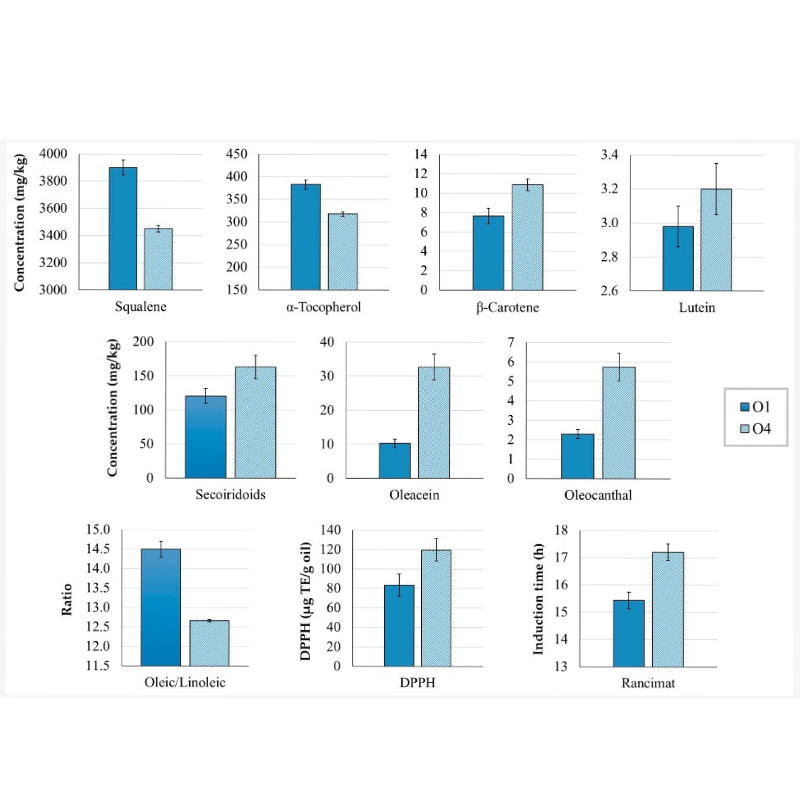
Figure 1.

Concentrations (mg/kg oil) of squalene, α-tocopherol, β-carotene, lutein, secoiridoids, oleacein, and oleocanthal in ‘Corbella’ Extra Virgin Olive Oil (EVOO) samples O1 and O4, along with the oleic/linoleic ratio, antioxidant capacity (DPPH, µg TE/g oil), and oxidative stability (Rancimat induction time, h). Sample O1 was produced on the day of harvest, while O4 was produced the following day using stored olives. Both EVOOs were malaxed at 18 °C for 30 minutes. Data are presented as mean ± standard deviation (n = 9). All parameters showed significant differences (p < 0.05) between samples.

One of the most notable discoveries was the ‘Corbella’ cultivar’s ability to yield EVOOs with a favorable oleic/linoleic ratio. The research indicated that storing olives overnight at ambient temperature, followed by malaxation at no less than 23 °C for 40–50 minutes (depending on the precise temperature), could substantially elevate the concentrations of oleacein and oleocanthal. This increase, in turn, contributed to a measurable improvement in the oxidative stability of EVOOs.

These findings represent a significant advancement in efforts to address and enhance EVOO stability, offering practical applications for producers aiming to extend shelf life while safeguarding quality.

The study also highlighted several promising avenues for future research. Key areas of interest include identifying strategies to further elevate oleacein and oleocanthal levels through agronomic and climatic variables, fruit maturity, and technological aspects of oil extraction.

Moreover, the evaluation of EVOO quality and stability over long-term storage, together with interventional studies assessing the direct influence of these secoiridoids on both product longevity and human health, remains a critical area requiring deeper exploration.

In summary, the research underscores the pivotal role of secoiridoids — particularly oleacein and oleocanthal — in enhancing oxidative stability and extending the shelf life of ‘Corbella’ EVOO. These insights hold dual significance: they offer tangible benefits for producers while also presenting potential health advantages for consumers, marking a milestone in the olive oil industry’s ongoing pursuit of excellence.

Research conducted by Alexandra Olmo-Cunillera 1,2ORCID,Maria Pérez 1,2ORCID,Anallely López-Yerena 1ORCID,Mohamed M. Abuhabib 1ORCID,Antònia Ninot 3ORCID,Agustí Romero-Aroca 3ORCID,Anna Vallverdú-Queralt 1,2ORCID andRosa Maria Lamuela-Raventós

  • 1,2, ORCID
  • 1  Polyphenol Research Group, Department of Nutrition, Food Science and Gastronomy, Catalonia Food Innovation Network (XIA), Faculty of Pharmacy and Food Sciences, Institute of Nutrition and Food Safety (INSA-UB), University of Barcelona, 08028 Barcelona, Spain
  • 2  CIBER Physiopathology of Obesity and Nutrition (CIBEROBN), Instituto de Salud Carlos III, 28029 Madrid, Spain
  • 3  Institute of Agrifood Research and Technology (IRTA), Fruit Science Program, Olive Growing and Oil Technology Research Team, 43120 Constantí, Spain
Read the Full Study: https://doi.org/10.3390/antiox12091776

About Secoiridoids

Secoiridoids exhibit a wide range of pharmacological properties, including anti-diabetic, antioxidant, anti-inflammatory, immunosuppressive, neuroprotective, anti-cancer, and anti-obesity effects. These diverse biological activities have significantly heightened scientific interest in the in-depth study of these bioactive compounds.

Australian Olive Growers Face Lower Yields After Unseasonal Weather

INDUSTRY UPDATE: AUSTRALIAN OLIVE GROWERS 2023 SEASON

Australian Olive Growers Face Lower Yields After Unseasonal Weather

   
The Australian olive industry has faced a tough growing season, with unpredictable weather conditions significantly influencing the 2023 olive harvest. Prolonged periods of unseasonably cold and wet weather shortened the growing cycle, slowed fruit ripening, and delayed harvest schedules, according to David Valmorbida, President of the Australian Olive Oil Association (AOOA). 

“Earlier in the season, the industry was anticipating an excellent harvest,” Mr Valmorbida said. “However, persistent cold weather and rainfall during May and June, particularly across south-east Australia, have taken their toll.”

Although the Australian olive harvest is not officially recorded each year, the AOOA estimates that the 2023 season will produce between 18 and 19 million litres of olive oil from roughly 110,000 to 120,000 tonnes of olives.

This compares with last year’s output of 14–15 million litres and the record-breaking 2021 crop, which yielded 20–22 million litres of oil.

Mr Valmorbida explained that these fluctuations reflect the biennial cycle of olive production. “This is what we call an ‘on’ year for olives. While we were expecting an excellent yield earlier in the year, harvest results always depend heavily on weather conditions, and this season has been quite mixed for many growers.”

“The oil yield per tonne is noticeably lower than average due to the cooler growing period,” he added, “but the quality of the oil remains excellent because the fruit had more time to ripen gradually.”

Around the world, olive oil prices have reached record highs in Spain, Italy, and Greece, driven by a severe global shortage of olive oil. Hot temperatures, minimal rainfall during key stages of the growing season, and extended drought conditions across southern Spain have drastically reduced European output. In addition, the ongoing conflict in Ukraine has disrupted the production of vegetable and seed oils, increasing global demand for olive oil as an alternative.

In Australia, growers are currently achieving $6–$7 per litre for larger commercial volumes of olive oil, with even higher prices for export batches, premium small-lot oils, and organic extra virgin olive oil.

“With this global shortage, some of the larger Australian producers are in a strong position to export olive oil to Europe and receive competitive returns,” Mr Valmorbida said.

“While that’s encouraging news for the Australian olive oil industry, globally the sector is under pressure,” he continued. “There’s currently a 35–40 percent shortfall in available products, combined with escalating packaging costs, especially for glass and tin materials.”

“These factors, along with rising labour and energy expenses, are leading to higher retail prices for consumers,” he noted.

Mr Valmorbida concluded with a reminder to consumers: “It’s important to remember there’s no product quite like olive oil—its distinctive flavour, health benefits, and culinary versatility make it irreplaceable.”

#oliveharvest2024 #harvest2024

About the Australian Olive Oil Association

The Australian Olive Oil Association (AOOA) is a not-for-profit, independent organisation dedicated to promoting the quality, integrity, and fair trade of olive oil in Australia. Membership is open to olive oil producers, distributors, industry stakeholders, and related organisations.

Since 1993, AOOA has been a signatory to the International Olive Council (IOC) global quality control program. Each year, the Association coordinates independent laboratory testing of leading olive oil brands to ensure compliance with IOC standards.

In addition, the AOOA Certified Quality Seal Program upholds even stricter quality criteria, allowing AOOA-member products to distinguish themselves in both domestic and international markets.


For more information: 

Jan Jacklin, General Manager, Australian Olive Oil Association gm@aooa.com.au www.aooa.com.au

Photo credit:  Julia, olive grove – Kyneton Olives” by avlxyz is licensed under CC BY-SA 2.0. To view a copy of this license, visithttps://creativecommons.org/licenses/by-sa/2.0/?ref=openverse

GROWING OLIVES: Research confirms importance of right Olive Oil Storage

When it comes to oil storage you need to consider the impacts on quality in relation to the proposed storage to be used.

This article is about some of the latest research as funded by RIRDC to determine the best storage for your oil.

Remember just because a manufacturer states the container(s) are food-grade doesn't necessarily means they are safe to use for olive oil. ?(All the containers used in this study were regarded as "Food Grade").

Here is a excerpt from the article:

For example, sometimes growers produce oil with very high quality initially, which quickly deteriorates due to the conditions under which it is stored,? he said.

The olive oil can deteriorate so much that it can no longer be classified as extra virgin olive oil, at a huge expense to the growers.

The changes in oil quality described in this report will encourage producers, as well as others in the supply chain of olive oil, to consider the facilities used to store olive oil in order to maintain the high-quality olive oil Australia is increasingly renowned for producing.

Read the article here....?Storing olive oil - Local News - News - General - Town and Country Magazine.