Introducing the F3020 Electrocoup Electric Pruner - 36V & 48V models
PRODUCT INNOVATION
The F3020 Electrocoup Electric Pruner
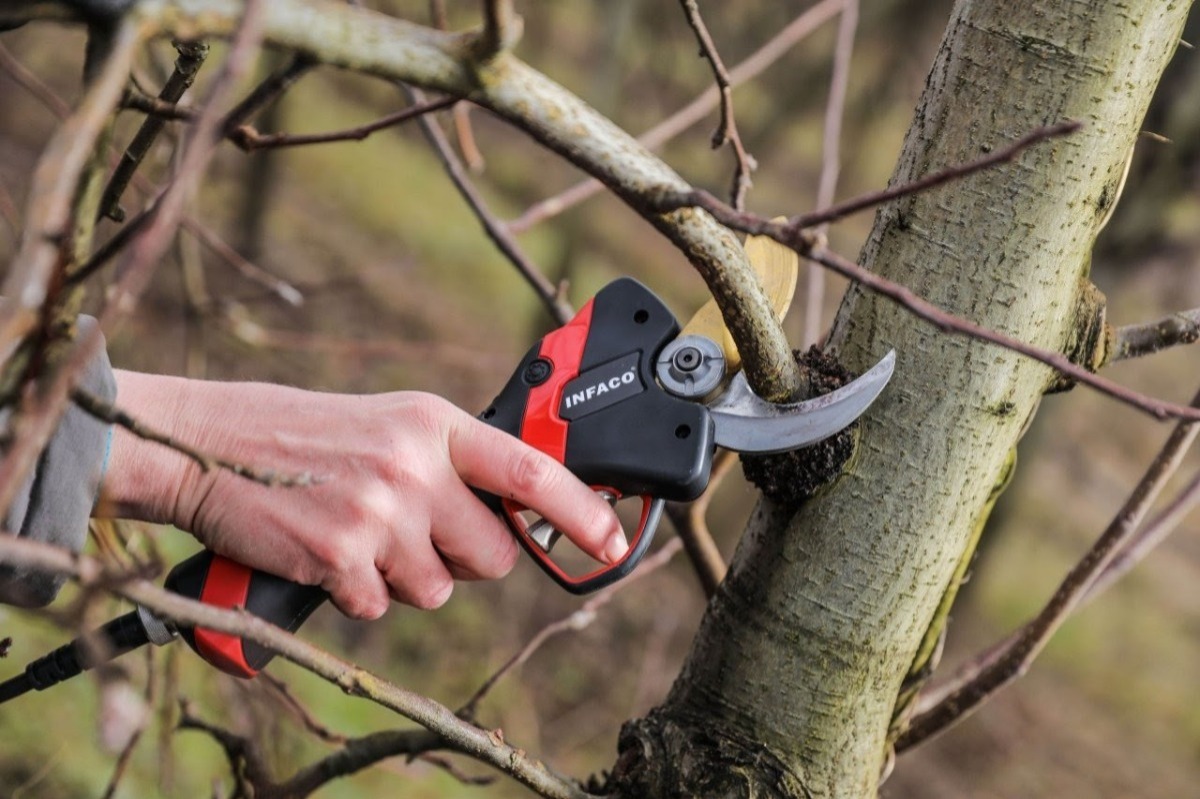
INFACO is proud to present the latest, most technologically advanced electric shears on the market.
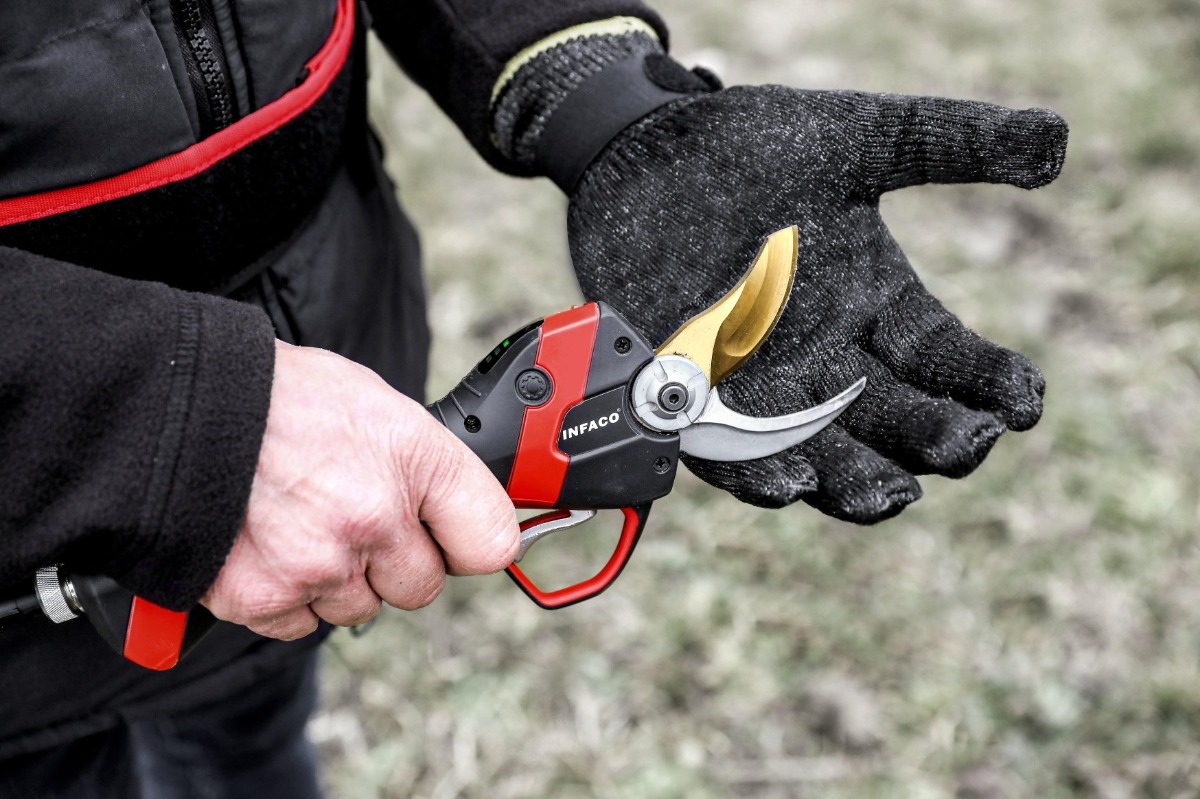
The Electrocoup F3020 offers a technologically advanced secateur packed with a multitude of features.
The F3020 Electrocoup weighs less and is more compact which offers improved efficiency and faster-cutting speed, making the new generation F3020 a total advancement in features. The separate battery and shear design ensures the handpiece has minimal weight maximising ergonomics, reducing fatigue, and providing a streamlined efficient day of pruning.
____________________________________________________________________
New & Improved Features
- Ergonomic Design - Easy To Handle
- Compact - Decrease In Length By 10mm
- Lightweight
-
Increased Speed
- Increased Power
- Lightweight Battery
-
Technological and Connected
- Upcoming Bluetooth Capability With Efficiency Reporting
- Wireless DSES Included Standard
- New Shear Holder
____________________________________________________________________
Video Overview - New & Improved F3020 & PW3
- 0:33 Safety System DSES
- 0:59 Adjustable Blade Opening
- 1:40 Deactivatable DSES
- 1:44 New Setting Button
- 1:51 New Soft Mode
- 2:00 Extreme Blade Control
- 2:18 Medium Blade
- 2:51 Maxi Blade for High Cutting Capacity
- 3:13 Extension Pole for F3020 Electrocoup (optional)
- 3:32 Bluetooth Wireless Control
- 3:58 Battery Charging
- 4:10 PW3 Powercoup Range
- 4:13 Chainsaw Head
- 4:26 Reciprocating Saw Head
- 5:03 Desuckering Head
- 5:09 Hedge Trimmer Head
- 5:15 Sweeper Head
- 5:19 Weeder Head
- 5:24 Rotary Weeder Head
- 5:27 Hoeing Machine Head
- 5:37 Olive Alternating Harvesting Head
____________________________________________________________________
Improved Design
- The new Electrocoup F3020 weighs only 708g, which is around 100g less than the F3015.
- The length of the unit has decreased by 10mm.
- There is a significant increase in power and speed by 20% & 15% respectively.
Technologically Advanced
The Electrocoup F3020 pruners are now fitted with some of the most hi-tech and powerful microcontrollers in the market that are used in mobile phones and computer technology. This technology results in improved user function and innovation enabling more data to be compiled and analyzed by the pruning shear to improve the F3020 performance.
Standard Mode
Progressive Blade Advance at Full Speed (+15% vs F3015)
The Standard mode is for experienced users and for those who are willing to take full advantage of the tool's increased cutting speed capabilities.
____________________________________________________________________
NEW Soft Mode
Progressive Blade Advance is at a slightly reduced speed
The Soft Mode is for users who prefer a slower cutting speed or beginners who are new to the trade. Same speed as the previous model F3015. (refer to the video to see soft mode in operation).
Electronic Blade Adjustment
Half Aperture Setting
10 Easily programmable half aperture settings for ideal half open postion.
____________________________________________________________________
Blade Overlap Setting
10 Easily programmable blade overlap positions for ideal blade crossing.
The new patented shear holder provides the cutting head protection and storage in just two actions.
Available for Standard and Medium heads.
** Fitted with Quick Lock-Unlock
Removable Accessory Holder
The removable accessory holder is included with your F3020 kit and allows you to store your smartphone within hands-reach.
A large zipped central pocket guarantees safe storage of sharpening stone, burnishing tools etc.
Cobalt L100B Li-Ion Battery
The Electrocoup F3020's new Cobalt L100B Lithium-ion battery weighs just 698 grams compared to 810 grams from the F3015. Its voltage is now 36 Volts as compared to the 48 Volts*** on the old F3015 model. However, the 48v battery from previous units is compatible with the new F3020. We can offer an optional 48v battery if you would like to make your previous units cross-compatible.
Its sleek design and small footprint will give you a day of pruning without recharging. With its versatile carrying system, the F3020 battery can be easily slipped into the user's pocket or clipped to a belt, giving the user an effortless pruning experience.
Electrocoup Battery Specifications
- Lithium 107 Wh Battery
- Weight 698g
- Full-Day Complete Autonomy
- Battery with Built-in Electronic Management System (BMS) and Cell Protection
- High Capacity Lithium Cells
- "High Power" type and "Long Life" Intelligent Cells
- 5 Year Warranty on a Pro-Rata basis
36V Cobalt Battery
- Battery Weight: 698g
- Weight Of Cable: 122g
- Right Hand/Left Hand Adaptable: Yes
- Battery Average Autonomy: Up To 8 hours Depending On Use
- Complete Charging Time: 2 hours
- Battery Average Voltage: 36V
- Charger Feed Voltage: 230V, 50Hz
- Sleep Mode Function: Yes
- Powercoup Range Battery Compatible: No
48V Lithium Cobalt Battery
- Battery Weight: 810g
- Weight Of Cable: 150g
- Right Hand/Left Hand Adaptable: Yes
- Battery Average Autonomy: up to 9 hours depending on use
- Complete Charging Time: 1.5 hours
- Battery Average Voltage: 48V
- Charger Feed Voltage: 230v, 50Hz
- Sleep Mode Function: Yes
- Powercoup Range Battery Compatible: Yes
***NEED 48V: The Olive Centre can provide a 48v Battery as standard instead of the 36v battery if purchasing a new set. If you have other Infaco tools we can offer the 48v to ensure there is no disruption with your other tools. This ensures seamless changeover to the new generation F3020

Battery used with Shoulder Straps and Waist Belt

Battery Used with Waistbelt Only

Battery Clipped on to Trousers
F3020 Automatic Smart Charger 36V
How long does it take to charge the battery?
The new F3020 Chargers are designed to charge the battery up in 2hrs. Similar to its predecessor, the new charger enables the battery to be charged up to 90% in 1.5Hrs and full charge is achieved in 2Hrs.
Can the battery remain on the vest while charging?
The new connector plug allows for the battery to charged up while on the vest making it more practical and easier to use.
How does the Battery Sleep Mode work?
The "Sleep Function" on the charger helps the battery fall in to an extended storage state thus optimizing its storage life. Recharging the battery is no longer required during the off-season. Just press the sleep button once after the pruning season and it does its thing for the next few hours. Once the sleep process is complete, the battery can be stored in its case in a cool, dry place until the following season.
Wireless DSES Is Now A Standard Feature
Infaco, the manufacturers of the Electrocoups, have always prioritized user safety over the years. A true pioneer in technology, the company has continually invested time and resources in order to ensure an innovative and safe experience for its users operating the Electrocoups. Today, the all-new Electrocoup F3020 come fitted with the wireless DSES system and is a standard feature on all units.
The Wireless DSES system comprises of a conductive metal trigger enabling a connection between the users body and the pruner's patented electronic system. While operating, if and when the cutting head touches any part of the opposite hand, the pruning shear blade opens instantly thereby preventing accidents.
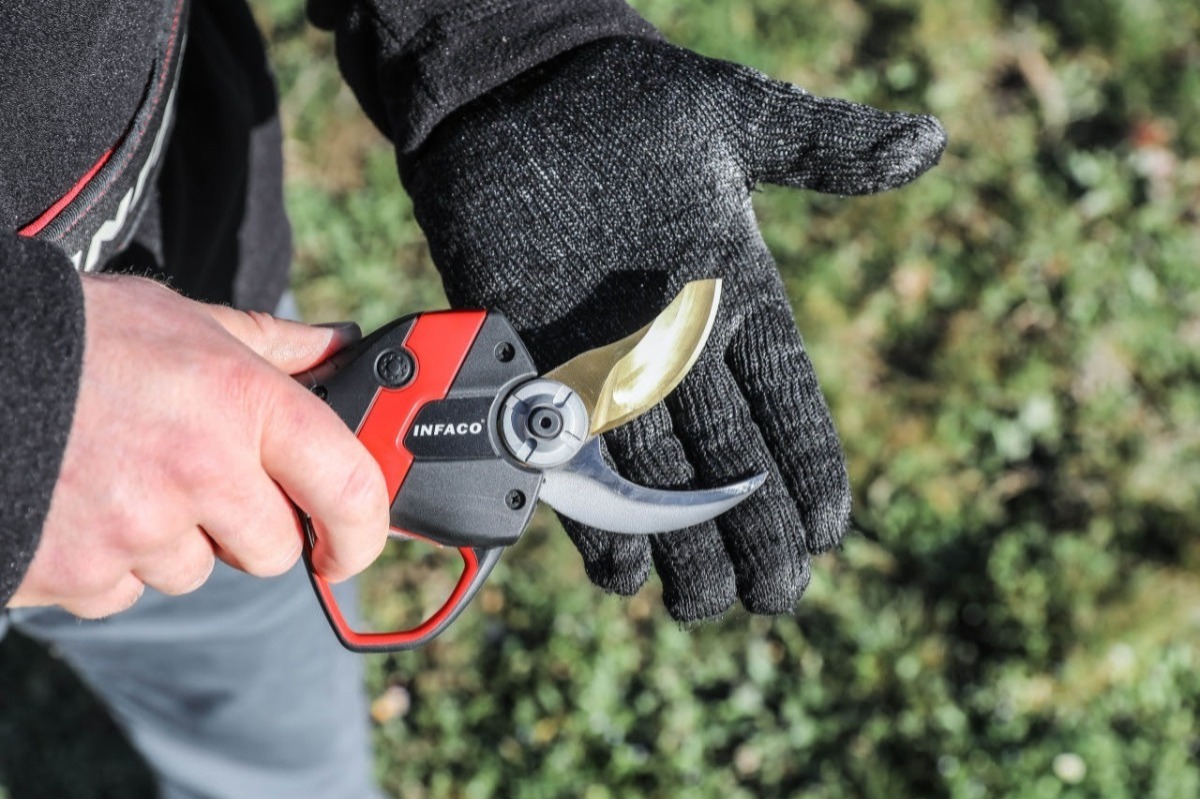
The Wireless DSES system operates in direct contact with the skin. However, each individual has their own level of conductivity. In order achieve a continuous level of high conductivity and better protection, INFACO recommends the use of its special conductive gloves.
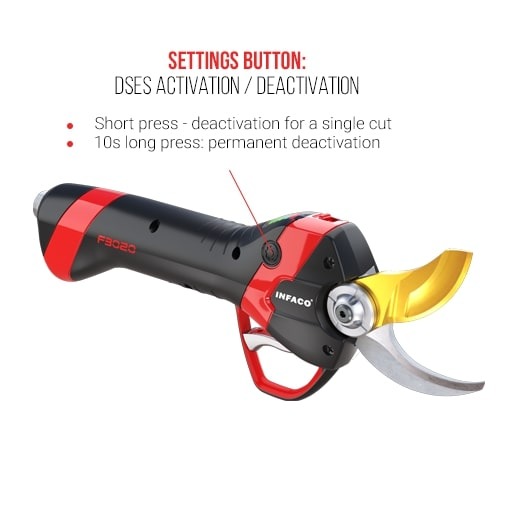
The Wireless DSES system may sometime trigger unintended opens on damp wood, sappy wood or when close to the ground. To prevent this from happening users now have the option of turning OFF & ON the DSES feature when required using the settings button.
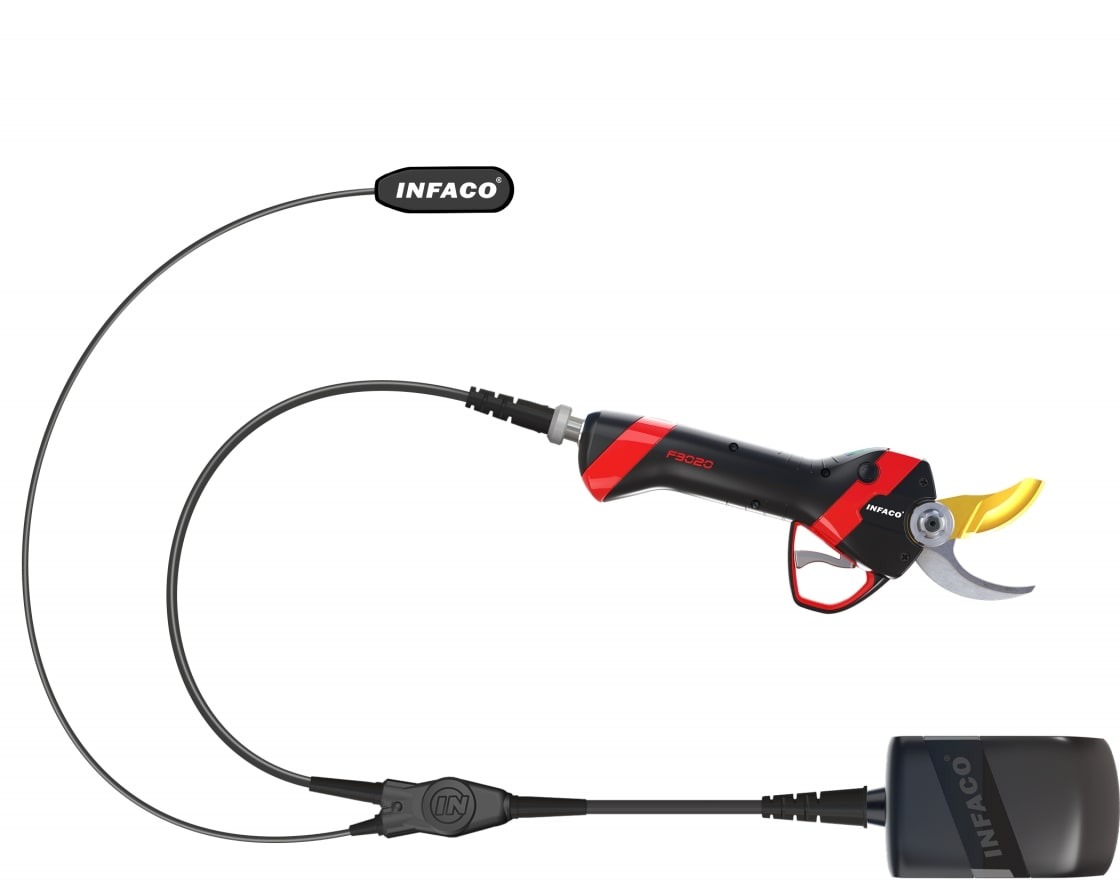
Contrary to the wireless system, the wired DSES option requires the user to wear the conductive glove that is physically connected to the handpiece by a power supply cable. The wired DSES system provides the user the same protection while reducing unintentional opening of the blade because of damp or sappy wood.
More information about DSES
Optional Interchangeable Kits : 3 TOOLS IN 1
Similar to its most recent predecessors, Electrocoups remain the only shears in the world with 3 interchangeable heads with adjustable blade opening and DSES safety systems. One of the tool's main assets is its versatility to use multiple cutting heads. With the options of the Standard Kit, Medium Kit or the Maxi Kit, users can easily swap the heads over in under 5 mins to meet the demands of the cutting application. Kits are optional and not part of the standard kit. Please ask for details.
40mm
Standard Kit
Ideal for pruning grapevines and orchard pruning. This kit achieves the highest results for cutting rate and power.
45mm
Medium Kit
Designed especially for fruit growers, forestry, and landscaping. This kit offers a higher cutting capacity while maintaining speed for relevant applications.
55mm
Maxi Kit
Perfect for cutting back vines, shaping fruit trees, and tree lopping. This kit with a single-piece blade-rack combo will give unrivaled cutting capacity.
More About Head Kits F3020
Optional Extension Poles For F3020
Infaco's design engineers have completely revolutionized the pole system by creating an ergonomic and innovative solution. There are 2 different kinds of pole options available with this new model. First option is the pole can be connected to the battery through a cord and the second option is the battery can be plugged in at the bottom of the pole. Both options have the cord on the sliding handle eliminated and replaced by a more advanced wireless Bluetooth technology making it easy and convenient to use.
Pole size options in the image to right.
____________________________________________________________________

Extension Pole with Wired Battery Connection

Extension Pole with Plug In Battery
*** Battery not included with Pole
____________________________________________________________________
More About F3020 Extension Pole Functionality
A48V3 Electric Sharpener
Regular blade sharpening reduces the cutting force exerted on the motor of the Electrocoup and also helps to reduce motor stress. Infaco recommends the use of the optional electric sharpener to help keep the blade profile sharp. Thanks to its 3-pin connector plug, the A48V3 electric sharpener is now compatible with the Electrocoup F3005, F3010, F3015, and F3020 batteries. It saves significant time on daily sharpening and maintains a good cutting profile on the blade.
See video at 1:02 for the A48V3 Electric Sharpener in action.
Carbide Burnisher
The new tungsten carbide burnisher helps maintain a good cutting edge on the blade. A sharp blade guarantees a good clean cut and reduces the risk of spreading wood diseases. In addition to 2 recommended daily sharpening sessions with the stone, it is also advised to use the new Carbide Burnisher to maintain a sharp edge on the blade for a good clean cut.
Bluetooth Control Box
With latest innovations in wireless connectivity, the Electrocoup F3020 pruning shears can be connected to the newly designed INFACO mobile app (available exclusively on Android and iOS compatible smartphones) through the Bluetooth Control Box.
The app provides a wide array of features that assists Electrocoup users in day to day operations:
- Setting up pruning shears - Adjust blade opening, blade bypass, choose operation modes (STANDARD or SOFT)
- View user statistics - Use time, number of cuts
- Manage pruning progress of the block via geolocated use points through the smartphone
The app also allows users (without the Bluetooth Control Box)
- View purchase history and guarantee status
- Access to service, troubleshooting, tips and video tutorials
- Option to take notes on the app that can be doubled as reminders
Information on pruning progress can also be managed on the computer with more detailed features.
What's In The Box As Standard
- F3020 Electrocoup Secateur
- 36V Battery Or 48V Battery
- Cable For Battery
- Charger (36 or 48V model) With Power Cord
- Battery Vest
- Secateur Sheath or Pouch
- Accessory Holder & Wristband
- Spare Blade
- Torque Tightening Tool
- Sharpening Stone
- Manual For Operation And Care
- Greasing Tool
- Spare Parts
- Glove (to fit the correct glove, please provide whether you need LH or RH and measurement from crease of your wrist to tip of your middle finger)
- Carry Storage Box For Whole Kit