My Account
Sign-in / Join

Sign-in

Hi My Account

Dashboard

Logout

Cart

My Shopping Cart

Subtotal
${{total.toFixed(2)}}
QUOTE

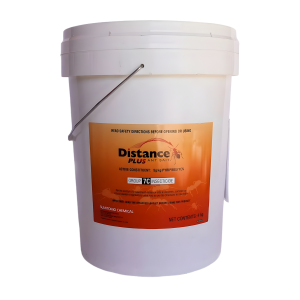
Ant Bait Distance Plus 4kg

Professional ant management for sensitive sites, horticulture, and agriculture.
Bulk Discounts Prices
Quantity Price
1 $367.50
Quantity

EADISTP
  • Description
  • Features
  • Enquiry
  • Specifications
  • Documents
  • Knowledge
  • Blog

Distance Plus Ant Bait | The Olive Centre – Intelligent Colony Control

Professional ant management for sensitive sites, horticulture, and agriculture.

Ant Bait Control in Olives and Crop applications with Distance PLUS by Sumitomo Chemical


Distance Plus Ant Bait is an advanced insect growth regulator (IGR) formulated to deliver long-lasting control of invasive and nuisance ants, including fire ants, big-headed ants, and black ants.
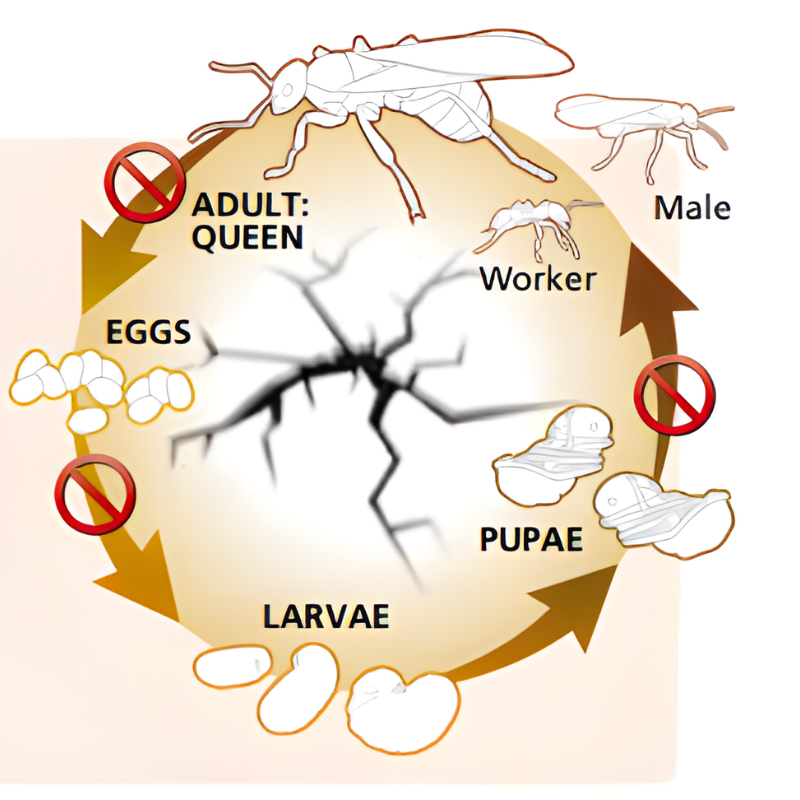
Unlike traditional contact insecticides, it works through intelligent colony control — targeting the queen to stop egg production. Foraging ants carry the bait back to the nest, ensuring complete colony elimination.
Containing 5 g/kg Pyriproxyfen (Group 7C Insecticide), this product combines outstanding performance with one of the safest profiles available, making it ideal for use in sensitive areas such as schools, parks, sports fields, horticultural zones, and around livestock.

Distance plus does not need to be eaten to be effective and unlike other baits, prevents a new generation of ants replacing the old.

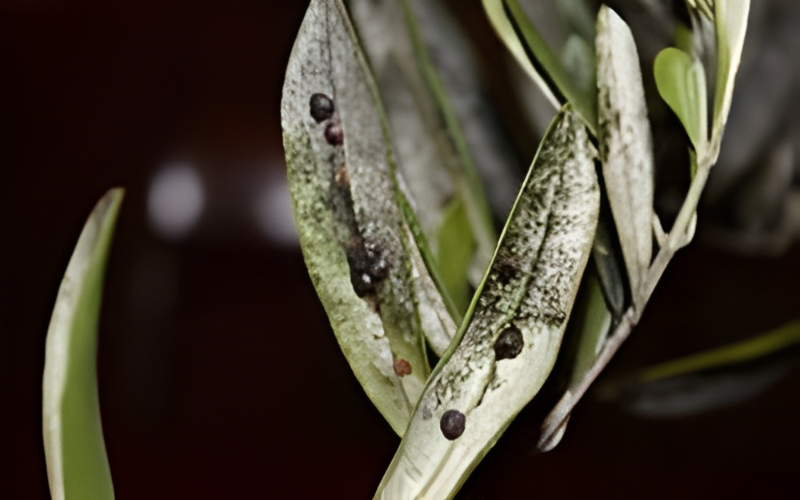
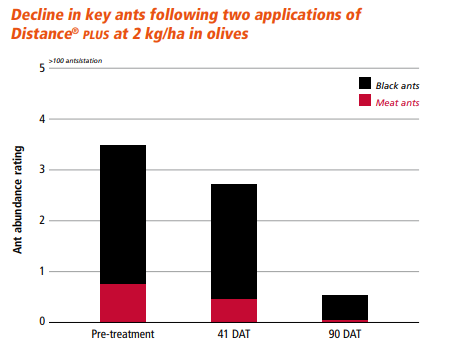
Olives is a crop where ants feature greatly in the population dynamics of a key pest the blackscale (Saissetia oleae). Natural control agents include coccinellid lady beetles, lacewings and parasitic wasps. Ants interfere with their ability to control populations of black scale but tending and protecting the scale in return for honeydew reward.In trials in western Victoria, Distance® PLUS Ant Bait has been very effective in reducing the populations of scale tending ants, mostly meatants (Iridomyrmex purpureus) and black ants (Iridomyrmex rufoniger andothers). These ants aggressively tend and protect black scale and reduce the effectiveness of natural predators such as coccinellid and lacewing larvae and parasitoid wasps. The use of Distance® PLUS Ant Bait as part of the program to reduce sap-sucking insects such as black scale in olives,fits very nicely with the IPM approach increasingly being adopted by Australian farmers.

Has been used effectively in the control of Fire ants and African bigheaded ant (aka coastal brown ant). It has also been tested on a wide range of others species including those normally less attracted to typical corn and oil-based baits.
 
Distance plus is the only product available in an IGR that can be used in Olives and Agricultural applications (as at August 2013).
 

Ant-homopteran Mutualism

Another important but often overlooked consequence of ants in crops is their protection of sap-sucking insects in return for honeydew reward, otherwise known as mutualism.
 

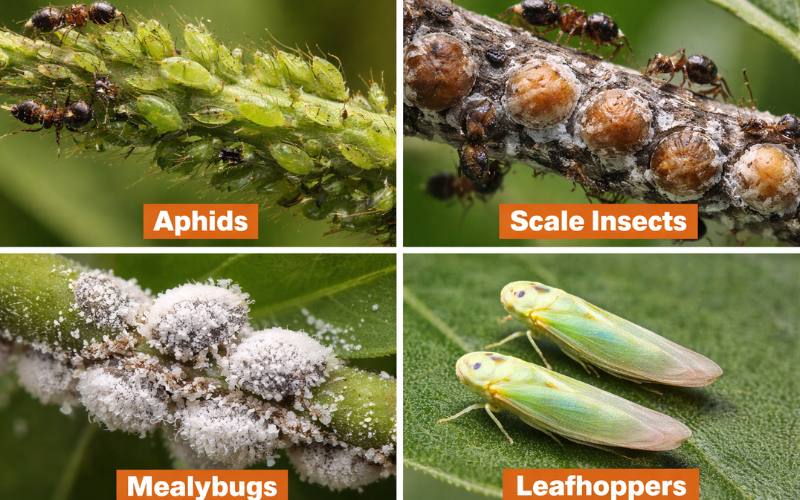
A wide variety of ants seek the honeydew produced by aphids, scale, mealybugs and leafhoppers, and in exchange, protect these pests from their natural enemies.

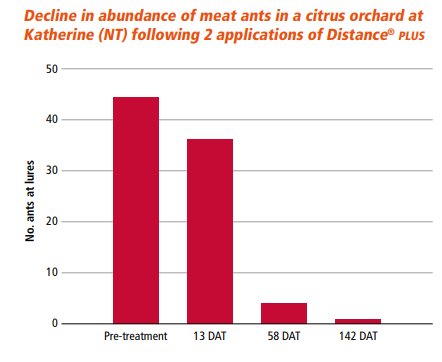
Proliferation of these pests also promotes sooty mould on the crop.  There have been a large number of studies worldwide showing the benefits of excluding ants from crops and the resulting reduction in pest populations resulting from increased numbers of beneficial insects and easier access to their sap-sucking prey. For instance, Australian researchers have shown that by physically excluding ants from citrus canopies they can dramatically reduce the number of live soft scale (Coccus hesperidum).

Baiting is an effective option to reduce ant abundance in canopies.   Olives is another crop where ants feature greatly in the population dynamics of a key pest, the black scale (Saissetia oleae). Natural control agents include coccinellid lady beetles, lacewings and parasitic wasps. Ants interfere with their ability to control populations of black scale but tending and protecting the scale in return for honeydew reward.

To find out more information, please click the below links or order online now! PACKED AS Drum - 29cm (H) x 31cm x 31cm
4.2kgs

Delivery not included

Uses
  • Effective for broad-spectrum ant control in domestic, agricultural, and environmental settings
  • Designed for use in sensitive areas where traditional baits are unsuitable
  • Ideal for horticultural and cropping systems, including olives, citrus, tropical fruit, and nuts
  • Suitable for parks, golf courses, walkways, lawns, national parks, and reserves
  • Safe for application around livestock (cattle, sheep, pigs, and horses)
Technical Specifications

 
Specification Details
Product Name Distance Plus Ant Bait
Active Constituent 5 g/kg Pyriproxyfen (Group 7C Insecticide)
Formulation Granular bait (ready-to-use)
Mode of Action Insect growth regulator – prevents queen from laying eggs
Target Pests Red imported fire ant, tropical fire ant, big-headed/coastal brown ant, yellow crazy ant, black ants, Singapore ants, green-headed (pony) ants, meat ants, tyrant ants, sugar ants, long-legged ants, and pennant ants
Application Rate 2–4 kg per hectare or 2–4 g per 10 m²
Application Timing Early Spring or Summer, at the first sign of ant activity
Coverage Effective control over large areas; repeat applications as needed
Suitable For Domestic, public service, commercial, industrial, cropping, and environmental areas
Safety Classification Unscheduled poison – low toxicity to vertebrates
Manufacturer Sumitomo Chemical Co. Limited, Japan

Situations & Application Areas 
 
  • Domestic, Commercial, and Public Service Areas
Parks, sports grounds, golf courses, lawns, gardens, paths, and walkways.
  • Cropping Areas
Olive plantations, citrus orchards, tropical fruit, nuts, herbs, vegetables, pastures, and managed forests.
  • Environmental Management Areas
National parks, reserves, and ecological zones where invasive ants threaten biodiversity.

Application Notes
  • Apply early in the season when ants are actively foraging.
  • Do not exceed three applications per year and allow at least three months between treatments.
  • Avoid direct exposure to land crabs or other terrestrial arthropods.
  • Vegetables: apply only to inter-row areas, not directly to crops.
  • Poultry: do not use in active grazing areas; apply only where birds cannot access bait (e.g. under raised cages).
  • Use lower rates for light infestations and higher rates for dense or northern infestations.
Why Choose Distance Plus Ant Bait
  • Proven colony-level control, targeting the queen for permanent results
  • Ideal for sensitive areas — schools, parks, or near livestock
  • Endorsed by Government ant-control programs across Australia
  • Safe, sustainable, and effective alternative to traditional insecticides
  • Trusted Sumitomo Chemical innovation, combining science and environmental care
Frequently Asked Questions


 
Key Features
  • Targets the queen for full colony elimination – no eggs, no ants, no problem
  • Unique insect growth regulator (IGR) mode of action using Pyriproxyfen
  • Long-term control by preventing reproduction rather than killing on contact
  • Broad-spectrum performance across multiple invasive and nuisance ant species
  • Granular formulation allows easy and discrete spreader application
  • Safe for use in sensitive environments – schools, parks, public grounds, and crops
  • No impact on vertebrates and minimal risk to non-target species
  • Unscheduled poison classification for greater operator and environmental safety
  • Trusted by Government programs in Australia for red imported fire ant and yellow crazy ant control
  • :
  • :
  • :
  • :
  • :
  • :
  • :
  • :
  • :
  • :
  • :
File Title File Description Type Section
distance_plus_ant_bait_sds_202105.pdf Distance Plus Ant Bait SAFETY DATA SHEET Diagrams Document
distance_plus_label.pdf Distance Plus Distance Plus Label Catalogue Document
Distance-Plus-Brochure_1.pdf Distance Plus Distance Plus Brochure Brochures Document

Herbicide Use in Olive Groves from Managing the Risk to Pollination and Yields

Herbicides are a crucial tool in modern agriculture, but recent research highlights an unintended consequence that olive producers must consider—potential harm to pollination. A study by Dummer et al. (2025) has identified that common herbicides, including glyphosate and 2,4-D, significantly impair olive pollen germination, raising serious concerns about their impact on fruit set and overall yield.
Please log in to view the entire article

A Strategic Path for Pest Management in Australian Olives

In March 2025, Hort Innovation released the updated Strategic Agrichemical Review Process (SARP) for the Australian olive industry, a comprehensive review designed to ensure sustainable, effective, and trade-compliant pest management for olive growers nationwide.
Please log in to view the entire article
olive-sarp-2025-final%20%281%29.pdf

Toro Waterbird Sprinklers Discontinued: What It Means for Olive Growers

Toro has discontinued its Waterbird irrigation sprinklers, prompting olive growers to reassess under-tree irrigation systems and consider modern alternatives including micro-sprinklers and drip irrigation. What are the alternatives?
Please log in to view the entire article

Ant Bait Control in Olives and Agricultural Crops


IPDM SOLUTION

Ant Bait Control in Olives and Agricultural Crops

Using Distance® PLUS Ant Bait (Pyriproxyfen – IGR Technology)


Effective ant management plays an important role in Integrated Pest and Disease Management (IPDM) programs in olives and other agricultural crops. While ants do not directly damage olive trees, they significantly disrupt biological control systems - particularly in groves affected by black scale (Saissetia oleae).

Distance® PLUS Ant Bait contains pyriproxyfen, an Insect Growth Regulator (IGR) that acts as a juvenile hormone mimic. Rather than killing ants immediately, it interferes with their life cycle by:

  • Preventing queens from producing viable offspring
  • Disrupting egg hatch
  • Preventing larvae from developing into reproductive adults
This results in a gradual decline in worker numbers and ultimately colony collapse. Because of its unique mode of action, control is progressive but long-lasting. 

Unlike conventional contact insecticides, pyriproxyfen does not rely solely on acute toxicity. It suppresses the next generation, preventing colonies from recovering and reducing long-term reinfestation pressure.

Why Ant Control Matters in Olive Production

In Australian olive groves, ants play a critical role in the population dynamics of black scale (Saissetia oleae) — one of the most widespread insect pests of olives


Black scale produces honeydew, which attracts ants. In return for this food source, ants: 

This mutualistic relationship can significantly reduce the effectiveness of biological control programs described in the Australian Olive Field Guide 

In western Victorian trials and other production regions, Distance® PLUS has demonstrated strong suppression of scale-tending ants, including:

     
Reducing ant activity improves access for natural enemies and supports an IPDM approach that minimises broad-spectrum insecticide use.

Ant–Homopteran Mutualism in Crops

The ant–honeydew pest relationship is not unique to olives. Across many crops, ants protect sap-sucking insects such as:


  • Aphids: Aphids are small, soft-bodied sap-sucking insects belonging to the superfamily Aphidoidea. They are commonly known as greenfly or blackfly and are found worldwide, particularly in temperate regions. Aphids feed by inserting their specialised mouthparts into plant tissues to extract phloem sap, which can weaken plants, distort new growth, and reduce crop productivity. Many species reproduce rapidly, often through parthenogenesis (asexual reproduction), allowing populations to build quickly under favourable conditions. Aphids are also significant agricultural pests because they can transmit plant viruses and produce honeydew, a sugary secretion that promotes sooty mould growth and attracts ants.
  • Scale insectsScale insects are small sap-sucking pests in the superfamily Coccoidea that attach to plant stems, leaves and fruit. Adult females are usually immobile and protected by a waxy or hard scale covering. They feed on plant sap, weakening growth, reducing yield and often producing honeydew that leads to sooty mould and attracts ants.
  • Leafhoppers: Leafhoppers are small, slender sap-feeding insects belonging to the family Cicadellidae. They are highly mobile and known for their ability to jump or “hop” when disturbed. Leafhoppers feed on plant sap using piercing-sucking mouthparts, which can cause leaf stippling, yellowing and reduced plant vigour. Some species are also important agricultural pests because they transmit plant pathogens, including bacteria and viruses.
  • Mealybugs: Mealybugs are soft-bodied, sap-sucking insects in the family Pseudococcidae. They are typically covered in a white, cotton-like wax that protects them from environmental stress and some insecticides. Mealybugs feed on plant sap, weakening growth, causing leaf yellowing and distortion, and reducing crop productivity. They also produce honeydew, which encourages sooty mould growth and attracts ants, further impacting plant health.
In exchange for honeydew, ants defend these pests against predators and parasitoids. The result can be:
  • Increased pest survival
  • Greater honeydew accumulation
  • Development of sooty mould
  • Reduced fruit quality and tree vigour
Research has consistently shown that excluding or suppressing ants leads to:
  • Increased beneficial insect activity
  • Reduced sap-sucking pest populations
  • Improved biological control outcomes
For example, Australian studies in citrus have shown that physically excluding ants can significantly reduce soft scale populations by allowing natural enemies to function effectively.

Baiting provides a practical and scalable alternative to physical exclusion in commercial olive groves.

Fit Within Integrated Pest and Disease Management (IPDM)

Modern olive IPDM systems emphasise:

  • Monitoring pest and beneficial populations
  • Understanding life cycles
  • Selecting targeted, least-disruptive control options
Because pyriproxyfen is an IGR, Distance® PLUS aligns well with IPDM principles:
  • Targets colony reproduction rather than causing immediate knockdown
  • Reduces disruption to beneficial species when used appropriately
  • Supports long-term biological control of black scale
Ant management is considered an important component of black scale biological control programs in Australia

Additional Applications

Distance® PLUS Ant Bait has been used effectively against:

     
  • Red imported fire ants
  • African big-headed ants (coastal brown ants)
  • Other species less attracted to traditional oil or corn-based baits
Always refer to current product labels and APVMA registrations for approved crops, rates and application timing.

Best Practice Recommendations

For optimal results in olives:

  1. Monitor ant activity regularly, particularly during black scale crawler periods.
  2. Apply bait when ants are actively foraging.
  3. Integrate with black scale monitoring and control strategies.
  4. Avoid unnecessary broad-spectrum insecticide use that may disrupt beneficial insects.
Effective ant management improves biological control performance and supports sustainable olive production.

Product:  Ant Bait Distance Plus 4kg


Ant Bait Control in Olives and Agricultural Crops


IPDM SOLUTION

Ant Bait Control in Olives and Agricultural Crops

Using Distance® PLUS Ant Bait (Pyriproxyfen – IGR Technology)


Effective ant management plays an important role in Integrated Pest and Disease Management (IPDM) programs in olives and other agricultural crops. While ants do not directly damage olive trees, they significantly disrupt biological control systems - particularly in groves affected by black scale (Saissetia oleae).

Distance® PLUS Ant Bait contains pyriproxyfen, an Insect Growth Regulator (IGR) that acts as a juvenile hormone mimic. Rather than killing ants immediately, it interferes with their life cycle by:

  • Preventing queens from producing viable offspring
  • Disrupting egg hatch
  • Preventing larvae from developing into reproductive adults
This results in a gradual decline in worker numbers and ultimately colony collapse. Because of its unique mode of action, control is progressive but long-lasting. 

Unlike conventional contact insecticides, pyriproxyfen does not rely solely on acute toxicity. It suppresses the next generation, preventing colonies from recovering and reducing long-term reinfestation pressure.

Why Ant Control Matters in Olive Production

In Australian olive groves, ants play a critical role in the population dynamics of black scale (Saissetia oleae) — one of the most widespread insect pests of olives


Black scale produces honeydew, which attracts ants. In return for this food source, ants: 

This mutualistic relationship can significantly reduce the effectiveness of biological control programs described in the Australian Olive Field Guide 

In western Victorian trials and other production regions, Distance® PLUS has demonstrated strong suppression of scale-tending ants, including:

     
Reducing ant activity improves access for natural enemies and supports an IPDM approach that minimises broad-spectrum insecticide use.

Ant–Homopteran Mutualism in Crops

The ant–honeydew pest relationship is not unique to olives. Across many crops, ants protect sap-sucking insects such as:


  • Aphids: Aphids are small, soft-bodied sap-sucking insects belonging to the superfamily Aphidoidea. They are commonly known as greenfly or blackfly and are found worldwide, particularly in temperate regions. Aphids feed by inserting their specialised mouthparts into plant tissues to extract phloem sap, which can weaken plants, distort new growth, and reduce crop productivity. Many species reproduce rapidly, often through parthenogenesis (asexual reproduction), allowing populations to build quickly under favourable conditions. Aphids are also significant agricultural pests because they can transmit plant viruses and produce honeydew, a sugary secretion that promotes sooty mould growth and attracts ants.
  • Scale insectsScale insects are small sap-sucking pests in the superfamily Coccoidea that attach to plant stems, leaves and fruit. Adult females are usually immobile and protected by a waxy or hard scale covering. They feed on plant sap, weakening growth, reducing yield and often producing honeydew that leads to sooty mould and attracts ants.
  • Leafhoppers: Leafhoppers are small, slender sap-feeding insects belonging to the family Cicadellidae. They are highly mobile and known for their ability to jump or “hop” when disturbed. Leafhoppers feed on plant sap using piercing-sucking mouthparts, which can cause leaf stippling, yellowing and reduced plant vigour. Some species are also important agricultural pests because they transmit plant pathogens, including bacteria and viruses.
  • Mealybugs: Mealybugs are soft-bodied, sap-sucking insects in the family Pseudococcidae. They are typically covered in a white, cotton-like wax that protects them from environmental stress and some insecticides. Mealybugs feed on plant sap, weakening growth, causing leaf yellowing and distortion, and reducing crop productivity. They also produce honeydew, which encourages sooty mould growth and attracts ants, further impacting plant health.
In exchange for honeydew, ants defend these pests against predators and parasitoids. The result can be:
  • Increased pest survival
  • Greater honeydew accumulation
  • Development of sooty mould
  • Reduced fruit quality and tree vigour
Research has consistently shown that excluding or suppressing ants leads to:
  • Increased beneficial insect activity
  • Reduced sap-sucking pest populations
  • Improved biological control outcomes
For example, Australian studies in citrus have shown that physically excluding ants can significantly reduce soft scale populations by allowing natural enemies to function effectively.

Baiting provides a practical and scalable alternative to physical exclusion in commercial olive groves.

Fit Within Integrated Pest and Disease Management (IPDM)

Modern olive IPDM systems emphasise:

  • Monitoring pest and beneficial populations
  • Understanding life cycles
  • Selecting targeted, least-disruptive control options
Because pyriproxyfen is an IGR, Distance® PLUS aligns well with IPDM principles:
  • Targets colony reproduction rather than causing immediate knockdown
  • Reduces disruption to beneficial species when used appropriately
  • Supports long-term biological control of black scale
Ant management is considered an important component of black scale biological control programs in Australia

Additional Applications

Distance® PLUS Ant Bait has been used effectively against:

     
  • Red imported fire ants
  • African big-headed ants (coastal brown ants)
  • Other species less attracted to traditional oil or corn-based baits
Always refer to current product labels and APVMA registrations for approved crops, rates and application timing.

Best Practice Recommendations

For optimal results in olives:

  1. Monitor ant activity regularly, particularly during black scale crawler periods.
  2. Apply bait when ants are actively foraging.
  3. Integrate with black scale monitoring and control strategies.
  4. Avoid unnecessary broad-spectrum insecticide use that may disrupt beneficial insects.
Effective ant management improves biological control performance and supports sustainable olive production.

Product:  Ant Bait Distance Plus 4kg