My Account
Sign-in / Join

Sign-in

Hi My Account

Dashboard

Logout

Cart

My Shopping Cart

Subtotal
${{total.toFixed(2)}}
QUOTE

Admiral Advance by Sumitomo for control of Black Olive Scale

** DELIVERY INCLUDED in Australia
Volume Pack Size
Quantity

EAdmiral
  • Description
  • Enquiry
  • Documents
  • Knowledge
  • Blog

Need to control Black Scale?


Admiral Advance is a new product for the control of black scale in olives.  It is an unconventional insecticide in the sense that it acts as an insect growth regulator that removes the pest from the grove by disrupting its life cycle and not killing it rapidly like traditional insecticides do.  

In practice, this means that female scales may remain on the trees for a period after treatment, however this is of no consequence because they would have been sterilised by Admiral and no viable offspring are being produced.

At the other end of the equation, use Admiral on a commercial scale in olives (and other crops) has shown that the duration of control given by Admiral most often exceeds one season.

Since the product has become available, the majority of olive growers using Admiral have reported that no sprays were required in the subsequent season following the initial application and after all scales were removed from the trees.


This observation has significant cost benefits for olive growers!


ABOUT
Black scale is a common pest of olives that is found in all parts of Australia. Black scale is referred to as a soft scale and is believed to have originated from South Africa. Adult females can be up to 5 mm in diameter and hemispherical in shape. They congregate on the twigs and leaves of olive trees. Crawlers are typically wind dispersed.

Black scale has one or two generations per year. As the scale feeds, they excrete a sweet, sticky, 'honeydew'. This excreted sticky liquid can cover the leaves of the entire tree. A fungus known as sooty mould grows on the honeydew and multiplies until the entire tree may be covered.

The black deposit of honeydew and sooty mould prevents photosynthesis leading to leaf drop, die-back and eventually tree death. The presence of scale and honeydew also attracts ants which tend and protect the scale from parasitoid wasps and predatory insects such as lady beetles and lacewings.


Insect Growth Regulator is a new and innovative product now available to olive growers for the control of black scale. Admiral has a unique mode of action which targets the development and reproductive cycles of black scale. The active ingredient in Admiral is Pyriproxyfen which is a juvenile hormone mimic. Juvenile hormone is an essential hormone during the early life-cycle of the scale and ultimately regulates the process of maturity to adult scale. It is also plays an important role in fecundity and egg lay of the female scale. As Admiral interferes with normal hormone balance in scale rather than having a toxic effect on individual scale, the product is slow acting but gives lasting effects leading to population decline over the season.

Admiral ideally should be applied at the time of crawler release for best effect but can be applied to later scale instars. Unlike some other chitin synthesis inhibitor type IGRs, Admiral does not prevent moulting during the early instar phases. The key points of activity are prevention of pupation to adult scale, sterilisation of adult females and prevention of egg hatch.

Available now to control silverleaf whitefly in curcurbits, lettuce and sweet potatoes and fruiting vegetables and the control of various scale in citrus, mangoes and olives.

MORE Information:
Download:  Admiral Economics
Download:  Managing Scale and Whitefly

APVMA approved for use in olives.


How Much Admiral?

(based on average 250 trees per hectare)

When to Apply:

At the time of crawler release - usually December - January, but sometimes also in Autumn.

Do not apply more than twice per season!

Do not apply if rain is forecast within 48 hours!

do not apply if surface water is evident!

Dilution rate: 1:2000

= 500ml Admiral / 1000L water

= 50ml Admiral / 100L water

Application Rate:

1000L Solution / Hectare~250trees

= 500ml Admiral / Hectare~250trees

=~2ml Admiral per tree (~4L solution per tree)

For Growers with:                For Growers with:

1 - 9 Hectares                          10 Hectares +

(250 - 2000 trees)                    (2500 trees+)

1L bottles                                5L bottles


Frequently Asked Questions

Whiteflies and scale insects present ongoing management challenges in olive production. Unlike other pests that can be targeted at a single damaging stage with one spray, these insects have overlapping generations and multiple life stages present at the same time. Armoured and waxy scales add further complexity by shielding their offspring under a protective covering, reducing the effectiveness of many conventional insecticides.

For this reason, management should be considered a strategic pest management program rather than a one-off control measure. The goal is to reduce pest pressure, protect tree health, and safeguard yield and quality.

ADMIRAL® is a highly effective tool for professional growers. Unlike conventional knockdown insecticides, ADMIRAL® is an Insect Growth Regulator (IGR), with the active ingredient Pyriproxyfen, a juvenile hormone (JH) mimic. By disrupting the pest’s reproductive cycle and preventing normal development, ADMIRAL® reduces populations over successive generations.

Its mode of action includes:
  • Blocking progression from larval to adult stages
  • Preventing egg hatch
  • Inhibiting metamorphosis
  • Sterilising adult females

The result is a progressive decline in whitefly and scale numbers, delivering long-term benefits when incorporated into an Integrated Pest Management (IPM) program. For commercial olive growers, this means more reliable pest suppression, fewer re-infestations, and a reduced risk of resistance compared to conventional approaches.
 
File Title File Description Type Section
admiral_advance_sds_202107.pdf Admiral Advance Safety Data Sheet Specifications Document

Anthracnose in Australian Olives: Identification, Impact & Management

Anthracnose is one of the most destructive olive diseases in Australia, capable of devastating crops and oil quality. This guide outlines how to identify early symptoms, understand the infection cycle, and apply proven prevention strategies to protect yield and grove health.
Please log in to view the entire article

Black Olive Scale Explained | Olive Pests & Diseases

INFORMATION SHEET - PEST & DISEASES

Black Olive Scale Explained

Occasionally a sap-sucking insect known as Brown or Black Olive Scale will be seen on olive trees. It is rarely a problem if the trees are in good health. We usually only spray our mature trees for scale every two to three years and only then if they need it. However, certain areas of Australia are more prone to the scale.

If your olive tree has black spots on branches or an infestation of black scale, it's crucial to act quickly. Scale on olive trees, including black olive scale, appears as dark bumps that weaken growth. For black scale treatment, use a proven treatment, introduce beneficial insects, and prune for better air circulation. If you're wondering how to get rid of black scale on an olive tree, early detection and prompt action are key to protecting your grove.

About

The adult females are very easy to recognise on the olive tree stems. They are dome shaped, dark brown to black in colour, and about the size of a match head.

The tiny eggs laid under the female, look like piles of very fine sand. Mainly during the summer, these eggs hatch into tiny, six-legged, cream coloured ‘crawlers’. The crawlers move up the stems and usually settle along the veins of young leaves. At this stage they don’t have the impervious shell of the adult and can usually be killed with one or two applications of white oil about two weeks apart. White oil should be used only as directed on the label by the manufacturers (and by your agricultural department) and never during the hot part of the day. It puts an oil film over the young ‘crawler’ and suffocates it. If applied in the hot part of the day it also stops the leaves from breathing properly and can be detrimental to the tree. The White oil application will also tend to rid the tree of ‘sooty mould’ as discussed soon.

If the crawlers are allowed to live, they will moult after about one month and then migrate to the young stems and twigs of the tree. Here they will mature and lay more eggs and their protective brown shells will be impervious to white oil. Squash the scale between your fingers to see if it is alive. If it is alive, then your fingers will be wet from the juices squeezed out. If it is dead then your fingers will be dry and dusty.

Bad infestations of live mature scale may need spraying with an insecticide such as Supracide. (Important: See note regarding “Treatment”) In Greece, Supracide is the main spray used for most olive problems. Once again, check with your local agricultural chemical supplier and the product label, for directions.

Probably the damage done by the scale itself to the tough olive tree is negligible compared with what happens next.

As the scale feeds, the ‘manure’ they excrete is a sweet, sticky, ‘honeydew’. This excreted sticky liquid can finally cover the leaves of the entire tree. A fungus known as sooty mould feeds on this food and multiplies until the entire tree may be covered with the black sooty mould. This is where the real problem lies.

The leaves are coated with the black deposit, so the sun’s light can’t penetrate the leaves properly. Therefore photosynthesis can’t take place efficiently. Therefore, ‘root producing’ food is not manufactured in the leaf. Therefore roots don’t develop properly. Therefore the poor root system can’t collect enough food and water from the soil to send up to produce more leaves, which in turn will produce more root. Once the vicious cycle begins, a stunted and unhealthy tree with poor crops is the result.

To make the problem worse, sweet ‘honeydew’ on the leaves also attracts large numbers of ants. It appears that as the ants constantly move over the scale, they frighten away the small wasp parasites which in normal cases would keep the scale under control.

Black Olive Scale Gallery

Adult scale on the underside of olive leaves

 Overturned scale with orange crawlers showing.

An olive branch covered in sooty mould.

Closeup of sooty mould on olive leaf.

The good news is that healthy olive trees don’t get the scale, sooty mould, and ant infestation to any great extent. More good news is that heavily infested trees are easily fixed.

Normally, one thorough spraying of the entire tree and soil below with a systemic insecticide will be adequate. Nevertheless, to be sure, a second spray about two weeks later may be worthwhile.

Now, if there is no more live scale, there is no more eating, therefore no more ‘honeydew’ excreta, therefore no more sooty mould and ants. Over a period of time the dead sooty mould deposit will peel off the leaves from exposure to the rain, wind and sun. The green leaf surface will be exposed and growth will continue as normal. Treat the tree to an occasional feeding of Seagold fertilizer/mulch and foliar application and some water and watch its health come back.


Scientific Name:  Saissetia oleae

DESCRIPTION OF THE PEST

Black scale adult females are about 0.20 inch (about the size of a match head) in diameter. They are dark brown or black with a prominent H-shaped ridge on the back. Young scales are yellow to orange crawlers and are found on leaves and twigs of the tree. Often, a hand lens is needed to detect the crawlers. Black scale usually has one generation per year in interior valley olive growing districts. In cooler, coastal regions multiple generations occur. Black scale prefers dense unpruned portions of trees. Open, airy trees rarely support populations of black scale.


DAMAGE

Young black scale excretes a sticky, shiny honeydew on leaves of infested trees. At first, affected trees and leaves glisten and then become sooty and black in appearance as sooty mould fungus grows on the honeydew. Infestations reduce vigour and productivity of the tree. Continued feeding causes defoliation that reduces the bloom in the following year. Olive pickers are reluctant to pick olive fruits covered with honeydew and sooty mould.


CULTURAL CONTROL

Pruning to provide open, airy trees discourages black scale infestation and is preferred to chemical treatment.


BIOLOGICAL CONTROL

A number of parasites attack the black scale, the most common are Metaphycus helvolus, Metaphycus bartletti, and Scutellista cyanea. These parasites, combined with proper pruning, provide sufficient control in northern and coastal orchards. In other regions, biological control is often ineffective because the black scale’s development pattern hampers parasite establishment.


ORGANICALLY ACCEPTABLE METHODS

Cultural and biological control and oil sprays. Organic pyrethrum sprays like Pyganic ( Pybo is no longer organically certified).


WHEN TO TREAT

If infestations are resulting in honeydew, treat the crawlers. In interior valleys, delay treatment until hatching is complete and crawlers have left protection of the old female body. Once crawlers have completely emerged, a treatment can effectively be made in summer, fall or winter provided the scales have not developed into the rubber stage (later second instar, which are dark, mottled grey, and leathery, with a clear H-shaped ridge on the back).


TREATMENT

Due to the chemical nature of the treatments, Please check with your agricultural chemical supplier as to the suitability, application and safety precautions of your chosen scale treatment for olives. Some growers have used Summer or Petroleum Oil and Supracide.  Californian olive growers use Oil Emulsions, Diazinon 50WP, Methidathion and Carbaryl. The use of chemicals reduces the microbial population in your soil and can inhibit the uptake of certain nutrients to your trees.  Harmful residues of chemicals can also build up in your soil structure.

A new product Admiral has become available which acts as an insect growth regulator rather than a kill-on-contact pesticide, it has been quite effective and like any treatment of scale; timing is essential.  Ants can be controlled with an Ant Bait suitable for Horticultural use.  We suggest Distance Plus Ant Bait.


References

“Olives – Pest Management Guidelines” (UCPMG Publication 8, 1994). These guidelines cover the major olive problems found in Australia and California and are available for free from their website http://www.ipm.ucdavis.edu/PMG/selectnewpest.olives.html . (The information comes from California so all references to places, seasons, months and treatments are Californian). If you have any questions, please contact The Olive Centre, PH: 07 4696 9845, Email: sales@theolivecentre.com.au

Comprehensive Guide to Managing Olive Lace Bug (Froggattia Olivina) | Olive Pests & Diseas

PEST & DISEASES - OLIVE GROWING

Comprehensive Guide to Managing Olive Lace Bug (Froggattia Olivina)

The Olive Lace Bug (Froggattia olivina) is an Australian native sap-sucking insect posing significant threats to olive groves. It specifically targets olive trees (Olea europaea), potentially reducing yields and causing tree death if left unmanaged. Olive lace bug infestation is considered a serious threat to the olive industry in Queensland, New South Wales, Victoria and across Australia.


Olive Lace Bug (Froggattia olivina) infestation on the underside of an olive leaf, showing multiple life stages 

nymphs, adults, and characteristic black excrement spots.

STAGES OF OLIVE LACE BUG 

Adults: Approximately 2-3 mm long, adults are flat, mottled dark brown and cream, featuring large, black-tipped antennae, lace-like transparent wings marked with dark patterns, and red eyes. 

Juveniles (Nymphs): Undergo five moults (instars). Early instars are wingless and vary from light cream or greenish-yellow to pinkish-orange. Later instars are green to greyish-black and very spiky, with wing buds developing.


Later-stage nymphs & transition to adults

  • Mix of partly developed nymphs (still spiny, smaller) and winged young adults.
  • You can see wings starting to develop and more elongated bodies compared to the earlier nymphs.


Nymphs (early instars)

  • Small, spiny, wingless forms.
  • Dark/black body with spines sticking out.
  • No lace wings yet, just stubby appendages.


Adult Olive Lace Bug

  • Distinct lace-like wings (reticulated pattern).
  • Body elongated, brownish in colour.
  • Long antennae visible.

Lifecycle

Female Olive Lace Bugs insert eggs into the tissue on the undersides of leaves, usually along the midribs. Eggs hatch into nymphs, which pass through five moults before reaching adulthood. Olive Lace Bug overwinters as eggs, with hatching typically occurring in early spring (September to October). Adults may also overwinter in protected locations on trees. Depending on climate conditions, there may be one to four generations per year, with a lifecycle ranging from 12-23 days in warm weather to up to 7 weeks in cooler conditions.

Distribution and Spread

Originally native to New South Wales and southern Queensland, olive lace bugs have spread throughout Australia, excluding the Northern Territory. The movement of olive plants and industry activities have facilitated this spread. Juvenile bugs, relatively immobile, cluster on leaf undersides and are easily spread through planting materials, workers, and tools. Adults disperse via short flights or wind

Identification and Monitoring

  • Regularly inspect leaf undersides from early spring. 
  • Early infestations appear as rusty-yellow spots about half the size of a pin-head on the upper surface of leaves, contrasting clearly with the dark green leaf surface. 
  • Severe infestations result in leaf browning, premature drop, and twig dieback.

Damage and Symptoms

Early feeding damage – mottling/yellow stippling on upper leaf surface
Severe lace bug damage – chlorosis with necrotic spotting
Advanced feeding damage – chlorotic mottling and leaf discoloration
Advanced feeding damage chlorotic mottling and leaf discoloration
Severe lace bug damage chlorosis with necrotic spotting
Advanced feeding damage chlorotic mottling and leaf discoloration


Heavy infestations significantly affect tree vigor, delaying flowering and fruiting, reducing yields for up to two seasons, and potentially causing young tree death. Mature trees can also be severely affected, with death observed in extreme cases.

Host Plants

Known hosts include native mock olive (Notelaea longifolia) and cultivated olives (Olea europaea).

Integrated Pest Management (IPM) Strategies

  • Regular Monitoring: Check frequently to detect early infestations. 
  • Cultural Practices: Keep trees healthy through adequate fertilisation, irrigation, systematic pruning, and canopy management. Avoid stress caused by poor soil preparation, proximity to large eucalypts, or nutrient deficiencies.
  • Biological Control: Support beneficial predators such as lacewing larvae, ladybird beetles, and predatory mites. Note: Biological controls require a continual supply of the pest to be effective, which can be difficult to achieve in the long term.
  • Spray Controls: Apply proven products known to be effective in the control of OLB.  See more:  Olive Lace Bug Products

Effective Spray Regime

  • Spray soon after initial detection. Severe infestations may require a second treatment 10-14 days later. 
  • Apply thorough coverage on leaf undersides. 
  • Prune regularly to open the canopy, improving spray effectiveness and reducing pest habitat.

Long-term Sustainability

  • Maintain optimal tree health with regular nutrient checks and soil testing
  • Remove dead or unwanted branches. 
  • Educate staff on proper pest identification and management techniques.

By proactively managing olive lace bug, you safeguard the health and productivity of your olive groves, ensuring sustained profitability.

A Strategic Path for Pest Management in Australian Olives

In March 2025, Hort Innovation released the updated Strategic Agrichemical Review Process (SARP) for the Australian olive industry, a comprehensive review designed to ensure sustainable, effective, and trade-compliant pest management for olive growers nationwide.
Please log in to view the entire article
olive-sarp-2025-final%20%281%29.pdf

Rejuvenating An Olive Grove

A new grove owner near Taree, NSW, faces challenges reviving a mature olive grove on heavy clay soil in a high-rainfall region. Here’s a practical guide to restoring soil health, drainage, nutrition, and yield. The grove was abandoned and in need of rejuvenation. See what steps can be considered to bring an olive grove back.
Please log in to view the entire article

Sunburn Damage in Olive Trees - What It Looks Like, Why It Matters & What You Can Do

PEST & DISEASES

Sunburn Damage in Olive Trees: What It Looks Like, Why It Matters & What You Can Do

Olive trees are well adapted to hot and dry Mediterranean climates, but even they can suffer from sunburn (also called sunscald) when exposed to intense sunlight, heat stress, or when bark that was previously shaded becomes suddenly exposed. In mature or neglected/abandoned groves - especially those with heavy pruning or thin canopies - the risk can increase significantly. 

Sunburn damage weakens trees, opens the way for pests and disease, slows growth, and in severe cases may lead to branch dieback or decline. It’s worth recognising early and managing before the damage becomes irreversible.


What Causes Sunburn to Olive Trees 


Several factors often combine to cause sunburn:


  • Sudden exposure of bark: If a tree is heavily pruned or loses branches, parts of the trunk or limbs previously shaded may be exposed for the first time to intense sunlight. This sudden change can shock the tissue.
  • Heat stress during dry periods: High temperatures, especially coupled with drought stress, reduce the tree’s ability to cool itself through transpiration, making bark and inner tissues more vulnerable.
  • Reflective heat / radiative load: In orchards with bare ground or light-coloured surfaces (rock, white gravel, concrete), heat can amplify and radiate back toward trunks and lower canopy, increasing the load on bark tissues. 
  • Thin bark or young growth: Younger trees or new branches often have thinner bark, which offers less protection from temperature extremes.
  • Water deficit: When the tree is already stressed by lack of water, its tissues are less resilient and more vulnerable to sun damage.
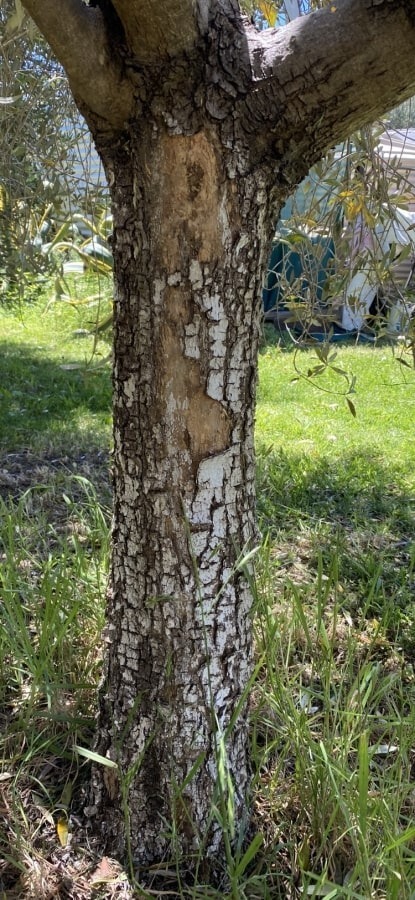
Once sunburn occurs, the damaged bark may crack, dry, peel, or become sunken. Underneath, the cambium (growing tissue) may be killed in patches, reducing the tree’s capacity to transport water and nutrients through that section.


Sunburn Damage to Olive Tree Trunk -The image above shows classic symptoms: cracked, peeling bark and exposed wood.

Recognising Sunburn Damage in Olives

Here are key symptoms to watch for:

  • Bark becomes discolored (straw, pale, or bleached areas) compared to healthy bark.
  • Cracking, peeling or flaking bark, sometimes exposing pale wood beneath.
  • Sunken or collapsed bark patches where the surface is depressed.
  • In severe cases, sections of bark slough off entirely and expose dead wood.
  • Cankers or lesions forming in the affected areas.
  • Reduced leaf vigor, scorching or browning of leaves, especially near the canopy edges.
  • Fruit drop or shriveling if the tree is already bearing. High heat stress may trigger olive abscission.
  • Over time, branch dieback or trunk weakness in the sunburned section may appear.

One important effect is that sunburned bark is more vulnerable to pest and fungal invasion, such as wood-boring insects or opportunistic pathogens that exploit the compromised protective barrier. 

Because olive trees often live many decades, even older trees can sustain recovery—provided the damage is not too extensive and you intervene early.

Why Sunburn in Your Olive Grove Is a Concern

  • Reduced growth and productivity: Damaged bark and cambium reduce the tree’s ability to translocate water and nutrients. The tree may divert energy to healing instead of growth or fruiting.
  • Structural weakness: Sunken or damaged trunk areas may become weak points, prone to breakage or cracks later, especially under wind stress. 
  • Higher susceptibility to pests and pathogens: Exposed or cracked bark invites insects (borers) or fungal pathogens to colonize. 
  • Delayed recovery: If large patches are affected, the tree may require a long time to compartmentalize the damage, and growth may be permanently affected in that area.
Given your background (older trees, clay soils, variable canopy coverage), sunburn may not be your primary challenge, but it can aggravate other stresses (nutritional, water, disease) and slow the recovery process.

Preventative Measures & Remedies

Here’s a set of strategies you can apply now or over seasons to protect your olive trees and help heal existing damage.

1. Maintain or restore shade to the trunk

  • When pruning, retain lower branches or scaffold limbs that offer partial shading to the trunk. Don’t prune so aggressively that bark is suddenly exposed. 
  • Use ground covers, mulch, or low shrubs around the dripline (but not touching the trunk) so that radiant heat from bare soil is reduced.
  • If possible, plant shade species (small trees or shrubs) in-line rows or adjacent to blocks to break sunlight incidence midday or afternoon.
2. Apply protective coatings or wraps
  • Whitewashing or painting the trunk with a light, water-based paint (often diluted limewash or similar) helps reflect sunlight and reduce temperature extremes. Many growers use this method on sensitive or newly exposed trunks. 
  • Use tree wrap or reflective sleeves on trunks, ideally on the side facing intense sun (often western or northwestern exposure in Australian climates). Wrapping material should allow air movement—avoid tight plastic wraps that trap moisture. 
  • In olive orchards, kaolin clay sprays (e.g. “Surround” brand or similar) are sometimes used on foliage and trunk to reduce radiant heat absorption and protect against sun and heat stress. Some trials report yield improvements by reducing fruit burn and drop under high-heat conditions.
3. Manage irrigation and soil moisture
  • Ensure the tree is not already under water stress. Provide adequate soil moisture during hot seasons (without overwatering).
  • Use mulches (organic materials like prunings, compost, bark chips) to help moderate soil temperature and reduce evaporation, which helps maintain a stable microclimate for roots.
  • Avoid practices that leave the soil bare and hot—bare clay can retain and radiate heat back onto trunks.
4. Gentle healing & care for affected trees
  • Remove loose or dead bark carefully, but don’t over-prune or cut live tissue aggressively. Let the tree compartmentalize the damage naturally.
  • For deeper or cankered sections, consult a tree health specialist to assess whether you need to trim back to sound wood or apply wound dressings.
  • Monitor the area over seasons; the tree may form callus growth around the margin of the injury and seal it internally if conditions are favorable.
  • Avoid additional stress (drought, nutrient deficiency, pests) in damaged trees so energy is available for healing.
5. Ongoing monitoring & orchard layout improvements
  • As you rehabilitate your grove, assess tree spacing, row orientation, and tree height to reduce reflective heat loading.
  • Avoid creating large expanses of bare, reflective ground under rows. Maintain a cover crop, grass alley, or soil cover to diffuse heat.
  • Track which trees show signs of sunburn after pruning or canopy changes. Use careful pruning patterns that don’t suddenly expose shaded bark.

Signs of sunburn in olive trees

Sunburn appears as pale, bleached bark patches on exposed trunk surfaces, cracks or peeling bark, and sometimes sunken or depressed bark areas. In advanced damage, bark may fall off, leaving wood exposed. Leaves near the margins of canopy may show browning or scorching, and fruit may drop prematurely under heat stress.

If you can, have a sample branch punched from just beyond the edge of the sunburn area so an arborist or consultant can evaluate whether live cambial tissue remains. Also, map out which exposures (north, west, etc.) in your grove tend to show sunburn more often—this helps plan protective shading or wrap strategies.

As you re-establish your grove’s health in other areas (soil fertility, drainage, pest and disease management, good pruning), protecting against sunburn becomes part of the maintenance process rather than a standalone issue.

References

  • UC IPM (University of California): guidance on whitewashing trunks to prevent sunburn/sunscald on trees. 
  • The Olive Centre: overview of sunburn damage in olive trees, risk factors (water deficit, heat), and vulnerability to borers.
  • Tessenderlo Kerley technical note: kaolin (Surround) particle film reduces heat load/sunburn and can improve olive yield/quality under high-radiation conditions.
  • Peer-reviewed study (Horticulturae/MDPI): mineral clay particles (incl. kaolin) evaluated on olives for effects on yield and oil quality.
  • Research summary (IPB/Portugal): field experiments with kaolin 5% on ‘Cobrançosa’ olives under rainfed and deficit irrigation; particle film proposed to reflect heat/irradiance. 
  • Australis Plants (AU olive resource): practical tips—white water-based paint (50:50) or trunk wraps on young/renovated olives; risk after hard summer pruning.
  • NSW DPI (citrus reworking guide—general orchard practice): after heavy cutting, paint exposed trunks/limbs with diluted white water-based paint to prevent sunburn (principle applicable to olives after renovation pruning). 
  • Agriculture Victoria (orchard recovery): recommends whitewash/diluted white paint on trunks/large limbs to minimise sunburn following canopy loss—relevant where olive canopies are thinned or defoliated. 
  • Australian Olives (Olives Australia): Peacock spot factsheet (context—sunburned tissue predisposes to disease; useful companion reference for disease pressure in humid regions).

Encouraging Productive Fruiting Wood in Olive Trees

OLIVE GROVE MANAGEMENT

Encouraging Productive Fruiting Wood in Olive Trees 

Marcelo Berlanda’s “Pruning for Production” guide highlighted why olive pruning is vital to sustain yields. This article builds on that foundation, focusing on how to encourage the growth of productive fruiting wood in Australian olive groves.

Why Productive Fruiting Wood Matters 


Olive trees bear fruit on one-year-old shoots – the growth produced in the previous season. Ensuring a steady supply of these young, fruitful shoots each year is critical for consistent yields. Without renewal, canopies fill with aging wood that carries fewer leaves and buds, leading to lower productivity. Pruning is therefore geared toward a few fundamental objectives : 

  • Maintain a high leaf-to-wood ratio: An olive canopy should have abundant healthy leaves for each unit of wood. Excessive old wood with sparse foliage is unproductive. Pruning removes overly woody, leafless limbs to optimise the leaf/wood and leaf/fruit balance that drives fruiting. In practice, growers aim to leave enough leaves to support developing fruit (often discussed as an optimal leaves-per-fruit ratio) while eliminating wood that no longer bears productive shoots. 
  • Promote new fruiting shoots: By cutting back old branches, the tree’s energy is redirected into new shoot growth. When these new shoots receive enough light and nutrients, they will form next year’s flower buds. Regular renewal pruning prevents the canopy from “running out” of fruitful wood. As olive expert Shimon Lavee noted, a strong flush of vegetative shoots in an “off” year provides the well-developed buds that form the next year’s heavy crop. Conversely, if few new shoots grew (for example, after an exhausting “on” year), the following crop will be light. Pruning helps balance this biennial tendency by stimulating fresh shoots each cycle. 
  • Maintain light penetration and airflow: Productive fruiting wood needs sunlight. Olive flower buds are more likely to differentiate (turn from vegetative to reproductive) when exposed to adequate light. A dense, shaded interior will have blind wood with dormant buds that never fruit. Pruning opens the canopy so that sunlight reaches inner shoots, enhancing their fruiting potential. Research shows that flower bud induction is improved by light - “opening the trees for effective light penetration... increases fruiting potential by enhancing flower bud differentiation”. Along with light, better air movement helps keep foliage dry and healthy (as discussed later in pest management). 
  • Prevent aging and sustain vigour: As olive wood ages, it can become less fruitful and more prone to dieback. Pruning is a form of controlled rejuvenation - removing limbs showing age or senescence to stimulate new growth (renewal). This keeps the tree in its productive prime longer. A well-pruned tree “does not lose its vitality or prematurely age”. Olive trees are long-lived and capable of sprouting new shoots from old wood, so with skilful renewal pruning, even very old trees can be reinvigorated. 
  • Optimise tree structure for management: Pruning also shapes the tree for efficient harvest and orchard operations. By managing height and width, growers improve harvest efficiency (whether by hand or machine) and reduce branch breakage from heavy crops. An open managed structure lets sprays penetrate and workers/equipment access the tree. All these benefits tie back to nurturing productive wood - a compact, sunlit canopy zone where fruitful shoots thrive.  

Physiology of Shoot Growth and Bud Formation

Understanding how and when olive fruiting buds form helps refine pruning practices. Unlike deciduous fruit trees, olives do not have a true winter dormancy – their buds remain in a state of quiescence and will grow when conditions permit. Flower buds initiate relatively late: studies have shown that olive buds begin differentiating into inflorescences about 2 months before bloom (around late winter/early spring in the local climate). This means the buds on this year’s spring flowering shoots were formed in the late summer or autumn of last year, on the previous year’s wood. Crucially, those buds needed sufficient resources and light while they were forming.

Several physiological factors influence fruitful bud development: 

  • Last year’s shoot vigour: Shoots that grew the previous spring and summer tend to have more nodes with flower buds. Very short, weak shoots often have fewer buds, but paradoxically, excessively vigorous shoots (“water sprouts”) often remain vegetative. Research in Tunisia (2025) found that thinner, moderately vigorous shoots carried higher inflorescence numbers than very thick shoots. This suggests that extremely strong vegetative growth (often caused by heavy winter pruning or excess fertilisation) can actually reduce floral initiation, whereas controlled, moderate shoot growth produces the best fruiting wood. Growers should aim for new shoots of medium length (e.g. ~20–40 cm, depending on cultivar) with good leaf cover – these are the shoots most likely to bear olives. Very long shoots can be tip-pruned in summer to encourage lateral fruiting spurs, but excessive heading should be avoided as it may induce unwanted branching that doesn’t flower. 
  • Light exposure of buds: Olive buds need light to differentiate into flowers. Buds heavily shaded by an overgrown canopy often remain latent or become vegetative. A classic recommendation is to ensure sunlight can filter to all bearing shoots, including those in the lower and inner canopy. Connor et al. (2014) emphasised that all foliage must receive at least ~20–30% of full sunlight for the critical steps of shoot growth, floral initiation, and fruiting to occur. In hedgerow orchards, the lowest parts of the canopy wall are often the limiting factor for light – if those interior shoots get below-threshold light, they won’t set fruit. Pruning strategies like thinning out dense upper branches or narrowing the canopy can increase light to these shaded buds, thereby activating more fruitful sites. As one guide succinctly puts it, “remove any part that shades other younger parts of the tree” to keep the fruiting zone vigorous. 
  • Resource allocation and alternate bearing: Olives are prone to alternate (biennial) bearing, partly due to resource competition between one year’s crop and the next year’s buds. A heavy fruit load (“on” year) not only uses up carbohydrates but also produces hormones (gibberellins from seeds) that can inhibit floral bud initiation for the following year. This is why a tree laden with fruit often grows fewer new shoots and may bloom poorly the next season. Pruning can mitigate this by adjusting the crop and stimulating vegetative growth at the right time. Strategic pruning in an “on” year (e.g. immediately after harvest) helps divert some resources to new shoot development, balancing the tree. In an “off” year, lighter pruning or none may be needed so as not to remove too much of the vigorous growth that will form next year’s inflorescences. The goal is to even out the boom-bust cycle: moderate pruning annually or biennially, rather than severe pruning at long intervals, tends to promote more regular yields.        
  • Bud dormancy and chilling: Unlike many fruit trees, olive buds do not require deep winter chilling to break dormancy – they can grow if conditions are favourable (hence olives can fruit in warm climates with mild winters). However, cool winter temperatures are still important to induce olive floral buds. Insufficient chilling or an excessively warm winter can lead to delayed or incomplete flower differentiation. This is more relevant to certain Australian regions (e.g. subtropical areas) where winters are mild. While growers cannot change the weather, they should be aware that a healthy complement of buds might still fail to bloom if winter conditions are suboptimal. Good orchard practices (nutrition, pest control, pruning) ensure the tree has plenty of viable buds ready; the weather then decides how many of those convert to flowers. If a spring shows poor bloom despite many new shoots, lack of chilling or even a heat shock could be factors. In such cases, focus on tree health and wait for next season – overreacting with drastic pruning is not advised.

Takeaway: Productive fruiting wood arises from a balance – neither too vegetative nor too weak – and it needs sunlight. Pruning is the tool to create that balance by removing what’s unproductive and making space for fruitful shoots under the right environmental conditions.

Pruning Techniques to Promote Renewal Wood

Having set the physiological context, we now turn to pruning methods that encourage renewal of fruiting wood. The approach will vary with the age of the tree and the orchard system (traditional vs. high-density), but several general principles apply: 

  • Prune after harvest during dormancy: In Australian conditions, this usually means late autumn to late winter (e.g. June–August, depending on region). Pruning right after harvest is a common practice – for oil cultivars harvested in autumn, growers often prune in winter before the next spring growth. This timing allows the tree to heal cuts before spring sap flow, and any stimulated shoot growth will occur as the weather warms (when it can actually develop). It’s important not to prune so early that a warm spell triggers regrowth in mid-winter, which could be damaged by frost. Generally, prune by late winter, after the risk of heavy rain or frost, if possible. For table olive varieties harvested earlier, pruning might begin in early winter (June/July in Australia). Always avoid pruning in wet conditions – cutting on a rainy day can spread diseases like bacterial olive knot to fresh wounds. 
  • Use mostly thinning cuts, minimise heading: A thinning cut removes a branch at its origin, opening space but not excessively stimulating regrowth. A heading cut (tipping a branch) can trigger multiple shoots at that point. While some heading is useful to lower height or induce laterals, indiscriminate heading leads to bushy water-sprout growth at the canopy tops. These vigorous shoots often won’t fruit the next year and just consume resources. The best practice is to thin out entire limbs or large shoots that are unproductive or overcrowding, and lightly head only where necessary for shape. A rule of thumb: “cut to a lateral” – i.e. remove a branch back to a fork where a healthy lateral branch can take over, rather than stub-cutting it mid-way. Thinning cuts preserve the natural balance and direct growth into existing shoots that have better light. This results in more fruitful wood and less wasted vigour. 
  • Renew in stages – avoid stripping all old wood at once: Particularly on older trees, do renewal pruning gradually. Remove one major old limb (or a few) each year rather than all in one year. Avoid severe, total canopy pruning whenever possible, as it causes a huge flush of vegetative suckers and a loss of a cropping year. Research confirms that severe pruning drastically reduces the next crop and prompts excessive regrowth. Instead, practice selective renewal: identify 20–30% of the canopy (by volume) that is oldest or least productive and remove that, leaving younger wood intact to fruit. The tree will channel energy into emerging new shoots near the cuts while still fruiting on the remaining wood that year. Over 2–3 seasons, this phased approach can completely refresh an old canopy with minimal yield loss in any given year. Even in low-density traditional orchards, renewal of aged trees is commonly done piecemeal because old olive wood can still sprout if some foliage is left to “pull” sap into the limbs. In very extreme cases where trees must be cut hard (storm damage, disease recovery, or neglected groves), expect a 1–2 year recovery period before normal yields return. Fortunately, olives are resilient – with adequate water and nutrients, they can refoliate and produce on new wood by the second or third year after even a brutal topping.
  • Alternate pruning zones or sides: In hedgerow (SHD/HD) systems and even large free-standing trees, it’s wise not to prune the entire tree uniformly in one go. In hedgerows, an established practice is alternate-side pruning: trim one side of the hedgerow (or every other row) in one year and the opposite side the next year. This way, each side always has some younger fruiting shoots while the opposite side is regenerating. The same concept can apply to big trees – for instance, prune some main branches this winter, and others next winter. The unpruned parts will bear fruit to compensate, while the pruned parts regrow. Never “lion-tail” a tree (stripping out all interior branches and leaving a tuft at branch ends) – instead, maintain a balance of interior and exterior growth. By alternating pruning areas, you optimise production while renewing wood. Ferguson et al. (2012) reported that this method in SHD orchards led to better annual yields versus pruning both sides in one year. 
  • Remove water sprouts and suckers judiciously: After pruning (especially if heavy), olives respond with vigorous shoots from latent buds – these can be watershoots (upright epicormic shoots along trunk or branches) or suckers from the rootstock/base. These are generally nonproductive in their first year and compete with desirable growth. It’s advisable to remove most of them in summer when they are green and soft (“summer pruning” or suckering). However, note that not all watershoots are bad – if a large limb was removed, some of the resulting watersprouts near the cut can be selected and managed to become the next fruiting branches. Typically, you’d thin out the excess shoots, leaving a few well-placed ones (avoid clusters of shoots all in one spot) and maybe pinch their tips to encourage them to harden and form flower buds. A study in Argentina found that thinning vigorous watersprouts about 3 months after winter pruning improved return bloom and yield compared to just heading them. By removing the most rampant suckers and keeping moderate shoots, you tame the regrowth flush into productive wood. Root suckers (from below the graft or ground) should usually be removed entirely, as they are often from the rootstock (if grafted) or will not form part of the canopy. 
  • Aim for a vase or hedgerow form with open centres: In traditional trees, the classic shape is a vase (open-centre) with 3–5 main scaffold limbs. Keeping the centre free of clutter ensures light can reach the middle of the tree. The same logic applies to hedgerows – though they are a “wall” of foliage, they must be kept porous. A Spanish study on olive crown porosity showed that different pruning treatments did not always change overall porosity dramatically, but removing inner branches and lowering canopy density are key to light penetration. An open canopy also reduces disease (more on that below). Therefore, prune with the mindset of creating windows for light and air. One practical tip is to stand inside the tree’s canopy (for big trees) or look through a hedgerow wall – you should see patches of daylight through the canopy. If you can’t, more thinning is needed. Conversely, if you can see too much daylight (the tree looks skeletal), you pruned too much, which can lead to sunburn on bark and excessive suckering. Strive for a balanced canopy – about 50% interior light interception as a rough guide, meaning a mix of sun and dappled shade internally. 

By applying these pruning techniques, growers encourage a continuous supply of young fruiting wood while avoiding the pitfalls of over-pruning. The result is a tree that renews itself gradually: always plenty of 1-year shoots ready for the next crop, and no big shocks to the tree’s system. 

Tailoring Practices to Different Orchard Systems

Olive orchards in Australia range from traditional low-density plantings to modern high-density (HD) and super-high-density (SHD) groves. The principles of fruiting wood renewal apply to all, but the methods and intensity of pruning are adjusted to each system’s needs :

  • Traditional (low-density) groves: These are widely spaced trees (e.g. 6m × 6m or more) often grown as large vase-shaped forms. Here, the challenge is managing tree size and rejuvenation over decades. Typically, traditional trees are pruned lightly every year or two, with a more severe renewal pruning maybe every 5–10 years on very old wood. The focus is on opening the centre, removing dead wood, and keeping height reachable (often below ~5–6m for ease of harvest). Growers might remove a few big limbs each winter (to stimulate new shoots inside), but avoid depleting the canopy too much in one go. Because these trees can get very large, sometimes entire sections are “stumped” in rotation – e.g. cut one scaffold back to a low knob to force new shoots, while leaving other scaffolds untouched that year. Over a cycle, the whole tree gets renewed. Traditional hand-pruning is labour-intensive, so it’s done strategically where needed. In these systems, sunlight is usually not a limiting factor around the outer canopy due to wide spacing; the main shading concern is the tree’s own interior. Thus, pruning concentrates on thinning the inside and top. Also, older trees may have hollow or leggy interiors – one objective is to populate those with new shoots by cutting back into those areas (“bringing the tree back in”). This not only produces fruiting wood closer to the trunk (improving harvest efficiency) but also reduces reliance on long, drooping peripheral branches that can break. 
  • High-Density (HD) orchards: These are intermediate (e.g. 200–400 trees/ha, perhaps 5m × 3m spacing). Trees are smaller than traditional but larger than SHD hedgerows. Often a central leader or vase hybrid form is used, sometimes trained to ~3–4m height. Pruning in HD systems seeks to maximise light to all sides of the tree while controlling vigour. Mechanical aids may be used (like topping or skirt pruning with saws), but hand pruning is still important to thin out centres. One practice is selective limb removal every couple of years to prevent crowding between trees. In hedgerow-like HD plantings (if trees are aligned in rows but not a continuous hedge), you ensure each tree has its space: branches extending into tractor alleys or too close to neighbours are cut back. Prune to a cone shape (wider base, narrower top) so that lower branches aren’t heavily shaded. If mechanical harvesters like trunk shakers are used, maintaining some clear trunk and strong primary branches is important (so pruning off low suckers and very weak branches that won’t withstand shaking). HD systems might adopt some SHD techniques, like mechanical topping annually to a set height, combined with periodic hand thinning. The key is regular moderate pruning – because these trees are managed for efficiency, you can’t afford the massive alternate bearing swings or overgrowth. In fact, studies suggest annual light pruning in small orchards yields better cumulative production than infrequent heavy cuts
  • Super-High-Density (SHD) hedgerows: These are very tightly spaced rows (e.g. 4m between rows × 1.5m between trees, ~1600+ trees/ha) pruned into narrow hedges ~2.5–3m tall. Cultivars like Arbequina, Koroneiki, and Leccino are common for SHD due to their naturally compact habit. Mechanical pruning is standard – typically, oscillating blade machines trim the sides and tops annually or biennially to maintain a harvestable “wall” for over-the-row harvesters. While mechanical hedging is efficient, it can lead to shaded interior wood and a decline in fruitful shoots deep in the canopy if done improperly. To counter this, SHD management includes: alternate-side pruning (don’t cut both sides of the hedge in the same year), and occasional, more severe “skimming” or renewal. For example, some growers, every 3–4 years, will do a heavy hedge cut on one side of the row (or remove every second tree, then replant) to renew the wall of foliage. Research by Gómez-del-Campo et al. noted that horizontal canopy porosity in tightly spaced hedges can be as low as 15% in mid-canopy, versus ~37% in the less crowded upper canopy. This highlights how dense these hedges can get. Maintaining porosity (gaps for light) through pruning is thus crucial. Connor et al. (2014) advise that both sides of an SHD hedgerow should never be heavily pruned simultaneously, and that light, frequent pruning is preferable to avoid big yield losses. In practice, this might mean yearly trimming plus a rotational renewal (e.g. flail pruning one side or topping lower than usual, but staggered). SHD groves also put a premium on controlling vegetative vigour – since trees are so close, excessive growth quickly leads to shading. Growers often use regulated deficit irrigation (RDI) and moderate nitrogen regimes to keep shoot growth in check. The pruning then accentuates this, ensuring the hedge doesn’t exceed the bounds (commonly hedged to ~2m wide at base, 1m at top, like an inverted “V”). The reward for this intensive care is early and high yields, but it requires disciplined pruning to sustain. 
  • Very old or neglected trees: A note on abandoned or oversized trees (sometimes found in older groves): rejuvenating these requires a special plan. Often, the best course is heavy structural pruning in stages. For instance, cut back extremely tall trees to ~3m height by removing the top third of the canopy (one portion each year over 2–3 years). Simultaneously, thin out interior suckers and apply fertiliser and water to stimulate new shoot formation. This process can essentially “reset” an old tree into a productive, smaller framework. As pointed out in the literature, renewal of olive trees is a traditional practice even in low-density orchards – old wood retains sprouting capacity if given a chance. Farmers in the Mediterranean have for centuries rehabilitated ancient trees by pollarding or scaffold replacement, proving the olive’s remarkable ability to bounce back. Just remember to sanitise tools and perhaps apply protective copper spray on large cuts (to prevent disease in those big pruning wounds, especially important in older trees that may have existing infections). 

In summary, the pruning strategy must fit the system: gentle but regular for intensive hedges, somewhat heavier but less frequent for large traditional trees, and always aimed at keeping enough young wood in the pipeline. Regardless of system, the fundamentals remain: capture sunlight, encourage new shoots, and remove what’s unproductive. 

Integrated Pruning and Pest Management 

Pruning not only influences yields – it also plays a significant role in Integrated Pest and Disease Management (IPDM). A well-pruned olive canopy is generally healthier and easier to protect. Here’s how encouraging productive wood ties in with pest and disease considerations:

  • Canopy density and fungal diseases: Many olive diseases thrive in dark, moist environments. Opening up the canopy allows better air movement and faster drying of foliage, which can substantially reduce disease incidence. For example, fungi like peacock spot (Fusicladium oleagineum) and anthracnose (Colletotrichum spp.) require periods of leaf wetness to infect. A dense canopy that stays humid after rain creates an ideal microclimate for these pathogens. By pruning to increase light and airflow, leaves dry quicker, interrupting fungal spore germination. The Best Practice IPDM Manual notes that speeding up evaporation of rain or dew through improved aeration can directly reduce fungal infections. Indeed, researchers observed higher anthracnose severity in very dense SHD plantings compared to more open canopies – underscoring that porosity matters. Growers are advised to prune out overly crowded branches and perhaps even lower canopy height to what their local climate can accommodate (e.g. in humid coastal regions, a shorter tree with a very open centre will suffer less disease than a tall, bushy tree). Additionally, better light penetration enhances bud health – weak, shaded buds are more susceptible to infections like botryosphaeria (which can cause dieback). Thus, a pruning program that keeps fruiting wood in the light not only improves fruiting but also inherently defends against disease. 
  • Scale insects and other pests: Pests such as black scale (Saissetia oleae) and olive lace bug (Froggattia olivinia) often reach higher populations in dense, shady canopies. The IPDM manual explains that the immature “crawler” stages of scale and lace bug survive better in cool, humid microclimates inside unpruned trees. Hot, dry conditions are detrimental to these pests (many scales desiccate in sun-exposed positions). By pruning the inner canopy and letting sunlight in, growers create less hospitable conditions for scale infestations. In effect, judicious pruning is a cultural control method: it can significantly cut down pest survival rates, reducing the need for chemical intervention. Similarly, good pruning reduces the hiding spots for other insects and allows natural enemies (parasitoid wasps, lady beetles, etc.) to move more freely through the tree. Spray penetration is also vastly improved – when you do need to apply an oil or insecticide for scale, an open canopy lets the spray reach inner leaves and branches where pests harbour. Many organic or soft pesticides (like soaps, oils, copper, and pyrethrum) rely on contact action, so coverage is critical. Pruning ensures that sprays can “cover” the target surfaces. 
  • Olive knot and wound management: One downside of pruning is the creation of wounds, which can be entry points for pathogens – notably olive knot disease, caused by the bacterium Pseudomonas savastanoi. Olive knot can invade fresh pruning cuts, especially during wet weather, forming galls on limbs. To mitigate this, avoid pruning in the rain and consider protective measures for large cuts. A common practice is to spray copper-based bactericide/ fungicide right after pruning or before the next rain. Some growers also apply tree wound dressing or a latex paint on big limb cuts as a physical barrier. These precautions help limit infection. It’s also wise to sanitise pruning tools between trees (a quick dip in disinfectant) if diseases like knot or Verticillium wilt are present, to avoid spreading them. In an IPM context, pruning is timed and executed carefully: e.g. in high rainfall areas, prune in late winter when rains are easing, and treat wounds. Fortunately, productive fruiting wood tends to be smaller diameter cuts (when you renew regularly), which heal faster and pose less risk than chopping massive old limbs. So keeping up with pruning not only fosters new fruit wood but also means you’ll have fewer huge wounds at any one time.  
  • Linking pruning to disease management strategies: Some cultural IPM tips explicitly involve pruning. For instance, with anthracnose, aside from fungicides, recommended actions are early harvest (to avoid autumn rains) and pruning trees to a more open canopy. With peacock spot, pruning to allow sunlight on leaves helps because UV light can suppress the fungus, and dry leaves don’t get infected as easily. Even bacterial diseases like olive knot are indirectly suppressed by faster drying (the bacteria thrive in moisture on plant surfaces). Thus, a grower focusing on productive wood (which implies a less crowded canopy) gains a double benefit: better fruiting and fewer disease issues. The Connor et al. review (2014) notes that in traditional low-density orchards, free air movement helps prevent humid microclimates, whereas hedgerow systems require careful pruning/irrigation control to avoid humidity-related disease buildup. They highlight that “narrow and porous hedgerows” achieved by pruning plus controlled water can reduce fungal problems like peacock spot and anthracnose. This aligns perfectly with IPM advice – integrate your pruning program with your pest/disease monitoring. If you notice heavy scale or sooty mould inside trees, it’s a signal to thin those canopies. If fungal outbreaks occur, consider that a sign to increase porosity and maybe lower tree density or height during the next pruning cycle. 
  • Pruning and beneficial insects: Keeping some openness in the grove (and not having a tangle of watershoots) also aids beneficial insects and mites. They can navigate and locate pests more effectively in a well-structured tree. Some predators, like lacewings, prefer slightly open trees. Additionally, if you combine pruning with cover crops or intercrops for natural enemies (as mentioned in IPDM manuals ), you create an overall environment where pests are less likely to flare up. 

In summary, a sound pruning regimen is a cornerstone of IPM in olives. It reduces pest and disease pressure naturally by altering the micro-environment and improving the efficacy of other controls. Always balance the need for opening the canopy with the tree’s productive capacity – a healthy medium density (not too sparse) is the target, so that you don’t invite sunscald or stress. With those caveats, pruning is one of the most cost-effective pest management tools a grower has.

Environmental and Management Factors Affecting Wood Renewal

Beyond pruning itself, several environmental and cultural factors influence how well an olive tree can produce new, fruitful wood. Understanding these helps growers create conditions that favour the continual renewal of fruiting shoots: 

  • Water availability and irrigation strategy: Olive is drought-tolerant but will not grow new shoots well under severe water stress. Adequate soil moisture during the spring and summer is necessary for shoot extension that becomes next year’s fruiting wood. However, too much water (or untimely irrigation) can fuel overly vigorous vegetative growth that, as noted, may be less fruitful. Modern orchard practice often employs Regulated Deficit Irrigation (RDI) – deliberately stressing the trees mildly at certain times – to manage vigour. For example, some SHD groves impose a dry period during early summer (pit hardening stage of the olive) to slow shoot growth and encourage floral induction. Then, irrigation is increased later to sustain the crop. This technique can result in shorter internodes and more flowering points. Connor et al. (2014) write that sustained or regulated deficit irrigation is useful to ensure high yields without excessive vegetative growth. In essence, water management and pruning go hand in hand: pruning sets the stage for how much the tree will try to regrow, and irrigation fine-tunes that regrowth. In rain-fed groves, the principle is similar – in a very dry year, the tree may barely replace lost wood, so pruning should be lighter; in a wet year (or if supplemental water is available), pruning can be a bit heavier since the tree can respond. Irrigation can also be used post-harvest to boost new shoot growth if needed (e.g. after a heavy crop year, watering after fruit removal can help push some late shoots before winter if the climate allows). 
  • Nutrient status: Proper nutrition, especially nitrogen, is crucial for shoot growth and bud formation. Nitrogen applied in late winter through spring supports the development of new shoots and leaves (which ultimately carry next year’s fruit). Nitrogen deficiency will result in short shoots with fewer nodes (hence fewer potential inflorescences). On the other hand, excess nitrogen can cause rank vegetative growth and poor fruiting as the tree stays in a “growth” mode. A balance is needed – typically, commercial growers use foliar and soil tests to guide fertilisation. Phosphorus and potassium are also important for overall tree health and flowering, but N is the main driver of shoot vigour. If heavy pruning is done, a small increase in nitrogen fertiliser can help the tree refill its canopy, but it should be carefully timed (supply N during active growth, not just before dormancy). Zinc and boron foliar spraysare micronutrients worth mentioning: zinc is involved in shoot elongation (zinc deficiency leads to stunted shoots and rosette leaves), and boron is critical for flowering and fruit set. Ensuring these micronutrients are sufficient (via Heat and sunburn if needed) can improve the quality of fruiting wood and subsequent bloom. In short, a well-fed tree can better renew its fruiting wood, but avoid over-fertilising to prevent vegetative bias. Always integrate fertilisation with pruning severity – e.g., after a significant prune, don’t heavily fertilise with N immediately, or you’ll get water sprouts; feed modestly and let the tree rebuild gradually. 
  • Climate stress (temperature extremes): Environmental stresses can affect both current fruiting and future wood. For instance, a severe frost can kill one-year-old shoots (either outright or by damaging their cambium), effectively destroying that fruiting wood. If a late spring frost hits just as buds burst, it can wipe out that year’s inflorescences and even the shoots, forcing the tree to push new secondary shoots (which may or may not have time to set buds for the next year). In frost-prone areas, the pruning strategy might include leaving a bit of extra wood as a “backup”. Some growers delay pruning until late winter specifically to assess frost risk – any frost-damaged twigs can then be pruned out, and some fruitful wood might be left untouched to allow a partial crop if frost was light. Mechanical harvesting (shakers or harvesters) are another concern: suddenly exposing older shaded limbs to intense summer sun (through heavy pruning) can scald the bark. This can girdle branches or invite disease. That’s why gradual opening is preferred. If a tree is pruned hard, doing it in winter helps because the summer sun intensity on the new shoots is mitigated by those shoots themselves growing and shading the bark. Also, a whitewash or spray-on kaolin clay can be used on exposed branches to reflect sunlight in the first summer after a hard prune. Wind can break vigorous new shoots if they are too long and unprotected; sheltered orchard design or windbreaks help prevent losing the very shoots you pruned to create. 
  • Pests and diseases affecting wood: We’ve touched on how pruning helps prevent pests, but pests can also reduce the formation of productive wood. Defoliation by pests (e.g. a severe peacock spot infection causing leaf drop, or heavy olive lace bug feeding) will weaken shoots and often cause them to die back or fail to form flower buds. For example, if scale insects heavily infest young shoots, the sooty mould and sap loss may stunt those shoots. This reduces fruitful nodes and may require pruning out those damaged twigs. Additionally, wood-boring pests (like olive wood-borer or even trunk diseases) can kill branches, necessitating more renewal. Good IPM to control these problems means the tree retains more healthy shoots to become next year’s fruiting wood. Nutritional disorders (like acute copper deficiency, which can kill shoot tips, or boron toxicity, which can cause twig dieback) similarly affect wood renewal and should be managed via soil and leaf analyses. 
  • Cultivar differences: Some olive cultivars naturally produce more or fewer new shoots. For instance, vigorous varieties like Frantoio or Koroneiki tend to sprout readily and may need extra thinning, whereas a slow-growing variety like Manzanillo might require lighter pruning to avoid reducing too much foliage. Cultivars also differ in how strongly they alternate bearing. Research has shown cultivar architecture (branching pattern, shoot length distribution) influences how we should prune. Recognise your cultivar’s habits – a weepy cultivar (drooping branches) might need cuts to upward laterals to prevent all fruit wood from hanging downward and shading itself; an erect cultivar might need opening in the interior. Tailor the pruning severity to how the variety responds. If unsure, trial different pruning levels on a few trees and observe the regrowth and fruiting. 
  • Harvest method and timing: Interestingly, how and when you harvest can impact fruiting wood. Mechanical harvesting (shakers or harvesters) can cause some damage to shoots – for example, trunk shakers might break off fruiting twigs, and over-the-row harvesters may knock off branch tips. Pruning can compensate by stimulating regrowth where breakage occurred, but be mindful of harvest injury (make cleaner cuts around damaged areas). Early harvesting (picking fruit earlier in the season) is often recommended to mitigate anthracnose; it can also benefit the tree by giving it a longer post-harvest period to grow new shoots before winter. Late-harvested trees (say, very late May or June picks) have a short window to initiate new growth before cold weather, potentially limiting the next year’s fruit wood. So there’s a trade-off: waiting for maximum ripeness vs. tree recovery time. Many commercial growers find a sweet spot where they harvest as soon as oil accumulation is adequate, then immediately prune and fertilise to maximise the “rest” period for the tree to rebuild. Over the long term, this can increase the consistency of production. 

In summary, productive fruiting wood is not just about cutting branches – it’s the outcome of the whole orchard management system. Pruning is the mechanical stimulus, but water, nutrients, and overall tree stress levels determine how the tree responds. The best results come when pruning is synced with these factors: prune to shape the growth, irrigate and fertilise to support it (but not overdo it), and protect the tree from stresses that could derail the process. By doing so, growers in Australia can maintain olive canopies that are youthful, vigorous, and laden with fruitful shoots year after year.

Conclusion: Practical Takeaways for Growers

Encouraging productive fruiting wood in olives is both an art and a science. The art lies in “reading” the tree – knowing which branches to remove and which to spare – while the science lies in understanding olive physiology and applying evidence-based practices. In this follow-up to Marcelo Berlanda’s pruning guide, we have underlined the key strategies:

  • Keep it light and frequent: Regular, moderate pruning (rather than drastic cuts at long intervals) keeps the tree in balance and minimises alternate bearing shocks. Little and often beats all at once. 
  • Maximise light, optimise canopy: Ensure every fruitful shoot gets sunlight. Open the centre, manage tree height, and avoid thickets of unproductive wood. A rule: if a bird can’t fly through your tree, it’s too dense! 
  • Renew systematically: Remove a portion of old wood each year to stimulate new shoots. Don’t wait until the tree is a solid mass of old branches. Proactive renewal is easier and more productive than drastic rejuvenation. 
  • Adapt to your system: Use appropriate techniques for your grove type – whether it’s hand-pruning a gnarly 100-year-old tree or mechanically hedging a super-intensive row. The end goal is the same: a canopy architecture that supports new growth and fruiting. 
  • Integrate health with pruning: Remember that pruning is also a sanitation and IPM tool. Dispose of pruned material that contains diseases or pests (don’t leave it on the orchard floor if it’s infested). Consider timing pruning after major disease periods (e.g., prune after the wet season to remove fungus-infected twigs). Always make clean cuts and protect the tree as needed. 
  • Monitor and adjust: Finally, observe how your trees respond. If you pruned a block and next spring you see an overly vegetative response (excess watershoots, low flowering), adjust by pruning a bit lighter or later, or try a growth regulator on vigorous shoots, as researchers have tested (e.g., some use plant growth regulators like paclobutrazol or mepiquat chloride experimentally to temper regrowth ). If you see the opposite – weak regrowth – it might mean the tree lacked resources (perhaps it was an “on” year and depleted, or needs more nutrition/irrigation). By following these guidelines, Australian olive growers can improve the productivity and longevity of their groves. The essence of Berlanda’s message, now enriched with current scientific insights, is that pruning for production is about forward-thinking – cultivating next year’s crop wood while harvesting this year’s crop. With a sound renewal strategy, your olive trees will reward you with consistent yields of high-quality fruit and remain robust against pests, diseases, and the vagaries of climate. As always, combine advice with on-ground experience, and happy pruning for productive wood! 

Sources: This article integrates findings from peer-reviewed studies and reputable industry publications, including research by Gómez-del-Campo et al. on light and yield distribution, Tombesi and Connor on pruning and olive physiology, Rousseaux et al. on bud dormancy and flowering, and Australian olive industry resources (NSW DPI, AOA IPDM manual) on best practices. These sources reinforce the recommendations above and ensure advice is aligned with the latest understanding of olive tree management. 

How to Value Olive Oil Processing Machinery and Farm Equipment (Australia)


VALUING OLIVE OIL PROCESSING MACHINERY IN AUSTRALIA

How to Value Olive Oil Processing Machinery and Farm Equipment (Australia)

Valuing your olive oil processing machinery – from presses and decanters to tractors and harvesters – is an important task for Australian producers. Whether you’re a small boutique grove or a commercial olive operation, knowing what your equipment is worth helps with insurance, resale, and financial planning. This guide explains how to value used olive oil processing machinery (with notes on new equipment costs), covers multiple valuation methods, and offers a practical Australian context. We’ll also include example scenarios (like a decade-old olive press vs. a nearly new separator) and provide tips to maintain your gear’s value over time.  

Equipment in an Olive Oil Operation 

Olive oil production involves specialised machinery at harvest and processing time. Key processing equipment includes olive crushers or mills (to crush olives into paste), malaxers (which slowly mix the paste), and centrifugal decanters/separators (which separate oil from water and solids). Supporting items like pumps, olive washers, and filtration units are also part of the system. Many Australian groves also use standard farm equipment such as tractors, mechanical harvesters, pruning and spraying equipment, and irrigation systems. When assessing value, focus first on the core olive oil machinery, but remember that methods discussed here apply to your tractors, harvesters, and other farm gear as well.  

Modern olive processing machinery is a significant investment. For reference, a small continuous-flow olive mill (e.g. 30 kg/hour throughput) might cost around A$20,000 new, while a large commercial plant (capable of ~1 tonne/hour) can run into the hundreds of thousands of dollars. Such figures underscore why proper valuation is essential – these assets represent major capital on the farm. Below, we outline several methods to evaluate what these machines are worth, especially as they age or when considering second-hand purchases. 

Valuation Methods for Used Machinery 

Valuing used farm equipment is not an exact science – it’s often best to use multiple methods to triangulate a reasonable value. Common approaches include using depreciation schedules, comparing recent market sales, calculating value based on income or cost savings, considering insurance replacement cost, and accounting for residual (salvage) value. Each method gives a different perspective:

  • Depreciation (Straight-Line or Declining Balance) – Calculates value loss over time based on age. 
  • Market Comparison – Looks at actual sale prices for similar equipment in the current market.
  • Income or ROI Approach – Values equipment by the income it generates or the savings it provides.
  • Insurance Replacement Value – Considers what it would cost to replace the item new, minus depreciation.
  • Residual/Salvage Value – Accounts for the minimal value at end-of-life (for scrap or parts).
Let’s break down each method in detail and how you can apply it.

Depreciation-Based Valuation (Straight-Line vs. Diminishing) 

Depreciation is the loss in value of equipment as it ages. A simple way to estimate a used machine’s value is to start from its original cost and subtract depreciation. There are two main depreciation methods: straight-line (also called prime cost) and declining-balance (diminishing value). Straight-line depreciation assumes the asset loses value evenly over its useful life, while declining-balance depreciation assumes a higher loss in early years and less in later years.

  • Determine Useful Life: First, establish the expected useful life of the machine. The Australian Taxation Office (ATO) provides guidelines for many assets. For example, olive oil processing equipment has an effective life of about 15 years according to ATO determinations. (For comparison, general farm tractors are given about a 12-year effective life .) You can use these as a baseline, though actual lifespan can vary with usage and maintenance.
  • Straight-Line Calculation: Under straight-line depreciation, each year the machine loses roughly an equal percentage of its original value. The ATO’s prime cost formula is: 
Annual Depreciation = Cost × (100% ÷ Effective Life). 

For instance, if a small olive press was purchased new for $30,000 and has a 15-year life, straight-line depreciation would be ~6.67% per year (100/15). After 10 years (two-thirds of its life), it would be about 10 × 6.67% ≈ 66.7% depreciated. In simple terms, its book value might be roughly 33% of the original cost (around $10,000 in this example). This assumes no residual value; in practice, you might add a small salvage value (see Residual Value section) instead of depreciating to zero. 

  • Declining-Balance Calculation: Declining or diminishing value depreciation accelerates the write-down in early years. The ATO’s diminishing value method uses roughly 200% of the straight-line rate. For a 15-year life asset, this means ~13.33% depreciation per year on the reducing balance. Using the same $30,000 press example, the first year depreciation would be $4,000 (13.33%), leaving $26,000 value; the next year ~$3,466 (13.33% of 26k), and so on. After 10 years, the formula would yield a remaining value of only around 20–25% of the original (about $6,000–$7,500). This method better reflects how equipment often loses value fastest when it’s newest.
In practice, many farmers use straight-line for simplicity or for setting uniform annual book values, but diminishing value gives a more realistic market pattern (high initial depreciation, then levelling off). Keep in mind these calculations provide an approximate book value, not a guaranteed market price. Real-world prices can be higher or lower depending on demand and condition. Still, depreciation schedules are useful to set a baseline. In fact, for tax purposes, you may already have a depreciation schedule – for instance, if you claimed capital allowances using ATO rates, your asset’s tax written-down value is a starting point for its value. 

Example (Depreciation Method): You bought an olive mill for $100,000 new, which is now 10 years old. Using straight-line (15-year life), its book value would be roughly $100k × (5/15) = $33k remaining. Using diminishing value (13.33% yearly), its book value might be closer to $24k–$25k after 10 years. You could cite these as a range – perhaps saying the machine is “approximately $25k–$33k based on age” – then adjust up or down for condition. If your equipment’s been exceptionally well maintained or lightly used, it might fetch more than the book value; if it’s in rough shape, it could be less.

Market Comparison Approach

One of the most practical valuation methods is to see what the market is willing to pay for similar equipment. Check recent listings and sales of comparable olive oil machinery or farm equipment. In Australia, useful platforms include: 

  • Online Marketplaces: Websites like FarmMachinerySales, Farm Tender, Gumtree, and even specialised sites (e.g. Used Olive Machinery on olivemachinery.com) list second-hand equipment. Use the search and filter functions to find gear similar to yours in make, model, age, and capacity. For example, on farmmachinerysales.com.au, you can filter by equipment type, brand, year, location, and even features, then sort by price to see the range of asking prices. This gives a ballpark of what sellers expect. Remember to note whether those are asking prices or finalised sale prices. 
  • Specialised Dealers and Classifieds: The olive industry community often shares leads on used equipment. The Australian Olive Association or local grower groups might have classifieds. The Used Olive Machinery site mentioned above compiles listings – for instance, a listing for a used Oliomio 700 processing line with ~1,936 hours was recently posted, indicating the machine was well-maintained and had a decanter refurb at 1,500 hours. While that particular listing was marked sold with the price “POA” (price on application), details like hours give context. If you find a similar model on sale, you can gauge value by comparing usage hours and condition.
  • Auction Results and Dealer Insights: Auction houses (like GraysOnline or farm clearing sales) sometimes sell olive equipment. Past auction results can signal what buyers paid. Additionally, don’t hesitate to talk to equipment dealers or valuers. Many farm machinery dealers have experience with resale values and can provide an informal appraisal or at least guidance on current market conditions. For niche machines, the dealer who sold it to you (or their competitors) might recall what similar used units went for.
Adjust for Differences: When using market comparisons, adjust for any differences between your machine and the listed ones. Key factors include age, capacity (throughput of a press in kg/hr), brand and model reputation, included accessories, recent overhauls, and location. For instance, if a press in WA is listed cheaper than one in VIC, consider freight costs or local demand differences. Also, recognise if the listings are scarce – olive presses are a niche item, so a lack of comparable sales might mean you rely more on general farm equipment trends or the other methods here. 

Example (Market Comparison): Suppose you own a 10-year-old press (same as above) and find two similar presses listed: one in NSW for $40k (fully serviced, ready for work) and one in SA for $30k (sold as-is, needs some repairs). If your machine is in good working order with maintenance records, the market approach might suggest a value in the high $30k’s. You’d then cross-check this against the $24k–$33k depreciation estimate – if the market seems to be paying a premium (perhaps due to a shortage of used presses), you might lean toward the upper end of the range. On the other hand, if no one is buying presses because many olive groves use custom processing services, you might have to price on the lower end to attract interest.

Income-Based (Cost Recovery or ROI) Approach 

Another angle is to value equipment based on the income it produces or the savings it provides. This method essentially asks: How much is this machine worth to my farm’s profitability? There are a couple of ways to think about it:

  • Return on Investment (ROI): Calculate how quickly the machine “pays for itself” through additional revenue or cost savings. For example, owning an olive press means you don’t pay an outside mill to process your olives. If a custom processor charges, say, $300 per tonne, and you press 50 tonnes a year, that’s $15,000/year saved by having your own mill. If your press has 5 years of useful life remaining, it could “generate” roughly $75,000 in savings over that time. The present value of those savings (discounting future years) might be somewhat less, but it suggests the machine is quite valuable to your operation. In reality, you’d also factor in running costs and labour, but the ROI perspective might justify that paying, for instance, $40k for a used press is reasonable because you’d recoup that cost in under 3 seasons of savings.
  • Income Stream Valuation: If the equipment directly produces income (e.g. you press oil and sell it, or you do contract pressing for other groves), you can estimate the net cash flow attributable to the machine. For instance, a separator (centrifuge) might enable higher oil yield or quality, boosting your product value by $X per year. You could then say the machine’s value is the net present value of those future cash flows. In practice, farmers often use simpler payback periods rather than complex discounted cash flow for on-farm decisions. A common rule is that machinery purchases should ideally pay back within their useful life or a set target (like 5-7 years). If a used harvester will save you hiring picking crews costing $20k/year, paying around $100k for it (5-year payback) might be justifiable, whereas a price of $200k (10-year payback) might be too steep unless the machine’s life is much longer. 
  • Cost of Alternatives: Sometimes the value is inferred by what it would cost NOT to have the machine. For example, without a sprayer, you might lose yield to disease; without an on-site press, you might have quality loss or transportation costs. Those implicit costs can be hard to quantify, but are real. If a machine prevents a $50k loss one year (by enabling timely harvest or processing), that adds to its value for your operation.
Using an income-based approach can be especially useful for equipment that is still fairly new or for unique situations. However, be cautious: a machine’s value to you (because of your specific cost structure or needs) might exceed its open-market value. If you plan to keep using the asset, the ROI tells you its worth in your business. But if you plan to sell it, a buyer will be doing their own ROI calculation for their scenario. Use this method to inform your hold-vs-sell decisions and insurance needs (you want enough insurance to cover the loss of that income potential). If the ROI analysis shows a machine is barely breaking even for you, it might be a sign that its market value is also low (perhaps better sold and the capital used elsewhere). 

Example (Income Approach): Consider a recently purchased separator (centrifuge) that cost $15,000 new and is only 2 years old. Depreciation might put it at $10k–$12k book value now. But you bought it to improve your oil quality and yield – and indeed, oil yields went up 5%, earning you an extra $5,000 in oil sales each year. If we assume it has at least 8 years of life left, that’s potentially $40k additional income coming. Even discounting future years, the value-in-use of that separator might be on the order of $30k. Of course, no one would pay $30k for a used unit when a new one is $15k, but this tells you that for your own insurance, you might want it covered for replacement cost, and that selling it would only make sense if you exit the business or get a bigger unit. In other words, the ROI approach here tells you the separator is “worth more to me on the farm than to anyone buying it,” so you’d hold onto it unless necessary. 

Insurance Replacement Value

From an insurance perspective, valuation is about ensuring you could replace the equipment if it’s damaged or lost. There are two main concepts used by insurers:

  • Replacement Cost (New for Old): This covers the full cost of buying a new equivalent machine at today’s prices. If you insure for replacement cost, you pay higher premiums, but if disaster strikes (fire, theft, etc.), the policy would pay out enough to purchase a brand-new replacement (provided you actually replace it). This is ideal for relatively new equipment or critical machinery you can’t operate without. Keep in mind the replacement cost might be higher than what you originally paid, due to inflation or newer models’ pricing. 
  • Actual Cash Value (ACV): This is essentially replacement cost minus depreciation. In insurance claims, ACV is the replacement cost less wear-and-tear deductions. For older equipment, insurers often default to ACV. In practical terms, ACV = current market value. For example, if a harvester would cost $200k new but is 10 years old, an ACV policy might value it at say $80k (after depreciation), and that’s what you’d get if it were written off. The difference between ACV and replacement can be huge – one insurance guide notes that replacement coverage pays for a new item, whereas ACV coverage factors in depreciation and can result in tens of thousands less payout on older gear.
For valuation purposes, consider what number you’d put on an insurance schedule. Many producers annually review their policy and list each item with an insured value. If you have agreed value insurance, that figure might be the cap on your payout. Thus, setting it correctly is important: too low and you’re underinsured (and may be penalised by coinsurance clauses); too high and you’re overpaying on premiums for value you’ll never recover. Typically, you’d list either the current market value (if insuring ACV) or the replacement cost (if insuring for new). 

Where to find replacement costs? Contact dealers or check current price lists for the closest equivalent new model. For instance, if your 2008 olive mill is no longer sold, find the price of the current model with a similar capacity. Don’t forget to include freight to your location and installation costs in the replacement figure, as a new machine often involves these. In Australia, companies like The Olive Centre or Olive Agencies can provide quotes for new machinery. We saw earlier that small Oliomio units started around $19.5k a few years back – those prices can guide insurance values for hobby-scale equipment. For larger systems, get a formal quote if possible, since custom setups vary widely.

Also, consider partial loss scenarios: insurance may cover repairs. If you have an older machine, parts might be scarce, so even repairs could approach replacement cost. This is another reason some farmers insure older critical items for replacement cost if they can.

Tip: Document your equipment’s details (serial numbers, specs) and keep evidence of its condition. In an insurance assessment, having maintenance logs, photos, and appraisals can support your valuation. Insurers might depreciate based on a generic schedule, but if you can show your press was fully refurbished last year, you have a case for a higher value. As one farm insurer explains, typically anything over ~8–10 years might only get ACV coverage. If your gear is older but in mint condition or has an ongoing role generating income, discuss options with your insurer – you might opt for a higher agreed value or a policy rider for replacement.

Residual and Salvage Value Considerations

No matter which method you use, don’t forget that machinery usually has some residual value at the end of its useful life. This could be as spare parts, scrap metal, or a second life in a lower-intensity setting. Incorporating residual value prevents undervaluing the asset (and avoids over-depreciating on paper). 

  • Salvage Value: This is the estimated amount you could get for the machine when you dispose of it after its useful life. For instance, large tractors might still fetch ~30–40% of their new price at 10 years old in decent condition, whereas very old, non-functional equipment might only fetch scrap steel prices. Setting a salvage value of, say, 10% of original cost is common in straight-line depreciation formulas, but it can be higher for well-built machinery. If your olive press is 20 years old and no longer suitable for prime production, you might still sell it to a hobby grower or for parts. Research scrap prices and second-hand parts demand: stainless steel components, motors, and gearboxes have value. Even if the entire machine is obsolete, a local metal recycler might pay per ton of steel.
  • Residual Functional Value: Sometimes a machine is fully depreciated in accounting terms, but still works fine. In the olive world, older-style presses (the hydraulic press with mats, as used traditionally) may be inefficient, yet a small producer or an enthusiast might buy one for a few thousand dollars for the “romance” of old-school pressing. Don’t assume that reaching the end of the official life means the value is zero. There can be a floor price for any working equipment. Even if you yourself consider it beyond use, check around – you might find a buyer regionally or even overseas (export markets for used farm equipment can offer surprising opportunities). 

When valuing for sale, you might actually set your asking price near the salvage floor if the item is very old. This makes the offering attractive to bargain hunters while ensuring you recover at least scrap value. On the flip side, if you’re buying used equipment, be wary of prices that are at or below typical scrap value – it could indicate the machine is only good for parts. 

In summary, always account for the “leftover” value. For insurance, that might not matter (since a total loss is a total loss), but for appraisals and decisions like trading in vs. running to failure, knowing the salvage value helps. For example, if a decanter’s internals are shot, it might still have a salvage value of $5,000 for the stainless steel. That $5k is effectively the bottom-line value no matter what. 

Example (Residual Value): You have a 15-year-old tractor that’s been fully depreciated on your books. However, it still runs and could be a backup or sold to a small farm. Checking online, you see similar 80 HP tractors from the mid-2000s selling for around $15,000. That’s the residual market value. Even if you only get $10k due to some issues, that’s far above scrap metal value (maybe a few thousand). Therefore, in your valuation, you wouldn’t list the tractor as $0 – you’d acknowledge, say, a $12k residual value in fair condition. This logic applies to olive equipment too: an old olive washer or oil storage tank might be fully written off in accounts, but it has residual usefulness that someone will pay for.

Comparison of Valuation Methods

Each method has its strengths. The table below summarises and compares these approaches:

Table of Comparison Valuation Methods


                 Valuation Method
How It Works Best Used For
            Straight-Line Depreciation           Spread original cost evenly over useful life (subtract salvage at the end). Example: 1/15th of the cost per year for olive machinery. Produces a steady book value decline.           Estimating book value or for tax/accounting purposes, a simple baseline for older equipment.          
            Declining-Balance Depreciation           Apply a constant percentage depreciation each year (e.g. ~13.3% for a 15-year life). Higher drop in early years, smaller later.           Modelling market value trajectory (most depreciation happens in the first half of life). Good for relatively new assets.          
            Market Comparison           Research recent sale listings or auction results for similar items. Adjust for age, condition, and location differences.           Real-world pricing for resale or purchase negotiations. Reflects supply/demand and brand premium.          
            Income/ROI Approach           Calculate value based on future earnings, savings, or cost avoidance that the equipment provides. Essentially, the net present value of its contribution.           Justifying investment decisions; valuing equipment’s worth to your business (especially for insurance or if considering selling vs. keeping).          
            Replacement Cost (Insurance)           Estimate the cost to replace with a new equivalent. For ACV, subtract depreciation from replacement cost. Consider the current new prices.           Setting insurance coverage; ensuring you’re not underinsured. Also helps in evaluating if repair costs exceed replacement costs.          
            Residual/Salvage           Assign a minimum value that the asset will retain (as scrap or second-hand parts). Often a % of original cost (e.g. 10–20% or more).           End-of-life decisions (sell or scrap) and preventing undervaluation. Useful in long-term depreciation planning and trade-in estimates.          

Each method yields a piece of the puzzle. In practice, when preparing a valuation (for example, for a financial statement or an insurance schedule), you might list multiple figures: “Depreciated value: $X; Likely market value: $Y; Replacement cost: $Z.” This gives a range and context rather than a single uncertain number  


Example Valuation Scenarios

Let’s apply the above methods to two concrete scenarios to see how they complement each other:

Scenario 1: Valuing a 10-Year-Old Olive Oil Press 

Background: You purchased a medium-sized olive oil press (continuous centrifugal system) 10 years ago for $100,000. It has been used each harvest, processing around 50 tonnes of olives per year. It’s well-maintained, though out of warranty now. You are considering upgrading to a newer model and want to determine a fair sale price or insurance value. 

  • Depreciation Estimate: With an effective life of 15 years, straight-line depreciation suggests about 2/3 of its life is used. If we assumed no salvage, book value ≈ $100k × (5/15) = $33,000. If we assume a salvage value (say 10% = $10k salvage), then the book value would be slightly higher (about $40k remaining depreciable portion – meaning roughly $40k if fully functional). The diminishing value method (13.33%/yr) would put it a bit lower, on the order of $25,000 remaining value. So from an accounting perspective, you’re looking at mid-five figures.
  • Market Comparison: You search the classifieds and find one comparable press – an 8-year-old unit of similar capacity in another state listed for $50,000 (with extras like spare parts and a service history). There’s also a 12-year-old smaller press at $25,000. From talking to a dealer, you learn demand for used presses is moderate; many small growers prefer to use local contract processors rather than buy these outright. Given yours is 10 years and well-kept, you gauge that the market value might be around $30,000–$40,000 if you find the right buyer. You’d likely start by asking in the low 40s and be prepared to negotiate down to mid-30s. This aligns reasonably with the depreciation figures, perhaps a tad higher due to good condition. 
  • Income/ROI: If you keep the press, how much is it worth to you? Pressing 50 tonnes/year at a custom rate of maybe $300/tonne would cost $15k/year, which you avoid by owning it. Over the next 5 years (assuming it remains operational), that’s $75k saved. In addition, having your own press has enabled immediate processing for quality (perhaps improving oil value) – but let’s focus on cost savings. The press “earns” $15k/year for you. If you sell it and switch to custom processing, you’d incur that cost. So internally, the machine is providing value. If you required a 5-year payback for a new purchase, $75k in savings suggests up to $75k could have been justifiable to pay for a press at this point. That doesn’t mean its market value is $75k (nobody will pay that since a new one is around that price), but it tells you that selling it for, say, $30k means the buyer is getting a great deal relative to what it could earn them. It may also inform your decision: if upgrading to a new $120k press, you’d compare the incremental benefits. The ROI view might actually convince you to keep the old press as backup or for capacity if its value-in-use is high and the resale market is soft.
  • Replacement Cost (Insurance): A brand new equivalent model now might cost $120,000 (prices have risen). You have it insured for its replacement cost, which is smart for a vital machine under a replacement policy. However, if it’s under an ACV policy, the insurer would factor heavy depreciation – likely paying only around $30k if it were destroyed. You decide to check your insurance: perhaps you consider switching to replacement coverage if the premium is justifiable, because you know finding a good used replacement would be tough if yours failed. At minimum, you ensure the insured value reflects at least the mid-$30k range, so you’re not underinsured. You also keep documentation of the maintenance (e.g. you have service logs and receipts, which can boost perceived value to both buyers and insurers ). 
  • Residual/Salvage: If the press utterly failed tomorrow (say the decanter drum cracked beyond repair), you could still sell it as parts – the motor, the stainless steel tanks, etc., might fetch a few thousand dollars. That sets a floor value of maybe $5k–$10k even as junk. This isn’t high, but it means you wouldn’t let it go for less than that under any circumstances. It also means in straight-line depreciation you might have set salvage = $10k, which matches the earlier book value calcs. 
Conclusion for Scenario 1: Taking all methods into account, you’d likely conclude the fair value of the 10-year-old press is around $35,000 (give or take). You might insure it for $120k (new replacement) if opting for that coverage, but you recognise market sale would be in the tens of thousands. If a potential buyer lowballs you at $20k, you know from multiple angles that’s likely below both its economic value and market trend – you’d counter higher, armed with knowledge that similar units list for more and that your machine can still generate significant savings. On the other hand, if someone offers $45k, you’d probably take it, acknowledging they are paying top dollar (maybe due to limited availability) above your depreciated value.

Scenario 2: Valuing a Nearly New Separator (Centrifuge)

Background: You bought a new centrifugal separator (vertical centrifuge for polishing oil) 1 year ago for $20,000. It’s a high-speed clarifier that improves oil quality. Unfortunately, you’re now restructuring your operations and might sell this unit. It’s in “as-new” condition. How to value it? 

  • Depreciation: Effective life per ATO for such equipment might also be ~15 years (similar category as other processing assets). After 1 year, straight-line depreciation would deduct ~6.7% (~$1,333), so the book value is ~$18,667. Diminishing value at 13.33% would put it at ~$17,334 book. In other words, it hasn’t depreciated much – only 1 year old means maybe 85–95% of value remaining on paper.
  • Market Comparison: The catch with very new used equipment is that buyers expect a discount vs. buying new (since they lose the benefit of being the first owner and possibly lose warranty coverage if it’s non-transferable). If new is $20k, a rule of thumb might be a 10–20% immediate drop once “used”. You check if any similar units are for sale – that’s unlikely given how new it is. Instead, you might call the supplier to see if they have demo units or trade-ins. Suppose they mention a demo separator was sold at 15% off the list price. That implies a fair market price of maybe $17k for a lightly used one. Considering yours has a full warranty remaining, you aim perhaps at $16k–$18k to entice a buyer (they save a bit, but you recoup most of your cost). Any more than that, and they may prefer to just buy new with full support.
  • Income/ROI: In its brief use, let’s say the separator improved your oil enough to get a higher price, earning you an extra $3,000 in that year. If you were to keep it, the ROI is great – it’d pay for itself in under 7 years at that rate, maybe even faster if oil volumes grow. Selling it means you lose those benefits (unless you have an alternative). However, if you’re exiting olive oil production, the ROI to you going forward is moot – better to get cash now. If you weren’t existing, this scenario likely wouldn’t come up (you’d keep such a useful item). This highlights that ROI valuation is very context-dependent. For an ongoing producer, a machine that improves product quality could be “worth its weight in gold,” whereas for someone leaving the industry, it’s only worth what someone else will pay. 
  • Replacement/Insurance: Being new, you probably insured it at the purchase price $20k (which is essentially replacement cost). It might even be under a year where the manufacturer or your business insurance covers it for full value. Any claim would likely get you a new one (less deductible). So insurance value is $20k. 
  • Residual: The separator should have easily 10+ years of life left, so residual is far off. It might be worth perhaps $2k as scrap in a distant future. That’s not really relevant now except to note it holds value well through life. 
Conclusion for Scenario 2: For a nearly new piece, market pricing and buyer perception dominate. The depreciation method says it’s barely lost value, but real buyers will expect a “used discount.” A reasonable valuation might be around 80–90% of the new price (so roughly $16k–$18k). You would likely set an asking price near the high end (since it’s effectively new) and be willing to negotiate. If you can’t get at least, say, $15k, you might decide to keep it or bundle it with other equipment in a sale, because anything lower would be a big loss relative to its utility. These scenarios show how we use each method as a sanity check on the others. Depreciation gives structure, market gives reality, and ROI and replacement give perspective on value to the owner vs. buyer. In the end, the “right” value is often a range, not a single number, and it may hinge on finding the right buyer or having patience in the market.

Australian Market Factors in Machinery Valuation 

Valuing farm equipment in Australia comes with some local considerations that can affect prices and depreciation. Here are a few factors particularly relevant to Aussie olive producers:

  • Regional Supply and Demand: Australia’s olive industry is modest in size and geographically spread (WA, SA, VIC, NSW all have groves). This means used olive equipment is a thin market. In areas like central Victoria or parts of NSW where olive growing is concentrated, there might be a few interested buyers for a used press, supporting your asking price. But in regions where olives are less common, demand is low – you might have to ship the item to a buyer elsewhere or accept a lower local price. Always consider the location factor: a machine in the remote Riverland or WA may sell for less than the same machine in central NSW, purely because fewer buyers nearby (and transport costs cut into what someone will pay). As one guide notes, prices can vary by location and demand – a factor to hone in on when comparing listings
  • Climate Impacts (Drought and Bumper Seasons): Agriculture is cyclical. Prolonged droughts or poor harvests can force farmers to liquidate equipment, which can flood the market and depress prices. For example, if a drought severely cuts olive yields for a couple of years, some growers might decide to sell their processing gear, leading to more used presses on sale and thus lower prices to clear them. Conversely, after a few good seasons or an industry expansion (say new groves coming into production), demand for equipment can spike – used machines might fetch a premium because buyers want them immediately rather than waiting for new. Keep an eye on industry trends: if many groves are pulling out trees due to water scarcity, used equipment could be more abundant (buyer’s market). If olives are booming, used machinery might hold value strongly or even temporarily appreciate due to long lead times for new units.
  • Distance to Service and Parts: Australia’s size means that service support for specialised machinery can be far away. Brand matters – a well-known brand with a local dealer or technician network (and readily available spare parts) will command a higher resale because buyers feel secure about keeping it running. For instance, an olive press made by a reputable Italian company with an Australian agent (like Mori-TEM’s Oliomio, represented by local agencies) is more desirable than an obscure brand with no local support. If you own the latter, expect to discount it, as the next owner takes on more risk (they might have to import parts themselves). Highlight any upgrades or commonality of parts in your machine if it helps – e.g. “uses standard ABB motors available locally” can ease concern. Additionally, if you’re in a remote area, a local buyer might factor in the inconvenience of servicing (e.g. “nearest qualified technician is 800 km away”). Sometimes the solution is to sell into a different region – e.g. a WA seller might find an east coast buyer if the machine is rare, but then transport cost must be negotiated. 
  • Agricultural Incentives and Tax Environment: Australian tax policies can influence secondhand values. In recent years, schemes like instant asset write-off or temporary full expensing (especially during 2020–2023) encouraged new equipment purchases. This may lead to a surge of used equipment being sold when those new ones arrive (potentially softening used prices). On the other hand, if such incentives lapse, more people may seek second-hand to save money. Also, the ATO’s depreciation schedules (as discussed) create a common framework – many farmers will mentally value a machine around its written-down value for tax, since if they buy it, that’s what they can start depreciating from. Knowing that, a piece of gear fully written off by the seller might still have plenty of life – a buyer gets a tax advantage of starting depreciation anew (if they buy at a low price). This dynamic sometimes pushes low-hour used equipment to sell at high prices (almost new) because buyers can effectively depreciate it again themselves.
  • Insurance and Finance Conditions: In Australia, if a piece of machinery is financed or used as loan collateral, the lender may require periodic valuation or adequate insurance. This can create a floor under prices because neither the bank nor the insured owner wants the declared value to fall below a threshold. Additionally, farm insurance policies here often use co-insurance clauses – you must insure for full value or face a penalty on claims. This means producers are incentivised to keep their insured values realistic. If everyone is insuring a certain type of tractor for $50k, that tends to also be roughly the market perception of its worth. 
  • Seasonality: The timing within the year can affect sale prices. Right before harvest (late autumn for olives in Australia) is when demand for harvesters and presses peaks – a desperate buyer might pay more in April than they would in December after processing is done. If you’re selling, try to list just ahead of the peak usage season to catch buyers who realise they need equipment urgently. Conversely, if you’re buying and can wait until after harvest, you might find better deals from sellers who don’t want to store equipment over the off-season.
In summary, always put your valuation in context: the broader farm machinery market in Australia, olive industry-specific factors, and the local economic climate can all sway what someone is willing to pay. Stay informed through industry newsletters or networks (e.g. the Australian Olive Association news) to know if, say, a lot of groves are changing hands (could mean equipment up for grabs) or if new plantings are on the rise (potential buyers emerging).

Preparing for Insurance, Resale, or Tax Write-Downs 

Depending on your goal – insuring the asset, selling it, or accounting for it – you’ll approach valuation with a slightly different mindset and requirements. Here’s how to handle each:

  • Insurance Assessments: When insuring farm equipment, decide between replacement cost vs. actual cash value coverage. For crucial olive equipment, many opt for replacement coverage if available, so that a total loss means you can buy new gear and continue operations. Work with your insurance agent to set the insured value. Provide any appraisals or evidence if the item is unique. For example, you might obtain a written valuation from a machinery valuer or dealer for your press – this can justify a higher insured value beyond book value, which is helpful if the insurer questions it. Also, maintain an inventory list with models, serial numbers, and your estimated value; update it annually. Insurance companies often require this detail, and having your own numbers (grounded in the methods above) helps ensure you’re adequately covered. Remember that at claim time, if you have ACV coverage, the payout will factor in depreciation. If your equipment is older, be financially prepared to cover the gap or consider an agreed value policy where you and the insurer pre-set a value. 
  • Resale Preparation: If selling equipment, presentation and documentation can significantly influence the price. Before listing, service and clean the machine thoroughly – a well-presented item signals to buyers that it’s been cared for (and indeed likely fetches a better price ). Fix any minor issues if cost-effective; an intact, working unit attracts higher bids than one sold “as-is” with problems. Gather your maintenance logs, part replacement records, and the operator’s manual – these reassure buyers and give you an edge. As noted in a farm machinery sales guide, having a great service history with receipts can allay buyers’ fears and attract added interest. When pricing, use the valuation range you determined and perhaps list slightly above your mid-point (there’s usually some negotiation). Be realistic and honest in your advertisement description about age and condition – transparency builds trust, and you won’t waste time with the wrong buyers. Lastly, timing (as mentioned, selling before the season) and a wide advertising reach (listing on multiple platforms) will help you get the best outcome.
  • Tax Write-Downs and Accounting: For your own accounting or when doing a tax write-down (disposal) of an asset, the value matters for calculating any gain or loss on sale. The ATO depreciation schedule gave you a book value; if you sell above that, there may be a balancing charge (essentially income) to declare; if below, a balancing deduction (a loss you can claim). It’s wise to align your valuation (and sale price) with fair market value to avoid red flags. Using the ATO’s effective life (e.g. 15 years for olive equipment ) ensures your depreciation is per guidelines, and any deviation in sale price is explainable by condition or demand. If you plan on scrapping the item, document its salvage proceeds (even if $0) – the ATO likes to see that you considered salvage. Also note, if you’re a small business using simplified depreciation (pooling assets), check the rules: assets under certain thresholds might be instantly written off, meaning their tax value is nil even if they have market value. That’s fine – just be aware that selling such a “written-off” asset still triggers income equal to the sale price. Consulting with your accountant on the planned value can ensure your financial statements reflect a sensible number. Many farmers keep an internal asset register with both tax book value and an estimated market value updated annually for management purposes – this is a good practice to adopt.

Maintaining and Enhancing Your Equipment’s Value


Regular maintenance, such as cleaning and servicing your machinery, is essential for preserving its value and performance. Proper care not only extends the working life of your equipment but also boosts its resale and appraisal value. Here are some practical tips for Australian olive producers to maintain asset value:


  • Keep Detailed Maintenance Logs: Record all servicing, repairs, and upgrades for each machine. This includes dates of oil changes, part replacements (e.g. new malaxer blades or decanter scroll repairs), and professional check-ups. When it comes time to sell or insure, these records demonstrate that the machine has been well looked after. Buyers pay a premium for equipment that comes with a full history, much like a car with logbook servicing. Even for your own use, logs help ensure you don’t miss scheduled maintenance, which can prevent costly breakdowns. 
  • Clean and Store Equipment Properly: Olive processing machines deal with organic material and moisture – if not cleaned, they can corrode or harbour mould. After each harvest season (or more frequently), thoroughly clean crushers, malaxers, decanters, and filters to remove olive residue. Dry them to prevent rust. Apply food-grade grease or protective coatings on metal surfaces as needed. Store machinery under shelter (in a shed or covered area) to shield it from the weather. A NSW DPI guide suggests an annual shelter cost of about 0.5–1% of machine purchase price – a small investment for retaining value. Sun and rain can quickly degrade paint, wiring, and rubber components, so indoor storage or covers preserve the appearance and functionality, which directly impact value.
  • Follow the Manufacturer’s Maintenance Schedule: Adhere to recommended service intervals (e.g. replacing separator seals, checking gearbox oil, calibrating sensors). Using genuine parts for replacements can be wise (as one machinery tip notes, non-genuine parts might compromise performance). A machine kept at spec will hold value better than one jury-rigged with mismatched parts. If you do use alternative parts or retrofits (sometimes necessary in Australia due to part availability), keep notes of it and ensure it don’t hinder performance. 
  • Implement Upgrades and Retrofits: If the manufacturer offers upgrades that can be retrofitted – for example, a newer control panel, a more efficient malaxer design, or software updates – consider investing in them. Upgrades can reset the clock on obsolescence. A buyer might pay more for a 10-year-old press that has the “2025 upgraded decanter module” than for one in original 2015 condition. Ensure any upgrades are well-documented (keep the receipts and ideally a letter or invoice describing the work). Similarly, if you’ve replaced a major component (like the centrifuge bowl or an engine in a harvester), that effectively increases the machine’s usable life, which you can argue increases its value beyond what straight-line age might suggest.
  • Monitor Usage and Don’t Overstress Equipment: Track hours of use (most machines have hour meters). High hours will reduce value, but it’s expected if it’s old. However, avoid unnecessary hours – e.g. don’t run the equipment idle for long periods. Use proper settings to minimise wear (overloading a crusher or running a press at higher throughput than designed can accelerate wear). If you have a mechanical olive harvester or tractor, train operators on best practices to prevent abuse that could cause premature failures. A machine that “feels” tight and operates smoothly will impress buyers during inspection, whereas a clunky, worn-out feel raises red flags. 
  • Cosmetic Care: Appearances matter for value. Touch up chipped paint to prevent rust (and improve looks). Replace faded decals or control labels if possible – it gives an impression of care. While cosmetic fixes won’t fool anyone about age, they do signal pride of ownership. When selling, presenting a clean, waxed tractor or a polished stainless steel tank can subconsciously increase perceived value. Just as photos in for-sale ads attract more interest when the item is clean and in good condition, the real-life inspection will go better if the equipment is clean and tidy.
  • Spares and Accessories: Maintain an inventory of any spare parts and include them in the sale (or mention for insurance). For example, if you have an extra set of separator discs, a spare pump, or filters, these add value. It’s practical value for the next owner and also a sign that you maintained the machine (since you had spares ready). Even things like the original manuals, toolkits, or any attachments (like different sieve sizes for a crusher, or a paste heat exchanger unit) should be kept safe – they complete the package and allow you to fetch a better price by selling a “turn-key” system. 

By implementing the above steps, you not only retain the value of your olive oil machinery but can enhance it relative to similar-aged units on the market. A well-maintained 15-year-old olive press could outperform a neglected 10-year-old press, and its value would reflect that. Many buyers would rather pay more for the former, knowing it was cared for. Good maintenance is like money in the bank for equipment value.


Specialised machinery like over-the-row olive harvesters can hold their value well if maintained, though hours of use and local demand are key factors. For instance, the Colossus harvester pictured (built in Mildura, VIC) had logged about 7,735 hours – yet with components rebuilt and good upkeep, it remains a sought-after asset for large groves. When valuing such equipment, consider service history (e.g. newly rebuilt conveyors or engines), as major refurbishments can extend useful life significantly. Heavy machinery also benefits from many of the tips above: regular cleaning (clearing out olive leaves and dust), timely engine servicing (as per John Deere engine schedules in this case), and storing under cover in off-season all help preserve value. Usage hours are akin to mileage on a car – they directly impact value, but how those hours were accumulated (easy flat terrain vs. rough use) also matters. Keeping detailed records (hours of use per season, any downtime issues resolved) will support a higher valuation when selling to the next operator. 

Finally, don’t underestimate the value of operational knowledge and support documents. If you’re handing off a complex piece of gear, providing training to the buyer or passing along your notes (like ideal settings for different olive varieties, or a log of any quirks in the machine and how to manage them) can make your item more attractive, thereby supporting your asking price. It’s not a tangible “value” in dollars, but it eases the sale and might tip a buyer to choose your machine over another. 

Conclusion and Valuation Checklist

Valuing olive oil processing machinery and farm equipment requires blending hard numbers with practical insight. By using depreciation formulas, checking market prices, considering the machine’s contribution to your farm, and factoring in replacement costs, you can arrive at a well-supported valuation range. Always adjust for the realities of the Australian market – our distances, climate, and industry size mean context is key. And remember, the way you care for and present your equipment can significantly sway its value.

Whether you’re insuring your olive press, selling a used tractor, or just updating your asset register for the accountant, a thoughtful valuation will pay off. It ensures you neither leave money on the table nor hold unrealistic expectations. Use the following checklist as a guide whenever you undertake a machinery valuation:

Valuation Checklist for Olive Machinery & Farm Equipment: 

  1. Gather Equipment Info: Note make, model, year, and specifications. Find original purchase price if available. Record current hours of use or throughput processed. 
  2. Assess Condition: Evaluate wear, any needed repairs, and overall condition (excellent, good, fair, poor). Consider maintenance history – compile your service logs and receipts. 
  3. Depreciation Benchmark: Calculate age-based value using straight-line or diminishing value. (Use ATO effective life guidelines – e.g. 15 years for presses, 12 years for tractors – or your own expected life.) Note the resulting book value and remaining life. 
  4. Market Research: Search online for similar equipment sales. Compare at least a few data points (listings or auction results) to gauge the current market value range. Adjust for differences (your machine’s extra attachments, or if your locale differs from the listing’s locale). 
  5. Income Value Analysis: (If applicable) Calculate how much income or savings the machine provides yearly. Determine how many years of service remain and consider the present value of those benefits. This is more for your insight – e.g., if the machine saves you $10k/year and has 5 years left, that’s $50k of value to you. 
  6. Replacement Cost Check: Get a quote or current price for a new equivalent. This is vital for insurance and also gives an upper cap (no one will pay more for used than new). Note if your machine has features no longer available in new models (sometimes older heavy-duty builds are valued by some). 
  7. Residual Value: Estimate a reasonable salvage value. Even if rough – say 10% of the new price – it prevents underestimating value. If you already have buyers in mind (scrappers, parts dealers), even better to get a real figure. 
  8. Local Factors: Account for any Aussie-specific factors: Is there strong demand in your region? Any upcoming industry changes (subsidies, big growers expanding or closing)? Also consider currency exchange if your machine is import-heavy – a weak AUD can make new imports costly, lifting used values. 
  9. Set a Value Range: Synthesise the above into a range (e.g. “$30k–$38k”). You might choose a precise number within for different purposes (e.g. insure at replacement $50k, ask $38k for sale, keep $30k as lowest acceptable). 
  10. Document and Explain: If presenting this valuation (to an insurer, buyer, or auditor), prepare a brief explanation. Cite the methods: “Based on age (10 years), the unit’s value is $X; comparable sales are around $Y; thus, we value it at $Z.” For insurance or formal appraisals, having this rationale written out (with sources if possible) adds credibility. 
  11. Maintain for Future Value: If not selling now, implement the maintenance tips to protect this value. Update this analysis periodically (annually or after major changes). 
By following these steps, Australian olive producers can confidently put a number on their presses, harvesters, and tractors – a number grounded in reality. In turn, this helps in making informed decisions, be it negotiating a sale, choosing insurance cover, or investing in new equipment. Your machinery is the backbone of your olive enterprise; treating its valuation with the same care as you do its operation will ensure you reap the maximum reward when the time comes.

Valuing farm equipment is part art and part science. The science comes from formulas and data; the art comes from experience and understanding of how your machinery fits into the bigger picture. With the guidelines above, you have tools from both domains at your disposal. Happy valuing – and may your olive machinery serve you efficiently and profitably throughout its life! 

Sources

  1. FarmMachinerySales – Tips on pricing used tractors/equipment 
  2. OliveAustralia (Olive Agencies) – Oliomio new equipment pricing example 
  3. ATO Tax Ruling TR 2012/2 – Effective life of olive oil processing assets (15 years) 
  4. FarmDoc Illinois – ASAE standard salvage value ~36% after 10 years for tractors 
  5. Mitchell Joseph Insurance – Explanation of Replacement Cost vs Actual Cash Value in farm equipment insurance 
  6. FarmMachinerySales – Value factors: condition, brand, service, location, maintenance records 
  7. Used Olive Machinery (Amanda Bailey) – Market for used olive equipment and example listing details

Understanding the Curculio Beetle (Apple Weevil) in Olive Groves

The Curculio Beetle (Apple Weevil) is a destructive pest in olive groves, attacking leaves, shoots, and roots. This guide explains its life cycle, damage signs, and proven control strategies. Learn how pruning, sticky barriers, poultry grazing, and organic sprays like Formula V can help protect olive trees. Explore integrated pest management methods to safeguard your grove and reduce costly losses.
Please log in to view the entire article