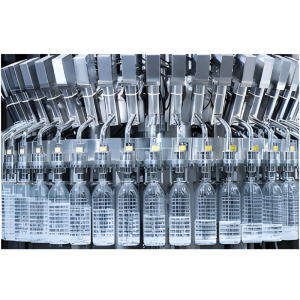
Automatic Liquid Filling Machine with 3-Section Depot System
Delivery calculated separately depending on freight, configuration and installation requirements.
Automatic liquid filling system with dual nozzles and multi-liquid depot for efficient and precise filling operations.
The Automatic Liquid Filling Machine with Depot is a versatile modular system designed for filling liquids such as brine, oil and vinegar. The unit features a 3-section depot tank, allowing different liquids to be managed within one integrated system.
Equipped with two automatic filling nozzles, the system delivers consistent and controlled filling while maintaining high productivity. A modular conveyor belt transfers containers between filling stages, enabling smooth and continuous operation.
The machine includes a jar stopper positioning system for accurate container placement, ensuring precise filling levels and minimal spillage.
Main Features
3-section depot tank for brine, oil and vinegar
Dual automatic filling nozzles
Modular conveyor transfer system
Electronic control panel with speed adjustment
Jar stopper system for precise positioning
Foot pedal control with automatic stop/start function
Expandable system for higher production capacity
Compatible with CIP-SIP automated cleaning systems
Technical Specifications
Specification
Details
Machine Type
Automatic liquid filling machine
Depot System
3-section tank (brine, oil, vinegar)
Filling Nozzles
2 automatic nozzles
Control System
Electronic control panel
Speed Control
Adjustable
Conveyor
Modular transfer conveyor system
Jar Handling
Stopper-controlled positioning
Operation
Foot pedal control with automatic stop
Max Output (System Range)
Up to 400 bottles per minute
Cleaning System
CIP / SIP compatible
Applications
Olive oil bottling lines
Brine and vinegar filling
Food and beverage packaging
Condiment and liquid food production
Cosmetic and chemical liquid filling
System Integration
This machine is part of a modular filling solution and can be integrated with capping machines, labeling systems and automated packaging lines. It supports scalable production from semi-automatic setups to fully automated high-speed filling lines.
Cleaning and Maintenance
The system is compatible with advanced CIP (Clean-In-Place) and SIP (Sterilization-In-Place) technologies, significantly reducing manual cleaning time and improving hygiene standards in food and liquid processing environments.
FAQ
Main Features
• 3-section liquid depot for brine, oil and vinegar
• Dual automatic filling nozzles for increased efficiency
• Modular conveyor system for continuous product flow
• Electronic control panel with speed control
• Jar stopper system for precise filling positioning
• Foot pedal operation with automatic stop/start
• Scalable system capable of high-speed production
• Compatible with advanced CIP-SIP automated cleaning systems
• Expandable up to multi-head filling and capping systems
:
:
:
:
:
:
:
:
:
:
:
:
:
:
Advisory Notice: Tax Changes on Glass Packaging and Impacts on Olive Oil Producers
An advisory update outlining recent Chinese export tax changes affecting glass bottles and jars, and what the removal of VAT rebates means for olive oil packaging costs and supply chains.
Please log in to view the entire article
Labelling Olive Oil Bottles: Tips for Australian Producers
Labeling your olive oil bottles isn’t just a legal formality - it’s a key marketing tool that communicates quality and builds consumer trust. Professional Australian olive growers should view the bottle label as valuable real estate... every element, from the product name to the nutrition panel, can inform customers and differentiate your brand. This article provides expert tips on compliant olive oil labeling according to Food Standards Austral
Please log in to view the entire article
End of an Era: The Olive Press Limited Enters Liquidation After 27 Years
The Olive Press Ltd enters liquidation after 27 years, hitting NZ's olive sector ahead of the 2026 harvest. Owing NZ$2.9M, the premier EVOO wholesaler ceases trading, putting its complete modern processing line up for sale.
Please log in to view the entire article
ANNOUNCEMENT: Warehouse in Sydney for growing needs in Olive Packaging
Over the past 12 months, The Olive Centre has a signed a new partnership agreement with a warehouse in Sydney to offer packaging supplies for predominantly glass bottles and cans.
"We explored a new warehouse as a potential option because we wanted to achieve better freight rates, overall competitively priced packaging through better efficiencies and improved delivery times for Producers.? We believe we have been able to deliver all these key objectives through improved efficiencies from delivery of packaging directly from the Manufacturer to the Producer.? The Olive Centre now also owns some of the moulds to the new packaging on offer.? ?We started the packaging revolution to attempt to overhaul pricing in the sector for anyone supplying the Olive Industry quite some years ago and since that time we have seen the general cost of packaging reduce across the board.? ?This is a great step in the right direction to reduce Growers costs to deliver an even more competitively priced packaging.? We would like to thank producers for their continued support and we have seen a tremendous growth in packaging demand over this time."? Amanda Bailey, CEO The Olive Centre
Shipments of packaging are directed through the warehouse which greatly reduces freight costs and delivery times.
The Olive Centre is also able to deliver directly into Perth and it is foreseen shipments in the near future could be sent directly to Melbourne and Adelaide under new arrangements being explored now.
If you have a need for packaging into the future, please contact The Olive Centre to ensure we can have the stock when you need it.
Does oxygen in the headspace of the packaging container influence Olive Oil quality?
28/11/19: Extra Virgin Olive Oil is the oil obtained from fresh olive fruit in perfect condition picked at optimal maturation with the utmost care and attention to the mechanical extraction processing to achieve the oil.? Olive Oil is the only vegetable oil that can be consumed directly in its raw state and contains important healthful nutritional properties.
Extra Virgin Olive Oil carries a unique profile of healthful properties and warrants special care and attention to the packaging and storage to uphold the nutrition, flavour and colour attributes of the product.
The 4 enemies which create a deterioration of olive oil are Heat, Air, Light & Time (HALT) and thus reducing these elements can greatly prolong the shelf-life of Extra Virgin Olive Oil.? Although no one has control over time but heat, air and light are at the centre of attention.? ?Evaluating the exposure to light, temperature, oxygen headspace, natural antioxidant or phenol content and oxygen dissolved in extra virgin olive oil during the bottling process all affects the deterioration rate and shelf-life during storage.
Researchers at the University of Florida aimed to assess factors to reduce or control the O2 headspace concentration in the package and the influence on quality, shelf-life and favourable sensory characteristics of Extra Virgin Olive Oil.? Due to the gap in information concerning the optimum package headspace O2 concentration during storage, additional research was needed to highlight the potential benefits of reduced oxygen headspace packaging of Extra Virgin Olive Oil.
The study looked at:
Headspace volumes at 50 mL after placing the oil in jars in dark and clear glass containers.
Four different oxygen concentrations were applied to the oil samples 21% oxygen (control/ normal atmosphere pressure); and 10% oxygen; 5% oxygen; and 2% oxygen (at atmosphere pressure).
Researchers noted "Low headspace oxygen concentration is important for maintaining quality and shelf-life of Extra Virgin Olive Oil and the findings at 2% and 5% headspace oxygen, in clear or dark glass containers, at 10 ?C protects chemical indices beyond 12 months and total polyphenols were protected beyond 6 months as was chlorophyll in dark bottles and colour parameters were protected beyond 9 months"
In another study, it was suggested that the above findings could be extended even further with the use of modified atmosphere packaging.
Modified atmosphere packaging (MAP) is the removal and/or replacement of the atmosphere surrounding the product within packaging.??In passive MAP, package atmospheres are left to change dynamically based upon gas consumption/production by packaged products and permeation characteristics of packaging.? ?Active MAP uses systems to remove and/or replace atmospheres prior to sealing packages.? Vacuum and/or gas flush systems are examples of active MAP systems.
It was also found that low oxygen MAP offers an opportunity to improve the shelf life of extra virgin olive oil.
Furthermore, the control of the storage environment (i.e. light and temperature) likely increase the efficiency of MAP on EVOO quality and shelf-life.
Overall, low oxygen MAP technology appears viable for enhancing the shelf-life of EVOO during storage. Understanding how MAP technology influences EVOO quality and shelf-life will ultimately assist processors in improving the storage conditions for EVOO. Combining MAP technology and other factors such as packaging type, package headspace volume, and storage temperature are also likely to present potential advantages for EVOO storage.
This research is interesting because it highlights possibly overlooked or under-appreciated factors that can influence quality parameters within the extra virgin olive oil.? Enabling to decrease the factors contributing to quality decline can have a beneficial effect for an extended time for the sale of the product.? It is also noted that no matter the type of packaging if temperatures are elevated during storage of the product in the container or at the retailer, will greatly contribute to a reduction in shelf life.
_____________________________________________
Influence of Headspace Oxygen on Quality and Shelf Life of Extra Virgin Olive Oil During Storage
Abstract
This study evaluated the impact of low O2 headspace in clear and dark containers at different storage temperatures (10 ?C and 28 ?C) on the quality and shelf life of extra virgin olive oil (EVOO). Bottle headspace was controlled at four different O2 concentrations 2, 5, 10, and 21%. Quality parameters were determined after 3, 6, 9, and 12 months storage: free fatty acids, peroxide value, absorption coefficients K270 and K230, total polyphenols, chlorophyll content, oxidative stability index, and color. Results show low headspace oxygen levels of 2 and 5%, significantly increased EVOO shelf life stored in dark and clear bottles at 10 ?C. While the improvement in EVOO shelf-life was less when stored at 28 ?C. No significant differences occurred between EVOO samples packaged at 10 and 21% headspace O2 concentrations in clear bottles stored at 28 ?C while significant differences were observed with 2 and 5% headspace O2 concentrations. These results suggest that it is important to minimize headspace oxygen in packages of extra virgin olive oil.
Is Smart Packaging for Extra Virgin Olive Oil Widely Accepted by Consumers?
6/12/19: Extra Virgin Olive Oil is a staple in the Mediterranean diet and plays an important role in international food commerce. However, olive oil is an ancient food and is probably the most studied oil and owns its right to the accolade in daily health and wellbeing. However, in order to secure the healthful properties provenance and the sustainability practices are noted by consumers and can form part of the processes or the story in obtaining the oil.
Since the wave of fake oils and low quality messages have rippled through to consumers to beware of fraud has now lead to a wave of other types of vegetable oils claiming 'be as healthy as olive oil' and consumer buying habits have backed this up. The average household in Australia buys $25 per year of Olive Oil.
True traceability brings with it the ability to follow the movement of a product through the differing phases of harvesting, production, processing and distribution. However, backward traceability is the process to allow a back trace of its processes with the critical steps. So what tools can be used to identify the origin and guarantee traceability and transparency of a product to give consumers confidence to buy your product?
In a recent study published in Foods Journal 2019, researchers from Italy aims to investigate the economic sustainability and the consumers preference with three proposed technological systems to support traceability.
The study looked at various labels that provide innovative electronic traceability & transparency:
NFC (near field communication) - Label placed underneath the external label and activated via a smartphone antenna to read traceability information.
DAB (tamper-proof device for bottles) - Tamper-proof device composed of a bottle cap, containing a RFID (radio frequency identification) adhesive label, which externally covers the traditional one.
QR-B (quick response blockchain) - QR code tag on the external label and protected by a 'scratch and win' system to allow the consumer to obtain the reward implemented with blockchains.
Researchers noted "EVOO represents the one of the excellence's of Italian products; it is a basic ingredient of the Mediterranean diet; for this reason, it must be protected from fraud and sophistication that could damage ?made in Italy? and have repercussions both for producers and consumers. This study showed some interesting and surprising outcomes.? First of all, the unexpectedly high willingness to pay (+17.8%) by Italian consumers for the implementation of traceability information on EVOO mediated by smart technologies.? Among the three proposed technologies for traceability, consumers greatly prefer the QR-B system, despite the different advantages linkable to the other systems.".
The researchers also noted that results show that 94% of the consumer respondents are interested in the implementation of such technologies, and among them 45% chose QR-code protected by a?scratch-and-win? system with a blockchain info tracing-platform (QR-B).? Although blockchains are not yet very widespread in EVOO traceability, their use may be an excellent solution to ensure reliability, transparency, and security, especially for those commodities susceptible to fraud such as EVOO to preserve its integrity.?
Blockchain is making its way into the bigger retailers like Walmart and it will not be long before Australia starts to see this trend.
It was also found in the survey, that the age composition revealed different spending behavior patterns. The respondents less than 35 years old (19.9% of the respondents) were less available to pay additional costs for the implementation of information regarding traceability.
This research is interesting because it highlights different ways of moving with the age of technology and enhancing messages to customers in terms of authenticity, sustainability and transparency. The costs to implement a change of packaging can have further impact so changes should be investigated thoroughly to ensure it is worth the move and whether such changes will be popular with consumers. However, making a simple QR code may be a step in the right direction to telling your provenance story with the various messages of sustainability, in-grove practices production techniques, distribution and care instructions for the product.
_____________________________________________
Are the Innovative Electronic Labels for Extra Virgin Olive Oil Sustainable, Traceable, and Accepted by Consumers?
Abstract
Traceability is the ability to follow the displacement of food through its entire chain. Extra virgin olive oil (EVOO) represents Italian excellence, with consumers? increased awareness for traceability. The aim of this work is to propose and analyze the economic sustainability and consumers? preference of three technological systems supporting traceability: Near Field Communication (NFC) based; tamper-proof device plus Radio Frequency Identification (RFID) and app; QR code tag plus ?scratch and win? system and blockchain. An anonymous questionnaire to Italian consumers (n = 1120) was made to acquire consumers? acceptability of the systems and estimating their willingness to pay additional premium prices for these. An economic analysis estimated and compared the technology costs at different production levels. Results show that 94% of the consumer respondents are interested in the implementation of such technologies, and among them 45% chose QR-code protected by a ?scratch-and-win? system with a blockchain infotracing-platform (QR-B). The consumers interested are willing to pay a mean premium price of 17.8% and economic analysis reported evidenced an incidence always lower than mid-/high-production levels. The success of the QR-B could be ascribed to different aspects: the cutting-edge fashion trend of blockchain in the food sector, the use of incentives, the easy-to-use QR-code, and the gamification strategy
1 Consiglio per la ricerca in agricoltura e l?analisi dell?economia agraria (CREA) - Centro di ricerca Ingegneria e Trasformazioni agroalimentari, Via della Pascolare 16, 00015 Monterotondo (Rome), Italy
2 Istituto Nazionale di Statistica (ISTAT) - Direzione centrale per le statistiche sociali e il censimento della popolazione (DCSS) - Servizio registro della popolazione, statistiche demografiche e condizioni di vita (SSA), Viale Liegi 13, 00198 Rome, Italy
3 Maticom S.r.l.-Via Carlo Spinola 5, 00154 Rome, Italy * Author to whom correspondence should be addressed.
Advisory Notice: Tax Changes on Glass Packaging and Impacts on Olive Oil Producers
An advisory update outlining recent Chinese export tax changes affecting glass bottles and jars, and what the removal of VAT rebates means for olive oil packaging costs and supply chains.
Please log in to view the entire article
End of an Era: The Olive Press Limited Enters Liquidation After 27 Years
The Olive Press Ltd enters liquidation after 27 years, hitting NZ's olive sector ahead of the 2026 harvest. Owing NZ$2.9M, the premier EVOO wholesaler ceases trading, putting its complete modern processing line up for sale.