My Shopping Cart
| Bulk Discounts Prices | |
| Quantity | Price |
| 1 | $95.70 |
Shipping calculated separately at checkout.
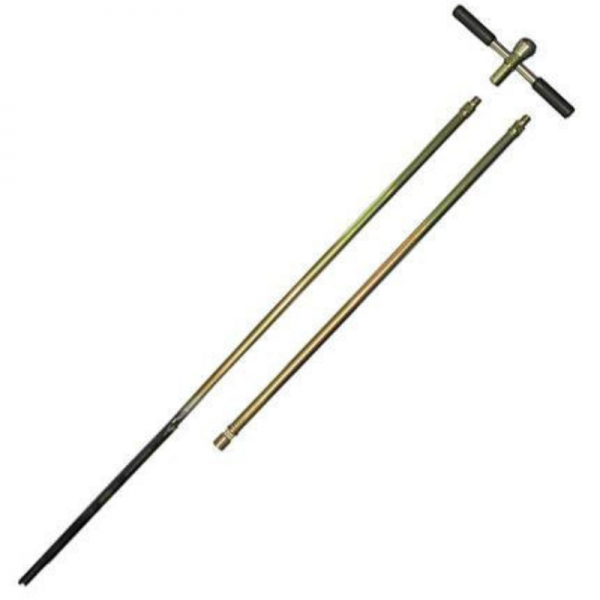
Manual auger tool designed for installing tubes and probes into soil.
The Auger for Tube Installation is a specialised tool used to create narrow holes in soil for inserting tubes, probes or irrigation components. The auger tip drills into the ground while the long shaft provides reach and control during installation.
Equipped with a removable T-handle, the tool allows operators to manually rotate the auger and penetrate soil efficiently. It is commonly used in agricultural applications where tubing or sensors must be installed below the soil surface.
| Specification | Details |
|---|---|
| Product Name | Auger for Tube Installation |
| Product Type | Manual installation auger |
| Application | Tube and probe installation |
| Construction | Steel shaft with auger tip |
| Handle | Removable T-handle |
| Operation | Manual ground drilling |
| Typical Use | Agricultural and irrigation systems |
The auger tip is inserted into the soil and rotated using the T-handle. As the auger rotates, the spiral blade cuts into the soil and removes material from the hole, allowing the shaft to gradually penetrate deeper.
Once the required depth is reached, the auger is removed and the tube or probe can be installed into the prepared hole.
Soil Testing Services - Australia-wide |
|
Soil Tests (PA02A) only $99 OFFER: incl GST & Air freight satchel (1knsatchel STE) (Promotion Code: soiltestfreedeliveryAug11)
HURRY offer ends 1st November 2011 (A further interpretation by an Expert Olive Agronomist is available upon request). |
|
A soil analysis program specific to the needs of olive trees will provide important and essential information on the soils nutritional status, which enables decisions of fertiliser and micro-nutrient applications to maximise the quantity and quality of crop yields (and not waste money on applying too much or not enough). A comprehensive measurement of available levels of macro and micro-nutrients such as nitrogen, calcium, magnesium, potassium, sodium, phosphorus, sulphur, iron, manganese, copper, zinc, boron, molybdenum and chloride in addition to pH, conductivity etc are available to assess the nutritional status of the soil and tree. It is recommended that a comprehensive soil test regime be performed at least once every 2 years to determine your soils nutritional status. Leaf tests should be performed every year in January. If possible in one year take samples every month to establish a Nutrient usage pattern. How this works? We send you the laboratory bags, information on taking the sample and a delivery satchel. All you need to do is take the sample and call the freighter for pickup. As the pickup is done by Star Track Express, their network extends Australia-wide to most areas*. IMPORTANT NOTE: The importance of plant and soil sampling should never be underestimated. The analysis and interpretation information you will receive is highly dependant on the sampling strategy used. The following information will assist you in collecting appropriate samples prior to submitting them for laboratory analysis. |
|
|
|
Contact The Olive Centre to identify your groves areas of need today... Ph: 07 4696 9845 Fax: 07 4696 9914 Email: amanda@theolivecentre.com.au www.theolivecentre.com* depending on freighter... call 132345 for your local delivery area. |
A successful Grove Management Plan must cover these key areas:
"A grove without an effective irrigation system is unlikely to deliver consistent yields year after year. Many growers still underestimate the water needs of olive trees, and few actually monitor soil moisture levels. This is why so many groves have never achieved a commercial crop." Marcelo Berlanda Specialist Olive Consultant
Water stress negatively affects flowering, fruit set, oil accumulation (oil production), fruit size (table olives), fruit quality, and overall tree health. However, many growers lack a proper system to monitor soil moisture or manage irrigation effectively.
Marcelo recommends:
"Growers should inspect soil moisture weekly during spring and summer, and every two weeks in autumn and winter. Use a shovel to dig at least 400mm under the tree canopy to check moisture. If the soil is hard to dig, it’s too dry – even if the canopy shows no visible signs of stress."
Advanced soil moisture monitoring tools can also provide reliable data on a digital display or computer dashboard.
For optimal grove health, growers must consistently check soil moisture and prevent water stress.
As discussed previously, taking leaf samples is essential to assess your trees’ nutritional status. This information guides the creation of a fertiliser program, a critical component for boosting or maintaining yields.
Typically, no fertiliser is needed in winter, unless you’re addressing soil amendments. However, some groves have severe nutrient deficiencies requiring fertiliser even in winter. Where proper irrigation systems aren’t in place, growers must broadcast fertiliser before rain to allow rainfall to incorporate nutrients into the soil profile, an inefficient use of resources but often the only option.
When applying fertiliser in these conditions, target the area beneath the canopy and, if possible, cultivate the soil to improve incorporation and reduce product loss.
Olives need four essential nutrients: Nitrogen, Phosphorus, Potassium, and Calcium. Check product labels carefully. As a general guideline, aim for:
Avoid pruning during the coldest part of winter and when it’s wet or foggy to reduce the risk of bacterial and fungal disease spread.
The main goals of pruning are to remove dead wood, reduce canopy size, restore tree balance, encourage healthy new growth, and increase fruit set in spring.
Tip: After pruning, apply a copper-based spray to protect wounds from infection by fungi and bacteria.
Pest & disease management is crucial for sustaining yield and tree health. Winter’s colder temperatures reduce insect activity, offering a prime time to tackle pest issues.
Set up a comprehensive Pest and Disease Monitoring Program. During winter, check-marked trees (previously affected by pests or diseases) every two weeks; in spring, check weekly. Look under leaves and on new growth for signs like crawlers, yellow spots, black sooty mould, or anything unusual.
Proactive, weekly management is essential for a successful grove.
If you need further assistance, please contact us.
A comprehensive measurement of available levels of macro and micronutrients such as nitrogen, calcium, magnesium, potassium, sodium, phosphorus, sulphur, iron, manganese, copper, zinc, boron, molybdenum and chloride in addition to pH, conductivity etc are available to assess the nutritional status of the soil and plant. It is recommended that a comprehensive soil test regime be performed at least once every 2 years to determine your soils nutritional status. ?Leaf tests should be performed every year in January. ?If possible in one year take samples every month to establish a Nutrient usage pattern.
IMPORTANT NOTE: Never underestimate...?The importance of plant and soil sampling. The analysis and interpretation information is highly dependent on the sampling strategy used.
For further information read more.
Soil organisms contribute to soil structure, water holding capacity, pH and nutrient availability, while the physical and chemical soil environment determines what organisms can live in the soil profile. ?There is a strong interaction between all of these components, where changes in one aspect will influence others! ?The holistic approach of looking at the soil as a system will enable you to use the natural soil processes to improve production, health and long-term yield.
A major function of soil biota (which includes many organisms from microscopic bacteria to giant tunnelling earthworms) is the breakdown and release of nutrients of organic matter decomposition. ?Carbon is a major component of organic matter and is integral to all energy functions/transfer in living matter. ?An active microbial population is responsible for the rate of this breakdown and the more diverse and abundant the carbon source is the more diverse and abundant the micro-organisms are. ?Microorganisms make up 80-90% of the soils biological activity and are the end stage of all decomposition.
Living organisms need to be considered in any soil evaluation and adopting a more sustainable, natural or organic approach rather than using chemicals as an easy short term fix will certainly help these organisms work for you. ?You can use organic products and methods even if your grove does not have organic certification.
Repetitive use of inorganic chemicals may not promote the 'beneficial organisms' in your soil and can build up harmful residues in your soil and rapidly degrade soil structure.
Inorganic chemicals, especially in concentrated forms, require special care with storage, handling and application and because of their nature may pose unacceptable risks to staff, olive trees and your final product (i.e. oil or fruit). ?The health risks associated with unnecessary use of toxic chemicals may have preventable medical, legal and financial consequences which any grove manager will naturally want to avoid.
Trying to improve microbial activity in the soil is pointless if there is no organic matter (i.e. food or carbon). ?Most of new population will simply die. This is why any successful inoculation program has the deal with the business of building a home for bacteria and then "stocking the shelves". ?Microbes work always work to increase and multiply - if they can. ?Thus the soil life profile is always 'in process'.
The problem is that under certain cropping condition, many soils become elementally depleted or unbalanced.
Read more about the Function of Nutrients
What is RAW?
Readily available water (RAW) is the water that a plant can easily extract from the soil.
RAW is the soil moisture held between field capacity and a nominated refill point for unrestricted growth. In this range of soil moisture, plants are neither waterlogged or water-stressed. ?Plant roots will continue to take water from the soil after the refill point is reached, but this water is not as readily available and the crop finds it difficult to extract. If the soil dries to the permanent wilting point, the plant can no longer remove any water from it: some water may still be present but is completely unavailable. The drier the soil.... download the full article